What's Under our Seawind 1160 Lite Catamaran - Hull Tour
With the cruising catamaran Sea Moon hauled out of the water on the hardstand at Cleopatra Marina in Preveza, Greece, Scott takes advantage of a dry-dock period to survey the vessel below the waterline. Operating alongside Sandy aboard Sailing Sea Moon, Scott conducts an inspection across both hulls, documenting underwater equipment, hull penetrations, and structural pods that remain hidden during cruising passages through the Ionian Sea.
Bowsprit, Bridge Deck Clearance, and Freshwater Pod
Starting at the bow, Scott examines the underside of the bowsprit and the anchor roller assembly. A synthetic line on the sprit has grown frayed from regular anchoring and sail handling, prompting a replacement during the yard period. Looking aft between the twin hulls, the entry lines remain clean up to the primary waterline. While the Seawind 1160 Lite does not feature the highest bridge deck clearance in the cruising catamaran fleet, the underbody profile is engineered to channel wave action through the tunnel with minimal resistance.
Mounted centrally along the bridge deck nacelle sits a large molded pod containing the vessel freshwater storage. Holding 670 liters of fresh water, this pod incorporates hydrodynamic shaping tested in naval architecture sea tanks to allow trapped water and sea swells to pass cleanly between the hulls. Although Scott notes occasional slamming when encountering choppy head seas, the centralized tank pod keeps essential tankage weight low while preserving internal living space—a design configuration retained by Seawind in subsequent production models.
Outboard Engine Wells and Rudder Handling
Unlike diesel inboard catamarans, the Seawind 1160 Lite variant utilizes twin 25 hp Yamaha outboard engines mounted inside specialized hull pods. Lowering the engines into their operating position reveals the spatial relationship between the propellers and the rudder foils. Scott observes that a distance of approximately a meter and a half separates the outboard thrust from the rudder blades, directly influencing how the vessel steers at low speeds:
“We really do need to get, you know, that one one and a half knots of speed before we have any steerage on the rudders.”
Without forward momentum pushing water across the foils, directional control relies entirely on differential engine thrust. Despite the lack of prop wash over the rudders, Scott points out that “there is enough distance between the two outboards in order to affect some maneuverability,” allowing the crew to spin the catamaran 360 degrees on the spot by shifting one throttle into forward and the opposite into reverse. To improve throttle responsiveness during tight harbor docking, new throttle control cables are being fitted during the haulout.
Transducer Array and Single Saltwater Intake
Hull penetrations on Sea Moon have been kept to an intentional minimum. On the starboard hull, a triducer unit incorporates a paddlewheel speed sensor, an acoustic depth sounder, and a water temperature sensor into a single through-hull opening. Opposite on the port hull, a forward-looking sonar transducer provides acoustic scanning for shallow reef heads and murky anchorages, though Scott notes that deep waters in the Med make the forward sonar rarely necessary.
For raw seawater supply, the catamaran avoids the numerous sea cocks common on offshore cruising boats. As Scott explains, “a lot of boats have quite a lot of through-hulls, but this boat is designed just to have the one.” This single intake fitting routes cooling seawater to the onboard watermaker, the interior heating unit, and the reverse-cycle marine air conditioning system. Because the air conditioning heat exchanger pulls heat or cold directly from surrounding sea water, climate control cannot be run while the boat rests on the hardstand.
Grounding Plate and Underwater Fixtures
Beneath the hull sits an external porous bronze grounding plate, which requires scrubbing during the haulout. The earthing plate serves as the underwater grounding point for all shipboard electronics and connects directly to the masthead lightning protection system, directing potential strike currents safely into the sea. Near the transom, a recently installed pair of white underwater LED lights provides stern illumination in anchorages.
Standard gravity discharge outlets handle greywater from the galley sink, washing machine, and head sinks, while blackwater holding tanks discharge through dedicated overboard valves only when the vessel is at least 3 miles out to sea.
Hull Specifications Summary
| Component / System | Specification & Configuration |
|---|---|
| Vessel Model | Seawind 1160 Lite cruising catamaran |
| Freshwater Pod Capacity | 670 liters in central streamlined pod |
| Outboard Propulsion | Twin 25 hp Yamaha outboard engines in pods |
| Low-Speed Maneuvering | 360-degree rotation on the spot via opposing throttles |
| Raw Saltwater Intake | 1 shared through-hull for watermaker and air conditioning |
| Blackwater Discharge Rule | Overboard release permitted at least 3 miles offshore |
Frequently Asked Questions
The molded bridge deck nacelle pod stores 670 liters of fresh water, designed with a streamlined shape to minimize wave slamming between the hulls.
The outboard engines sit roughly a meter and a half forward of the rudder foils, meaning water does not flow directly over the rudders until the catamaran reaches one to one and a half knots of boat speed.
The Seawind 1160 Lite utilizes a single raw saltwater through-hull fitting that supplies water simultaneously to the watermaker, heating system, and air conditioner.
Because of the wide separation between the twin 25 hp outboards, setting one engine in forward and the other in reverse enables the boat to rotate 360 degrees on the spot.
Book a trip where this was filmed — near Lefkada
Marine Adventure Cruise Snorkeling and Swimming in Lefkada
Sold by Marine Adventure Lefkada
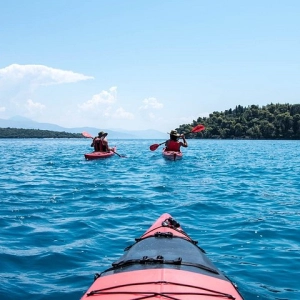
Lefkada Skorpios and Madouri Island-Hopping Kayak Tour with Lunch
Sold by TREKKING HELLAS
Support Sailing Sea Moon
At WeBoating.com, we profoundly acknowledge the unwavering dedication that Sailing Sea Moon invests in crafting each and every video or voyage. Their passion for delivering exceptional ocean content shines through every frame, and it's a labor of love that deserves your attention.
We invite you to watch their captivating videos here and actively engage with their content, including their social media links above. Liking, commenting, and sharing their work goes a long way in fueling their creative fire.
We're also inviting you to explore the gear, sponsorships, and boat partnerships highlighted in the "What's Under our Seawind 1160 Lite Catamaran - Hull Tour" video description, or directly on YouTube. By engaging with these offerings or purchasing services and items, you directly support Sailing Sea Moon, their collaborators, and the brands they're associated with.
To ensure you never miss an offshore update, consider visiting their official YouTube Channel to subscribe, like, and join their community directly.
If you have any feedback, corrections, or additional information about Sailing Sea Moon or their videos, please use the comment form below to share your thoughts with us.
Thank you for being a part of our community and supporting the creators we cherish. Your time and support truly matter!
What's actually underneath a Seawind 1160 catamaran?
With Sea Moon out of the water and safely on the hardstand in Greece, Scotty takes advantage of a rare opportunity to show you everything normally hidden below the waterline.
In this episode of Tech Talk with Scotty, we're taking a closer look at the underside of our Seawind 1160 Lite, including the bow sprit, waterline, freshwater pods, outboard engine pods, rudders, through-hull fittings, transducer, grounding plate and underwater lights.
Whether you're a Seawind owner, considering buying a catamaran, or simply curious about what keeps these boats functioning beneath the surface, come along for a look!
👍 If you enjoy our Tech Talks, give us a thumbs up, subscribe and join us for more sailing adventures.
CHAPTERS - For those who want to skip ahead
00:00 Introduction
00:41 What's Underneath Sea Moon?
01:17 Bow Sprit
01:35 The Waterline
01:50 Freshwater Pods
02:38 Outboard Engine Pods & Rudders
03:55 Through-Hull Fittings & Transducer
04:57 Saltwater Through-Hulls
05:49 Grounding Plate
06:15 Underwater Lights
06:25 Other Outlets
⛵ Welcome Aboard Sailing Sea Moon
Hi, we're Scott & Sandy.
Five years ago we matched on Tinder. Today we're living aboard our Seawind 1160 Lite catamaran, Sea Moon, sailing full-time around the world.
Every week we share honest sailing adventures, cruising guides, boat projects, tech tips, destination guides and the realities of life aboard. From hidden anchorages and unforgettable experiences to the challenges that come with living at sea, we bring you along for the journey.
If you've ever dreamed of sailing, travelling full-time or living life differently, we'd love to have you aboard.
🔔 Subscribe and join the adventure!
📅 New Videos Every Week
Wednesday (Alternating)
• Sea Moon Tech with Scott
• Coffee with Sandy
Sunday - Mixture of;
• Sailing adventures, destination guides and life aboard Sea Moon
🌐 Follow Our Journey
📺 YouTube
https://www.youtube.com/@SailingSeaMoon
https://www.instagram.com/sailingseamoon
https://www.facebook.com/SailingSeaMoon
⛵ Our Boat
SV Sea Moon
Seawind 1160 Lite Catamaran
Twin Yamaha 25hp Outboards
🎥 Our Gear
Cameras
• DJI Action 4
• iPhone 17 Pro
• DJI Mini Drone
Audio
• DJI Mic
Editing
• Movavi Video Editor
• Canva Pro
🎵 Music
Music created using the built-in music library in
- Movavi Video Editor
- YouTube Studio
Other
- Google Earth
- Google Earth Pro
📧 Business Enquiries

Sailing Sea Moon
Five years ago, we matched on Tinder. Now we’re sailing around the world aboard 'Sea Moon' — our Seawind 1160 catamaran — chasing weather windows, freedom, and a life we once only talked about over drinks on a first date. Three years on, we feel it's time to share our stories and help others find their pathway to freedom and adventure. If you’ve ever wondered whether a different kind of life is possible, you’re in the right place. What will we share? Adventures, stories, tech tips…it’s all In our greater plan to share with you all. Please SUBSCRIBE and LIKE (on YouTube)and tell your friends ☺️. This helps us reach more people and share more stories. Let our adventures continue! Scott and Sandy Sailing Sea Moon CREDITS Video equipment used - iPhone 17 Pro, DJI Action 4, DJI Mini 3 - Video editing tool- Movavi - Music - Movavi music
Channel Information:
Social Media Links:
What's Under our Seawind 1160 Lite Catamaran - Hull Tour Location
- Cleopatra Marina, Preveza, Greece (38.9623,20.7558)
Latest Episodes from Sailing Sea Moon
Explore the most recent voyages. Subscribe to the channel to never miss an update!
What’s Under our Seawind 1160 Lite Catamaran – Hull Tour
Scott inspects the hull of Sea Moon, a Seawind 1160 Lite catamaran on the hardstand at Cleopatra Marina in Preveza, Greece, examining the freshwater pod, outboards, and through-hulls.
Locking up our floating home – Winterising Sea Moon
Scott and Sandy prepare their Seawind 1160 Lite catamaran, Sea Moon, for four months on the hardstand at Cleopatra Marina in Greece, tackling ventilation, systems, and rigging.
7 Days Living in Cleopatra Boat Yard – My Honest Opinion
Sandy and Scott hauled out Sea Moon at Cleopatra Marina in Preveza, Greece, spending seven days living on the hardstand to prepare their catamaran for winter.
Why we are hauling out our catamaran for winter – Greece 2026
After a Force 10 to 11 storm devastated Rhodes Marina in January 2026, Scott and Sandy haul out their Seawind 1160 Lite catamaran Sea Moon at Cleopatra Marina near Preveza, Greece for four months of winter hardstand storage.
Boat Show Cleopatra Marina Preveza Greece
A unique Boat Show | A Cruising Sailor's Perspective Welcome to a slightly different episode of Sea Moon Tech Talk with Scott! We've hauled Sea Moon out of the water for the winter at Cleopatra Marina near Preveza, Greece, and with hundreds of boats surrounding us, Scott couldn't re...