Sailing the Italian Riviera (After Some Classic cars) | S2 E06
Anne-Lill and Dean prepared to cast off their Bali 4.6 catamaran from Sanremo on the Italian Riviera, beginning a coastal voyage aboard Sailing Queen Lizzy after returning from classic supercar driving through Tuscany. Moored in a tight slip where shore chains complicated the release of dock lines, the crew coordinated with local marina personnel to unhook the gear and clear the berth under calm conditions.
Before releasing the lines, Dean organized the unmooring sequence on the dock to prevent snags on the submerged chains. The crew slipped the slime lines clear of the underwater obstacles and maneuvered the catamaran out of the marina into open coastal waters.
Casting Off from Sanremo and Relocating to Isola Gallinara
Departing the slip required structured communication on the foredeck. Dean coordinated each step before releasing tension on the dock lines, explaining the routine handling required for tight marina exits: “Yep, we always have a briefing before we start just to work out what the plan is, which line we take off first, second, etc.” Marina marineros assisted from the quayside, unhooking lines that had fouled around the bottom chains so the slime lines could run free.
The catamaran made its initial stop at an open anchorage down the coast, intending to pause for a quiet lunch and spend two days at anchor. Persistent ocean swell rolled the vessel, unsettling the salon and causing the onboard anchor alarm to trigger repeatedly even after resetting the hook. Observing windsurfers skimming across the rolling water, the crew chose to abandon the exposed beach anchorage and relocate across to Isola Gallinara, a nature reserve crowned by an old historic building.
At Isola Gallinara, the crew sought shelter along the lee side of the island. Dean brought the catamaran into position and deployed the ground tackle in 18 m of water, paying out 60 m of chain to ensure adequate holding on the steep bottom. The sheltered water off the nature reserve provided a far calmer night at anchor before the upcoming passage along the coast.
Passage Planning and Crossing to Santa Margherita Ligure
The following morning, the crew readied Queen Lizzy to raise anchor and set course for Portofino. In the galley, Anne-Lill inspected the interior, latching the refrigerators, verifying the wine cabinet was secured, and clearing stray cups from tables. She packed a travel bag with cameras, extra blankets, drinks, cheese, sliced apples, and protein bars to stock the upper flybridge helm station for the long watch.
Dean reviewed the forecast and navigation numbers at the upper helm, noting the absence of usable breeze across the open sea: “Uh about 40 miles, so about 7 hours. Probably not much sailing cuz there’s only about three or four knots of wind, but you never know, it might pick up and we might get to sail. Otherwise, one engine all the way.” The crew settled into the enclosed flybridge behind the Alpha 9 instrument setup, motoring eastward across glassy seas.
Arriving off Portofino seven hours later, the crew found the inner harbor packed to capacity with visiting yachts. Rather than attempting to negotiate the congested mooring field, they continued just around the headland to drop anchor in the spacious anchorage at Santa Margherita Ligure. The location offered a free anchorage with convenient ferry and bus connections running directly back into Portofino.
Shore Exploration in Portofino
After launching the tender and securing the catamaran in Santa Margherita Ligure, Anne-Lill and Dean boarded a local public bus to visit Portofino by land. Arriving before lunch, they navigated dense crowds of visitors walking along the harborfront. They took a table at a quayside cafe for a meal of seafood stew accompanied by rosé wine before touring the surrounding cobblestone streets.
The crew walked through the tiny Piazzetta, which received recognition as a historic place of Italy in 2012. Ascending the steep paved alleys lined with flowering stone walls, they reached the Church of San Martino. Inside the stone nave, they observed the pebble compass rose set into the entrance pavement, painted wooden religious figures carved by Genoese sculptor Maragliano, and a historic church organ dating from 1679. Outside, the walking path climbed toward the headland, revealing views across the anchored yachts, Castello Brown, and the red cross flag of St. George flying above the harbor.
Cruising Past Cinque Terre to Porto Venere
The next morning in Santa Margherita Ligure began with breakfast in the cockpit before underway checks. Dean conducted test flights with his drone off the deck to practice flight maneuvers in light air, dryly remarking that it was “best not to crash the drone into the ocean.” While prepping the deck, Anne-Lill sat in bird droppings on the cockpit cushion, prompting Dean to joke that “Happily elephants doesn’t fly.”
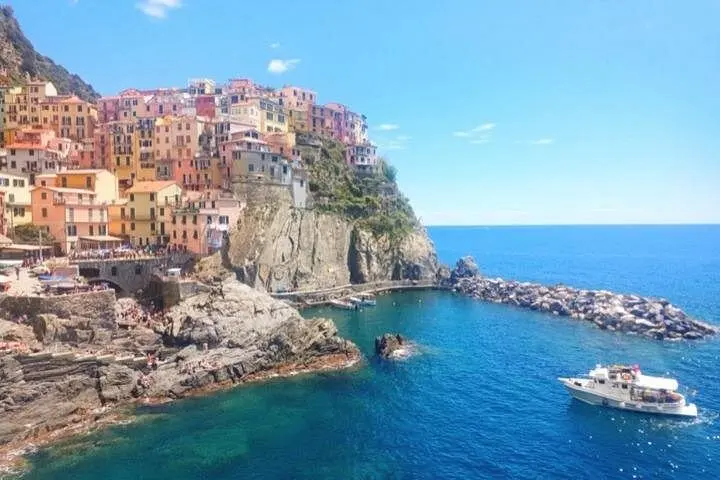
With flat water and no wind filling the sails, the crew motored toward Cinque Terre. They had 5 miles to run to a refueling fuel dock and roughly 30 miles of coastal passage ahead to reach their destination. Passing Monterosso al Mare, the first village of the Cinque Terre chain, they observed the colorful cliffside houses from offshore before steering toward Porto Venere.
Entering the narrow harbor passage of Porto Venere, Queen Lizzy tied up directly on the town quay alongside the coast guard station. Dockside helpers assisted with stern lines and connected the catamaran to shore water. Going ashore, Anne-Lill and Dean explored the steep alleys, sampling local focaccia, browsing shops stocked with limoncello and hot sauces, and walking up the rocky promontory toward the cliffside church.
The striped black-and-white stone church sits atop sea cliffs where an ancient temple dedicated to Venus originally stood. The site transitioned to an early Christian church in the 5th century, was formally consecrated in 1198, and saw its distinctive Genoese stone structure erected between 1256 and 1277. The crew toured the quiet stone interior, noting historical records dating back to 1494, before watching an exceptionally wide motor vessel negotiate the narrow harbor entrance without incident.
Marine Chandlery Search in La Spezia
With Queen Lizzy safely moored at the Porto Venere town quay, the crew caught a local bus into the port city of La Spezia to complete necessary boat maintenance tasks. Walking past an old military moat where large schools of fish gathered in the water, Dean and Anne-Lill searched for marine electronics and hardware suppliers.
Their primary goal was sourcing electronic navigation chart memory cards and an electrical switch. After checking four separate chandleries across the port district, they were unable to locate the required chart cards. Anne-Lill summarized the search: “Four chandleries, no charge. No SD cards. So, we are still stuck. Luckily, we got the maps on our iPad as well” After purchasing the electrical switch, they attempted to board a train to Pisa, but midday scheduling gaps prevented the side trip. Returning by bus to Porto Venere, the crew began preparations for their next passage toward Elba.
Voyage Logbook and Navigation Metrics
| Leg or Waypoint | Distance or Depth | Operating Conditions and History |
|---|---|---|
| Sanremo Departure | Tight marina slip | Assisted line handling to clear shore chains |
| Isola Gallinara Anchorage | 18 m depth, 60 m chain | Sheltered nature reserve anchorage |
| Gallinara to Portofino | 40 miles | 7 hours motoring in 3 to 4 knots of wind |
| Santa Margherita Ligure | Free anchorage | Bus and ferry connections to Portofino |
| Cinque Terre Passage | 30 miles offshore run | 5 miles to fuel dock, calm motoring |
| Porto Venere Cliffside Church | Consecrated 1198 | Genoese construction completed between 1256 and 1277 |
Frequently Asked Questions
When Portofino harbor was packed with yachts, the crew anchored next door at Santa Margherita Ligure in a free anchorage and rode the public bus into Portofino.
The crew dropped anchor in 18 meters of water off Isola Gallinara and deployed 60 meters of chain to hold the catamaran along the island nature reserve.
The passage covered about 40 miles and took approximately 7 hours under motor in light winds measuring 3 to 4 knots.
Queen Lizzy moored directly on the town quay in Porto Venere alongside the coast guard station, where shore crew assisted with docking lines and water connections.
No, after visiting 4 marine chandleries in La Spezia, the crew found no electronic chart SD cards and relied on backup digital navigation charts loaded on their iPad.
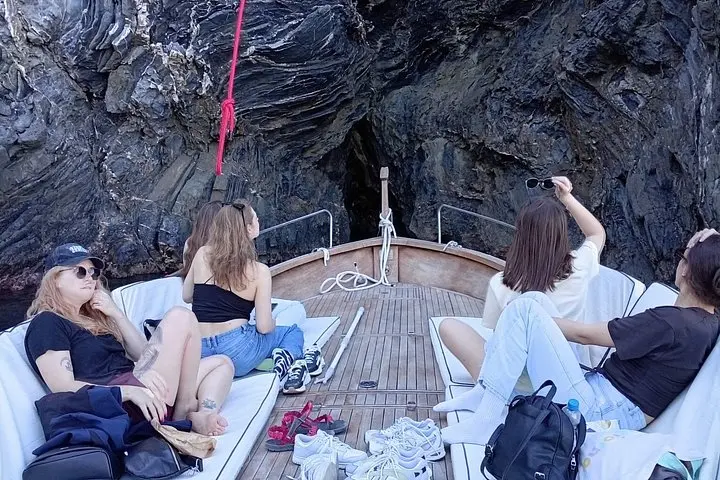
Book a trip where this was filmed — near Cinque Terre

Support Sailing Queen Lizzy
At WeBoating.com, we profoundly acknowledge the unwavering dedication that Sailing Queen Lizzy invests in crafting each and every video or voyage. Their passion for delivering exceptional ocean content shines through every frame, and it's a labor of love that deserves your attention.
We invite you to watch their captivating videos here and actively engage with their content, including their social media links above. Liking, commenting, and sharing their work goes a long way in fueling their creative fire.
We're also inviting you to explore the gear, sponsorships, and boat partnerships highlighted in the "Sailing the Italian Riviera (After Some Classic cars) | S2 E06" video description, or directly on YouTube. By engaging with these offerings or purchasing services and items, you directly support Sailing Queen Lizzy, their collaborators, and the brands they're associated with.
To ensure you never miss an offshore update, consider visiting their official YouTube Channel to subscribe, like, and join their community directly.
If you have any feedback, corrections, or additional information about Sailing Queen Lizzy or their videos, please use the comment form below to share your thoughts with us.
Thank you for being a part of our community and supporting the creators we cherish. Your time and support truly matter!
Sailing the Italian Riviera from Sanremo to Porto Venere, after a detour to Tuscany to drive classic supercars. Sailing Queen Lizzy — liveaboard life aboard our Bali 4.6 catamaran in the Mediterranean.
We’re Anne-Lill and Dean, an Australian couple sailing our Bali 4.6 catamaran across the Mediterranean — slowly building toward the big one: an offshore passage through French Polynesia and maybe home to Sydney. Real liveaboard life, no filter, no fluff.
This episode we leave Sanremo, take a detour to the Tuscan hills to drive some old classic supercars, and come back to the boat. The first anchorage rocks. Then Isola Gallinara, Santa Margherita Ligure, a bus to Portofino, an aperitivo, the first drone shot of the season, and a castle on the hill above Porto Venere.
The cars were faster. The boat has a kitchen.
We’re Australian, we probably should have known better, and we swapped the boat for supercars for a bit anyway.
🔔 Subscribe and come sail with us, one mile at a time:
https://www.youtube.com/@SailingQueenLizzy?sub_confirmation=1
⛵ Boat: Bali 4.6 Catamaran
🌍 Location: The Mediterranean Sea
Chapters
00:00 — Intro
00:22 — Docking in Sanremo
00:53 — Classic cars are great fun! (Tuscany)
02:36 — Getting ready to leave Sanremo
05:33 — First anchorage after Sanremo. It rocks…
06:41 — Moving to Isola Gallinara
07:58 — Next morning
08:54 — Things to check before going...
09:52 — Where do we spend our time during passage?
10:58 — Portofino, Italy
11:22 — Arriving at Santa Margherita Ligure
12:27 — Aperitivo, Italian style, then on to Portofino
15:53 — Next morning
17:40 — The first drone shot of the season
18:05 — Cinque Terre, here we come
19:43 — Porto Venere, the gateway to Cinque Terre
20:35 — Docked at the town quay in Porto Venere
24:36 — The castle on the hill
28:51 — Pisa on our mind
29:11 — La Spezia
📘 Facebook: https://www.facebook.com/sailing.queen.lizzy/
📸 Instagram: https://www.instagram.com/sailingqueenlizzy
Come along for all of it — the harbours, the headlands and the long blue days.
#SailingQueenLizzy #sailing #catamaran #liveaboard #Bali46

Sailing Queen Lizzy
We're Anne-Lill and Dean — an Australian couple living aboard our Bali 4.6 catamaran, Queen Lizzy 2, sailing the Mediterranean. On Sailing Queen Lizzy, we document real liveaboard life as it happens — breathtaking anchorages, coastal towns, ocean passages, boat projects, and the everyday highs and lows of life at sea. No filter, no fluff — just honest cruising vlogs from two people chasing freedom under sail. We're exploring the Mediterranean while building the skills, courage and confidence for the big one — an offshore passage through French Polynesia and home to Sydney, Australia. On this channel you'll find: ⚓ Sailing vlogs & passage updates 🌊 Liveaboard lifestyle & catamaran life 🔧 Boat projects, tips & gear 🗺️ Mediterranean anchorages & destinations 🌏 Long-distance ocean sailing prep If you love sailing content that's real, relatable, and occasionally chaotic — you're in the right place. 👇 Hit Subscribe and come sail with us — one mile at a time.
Channel Information:
Social Media Links:
Sailing the Italian Riviera (After Some Classic cars) | S2 E06 Location
- Porto Venere Town Quay, Liguria, Italy (44.0504,9.8335)
- Santa Margherita Ligure Anchorage, Liguria, Italy (44.3333,9.2133)
- Isola Gallinara Anchorage, Liguria, Italy (44.0264,8.2258)
- Sanremo Marina, Liguria, Italy (43.8159,7.7766)
Latest Episodes from Sailing Queen Lizzy
Explore the most recent voyages. Subscribe to the channel to never miss an update!
Please don’t anchor on top of us ⚓ #shorts
Three boat jobs and one very small crawl space. First up, an anchor buoy. It floats above our anchor so the next boat can see exactly where it is and has no excuse for dropping theirs on top. The ones you can buy were 500 to 1000 euro, so we made our own. Then a hose for the anchor locker, and a s...
Bird Poo, Choice Words, Then Just Wind #Shorts
Leaving Porto Venere under sail: a hose-down, the Code 0 going up, and no engines all day. 👉 Watch the full episode: Sailing Queen Lizzy — liveaboard life aboard our Bali 4.6 catamaran in the Mediterranean. 🔔 Subscribe: #Shorts #sailing #catamaran #SailingQueenLizzy
Our Glorious First Day on Elba #Shorts
Arriving off the headland of Elba, the crew prepares to drop anchor, spots a tall ship in the harbor, and takes the tender ashore to explore local markets and waterfront streets.
Five Villages. One Coastline. One Day. #Shorts
Cinque Terre in one day. Five villages, one coastline, and we're having a go anyway. 👉 Watch the full episode: Sailing Queen Lizzy — liveaboard life aboard our Bali 4.6 catamaran in the Mediterranean. 🔔 Subscribe: #Shorts #sailing #catamaran #SailingQueenLizzy
Cerbo GX, Anchor Buoy and Hose Fixes | Boat Jobs & Fixes 02
Dean and Anne-Lill tackle three essential maintenance jobs aboard their Bali 4.6 catamaran, setting up Victron Cerbo GX tank monitoring, fabricating an anchor marker buoy, and plumbing an anchor locker washdown hose.