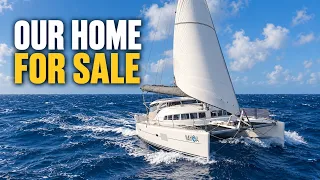
Why We Bought This Pocket Diesel Cruiser
Ben and Ashley Stobbart of Sailing Nahoa set a straightforward goal for their newly restored 2002 24-foot Monaro pocket diesel cruiser: take their children, Willa and Bodhi, on a 4-hour overnight boat camping run up British Columbia’s remote Princess Louisa Inlet. With no roads and no cell coverage along the route, the trip serves as the first major test of a project boat Ben purchased at a steep discount because it was broken.
When Ben acquired the 20-year-old Monaro, water had entered the stern drive and the exhaust elbow had rotted through onto the turbo. Marine repair shops quoted anywhere from four to $20,000 to put the diesel back in service. Betting he could handle the mechanical restoration himself and save the shop labor, Ben tackled the engine repairs—only to discover how many smaller mechanical and electrical vulnerabilities linger inside a 20-year-old boat. During an early run, the shift linkage lost both reverse and neutral, forcing Ben into the frigid Canadian water at the transom to inspect the forward-and-reverse linkage.
“Kind of makes you wonder what else is held together on this boat by a 20-year-old cotter pin that nobody has checked.”
Ben Stobbart
Rewiring the Fuse Panel and Tracing the Bilge Short
Before departing for the inlet, Ben turns his attention to the 2002 electrical harness and bilge pumping system. While the primary runs of marine wire remain intact, two decades of ownership had left the boat with scattered inline fuses and corroded terminal ends. Ben removes the original main fuse box panel—which relied on push-on spade connectors—and installs a replacement fuse block that secures positive and negative leads under screw-down bolts that cannot vibrate loose.
Tracing the remaining inline fuses around the battery bank reveals a deeper problem. A blown fuse right at the battery end immediately pops its replacement the moment Ben plugs a new one in. Following that wire down beneath the aft end of the engine compartment leads to a secondary bilge pump submerged in standing water. After manually bailing the bilge so he can reach the unit, Ben pulls out the aft pump—an 800-gallon-per-hour centrifugal unit wired through a 12-volt, 5-amp fuse.
The pump housing is matted with hair, oily grime, and a loose screw sitting inside the casing. Because a traditional centrifugal bilge pump sits at the very bottom of the bilge with its motor and spinning impeller submerged in salt water, oil, and debris, the foreign material jammed the impeller shaft solid, locking the rotor and blowing the fuse every time the float switch lifted.
Upgrading to a High-Mounted Gulper 320 Diaphragm Pump
Rather than dropping another submerged impeller motor into the aft bilge, Ben formulates two rules for the refit: keep a clean bilge, and keep moving mechanical parts out of the water. While the boat retains an 1,800-gallon-per-hour pump forward and a centrifugal pump near the front of the engine that he plans to upgrade closer to 1,500 gallons per hour, he replaces the seized aft pump with an unsponsored Gulper 320 diaphragm pump.
Mounted high and dry above the bilge, the Gulper 320 sends only its pickup hose down into the sump. Inside the housing, a flexing rubber diaphragm gulps water overboard without spinning impellers, allowing the unit to run dry without damage and pass small bilge debris straight through the line. Since the Monaro has a toilet through-hull and no transom drain plug, a clog-resistant primary pump is critical for keeping the hull afloat during heavy West Coast rainstorms.
Switching to Dual-Purpose LiTime Marine Lithium Batteries
The bilge pump failure prompts Ben to examine why boats frequently sink at the dock without hull breaches: heavy rainstorms overwhelm aging lead-acid batteries that lack the reserve capacity to run bilge pumps over extended periods. Inspecting the Monaro’s existing battery compartment, he finds an old AGM lead-acid marine/RV deep-cycle battery with mismatched terminal nuts stacked two deep on the posts.
Beyond its poor terminal connections, a standard deep-cycle lead-acid battery is designed for steady, modest house loads—such as running a cabin fridge, lights, or a toilet flush—rather than cranking a heavy diesel. Because a diesel engine has no spark plugs and relies on high cylinder compression to ignite fuel, spinning the starter requires a massive surge of current measured in cold cranking amps (CCA). Conversely, standard lithium house batteries are typically not engineered for high-amperage engine starting.
To solve both demands on a compact 24-foot motorboat, Ben removes the old AGM bank and installs 12V 165Ah LiTime dual-purpose marine lithium batteries configured for port and starboard banks. Each battery is engineered for deep-cycle house service as well as diesel engine starting, delivering 1,200 cold cranking amps and 1,300 cranking amps. He bolts the ring terminals directly onto the battery posts beneath a single top bolt rather than stacking nuts between terminals.
“In the remote part of Canada, a flat battery isn’t an inconvenience. It means you’re not getting home.”
Ben Stobbart
After switching the main battery selector on, Ben lifts the float switch to confirm the bilge pump runs and cranks the diesel engine over. Using the battery’s Bluetooth phone interface, he monitors the newly installed port battery at 82% state of charge. The battery management system automatically holds back an emergency starting reserve so the crew can run cabin lights, the fridge, and phone chargers overnight and still crank the diesel in the morning. With two windshield wipers, the aft bilge blower, navigation lights, and cabin accessories running simultaneously, the Bluetooth monitor registers a 6.7-amp draw.
| System / Specification | Monaro 24 Pocket Cruiser Detail |
|---|---|
| Vessel Model & Year | 2002 24-ft Monaro pocket diesel cruiser |
| Shop Repair Estimate (Pre-DIY) | Four to $20,000 (stern drive water & rusted turbo exhaust elbow) |
| Battery Upgrade | 12V 165Ah LiTime dual-purpose lithium (1,200 CCA / 1,300 CA) |
| Measured DC Load Test | 6.7 amps (two wipers, aft blower, nav lights & cabin lights; port battery at 82%) |
| Bilge Pump Configuration | Aft Gulper 320 diaphragm pump (replacing seized 800 GPH 12V 5A centrifugal); 1,800 GPH forward pump |
| Cruising Speed & Fuel Endurance | 25 to 30 knots for 6 to 8 hours on one tank of diesel |
| Princess Louisa Inlet Depth | Nearly 600 ft deep (4-hour run from departure) |
Trimming Bow Down in West Coast Chop and Refueling in Pender Harbor
Inside the compact cabin—where the uncleaned ice-box fridge still needs a soak—Ben, Ashley, Willa, and Bodhi load their gear for the overnight trip. Waiting for a favorable forecast proves frustrating; Ashley notes that Environment Canada’s marine weather forecast has been wrong every single day, while Ben prefers checking Windy. When they finally cast off, they meet steep 2-to-3-foot West Coast chop with waves stacked closely together.
At first, the hull slams heavily into the head sea. Out of habit from other boats, Ben trims the bow up to ride over the waves, which only makes the flat aft sections of the hull pound harder. Adjusting the drive trim reveals the exact opposite handling characteristic for the Monaro’s deep-V hull.
“On this boat, the rougher it gets, the more you trim the bow down. It’s completely backwards from everything we know, but that deep V is built to cut through the wave, not right over it.”
Ben Stobbart
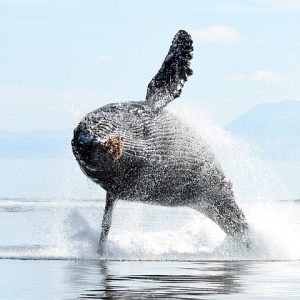
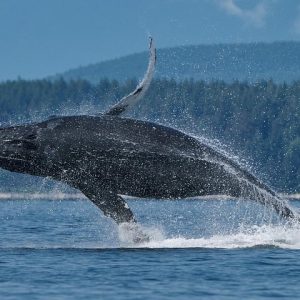
With the bow trimmed down, the sharp entry slices cleanly through the steep chop. After 20 minutes in the open conditions, the family reaches the lee of the land and slows down to watch whales surfacing nearby.
Along the way, they stop by two previous owners’ waterfront homes to pick up the final piece of the boat’s cockpit enclosure: the rear support frame that holds the aft canvas canopy up out of the rain. Entering Pender Harbor on the northern Sunshine Coast—sheltered to the west by Texada Island—they pass exclusive summer cabins equipped with mechanical boat and dock lifts that hoist entire floats clear of winter storms. Although the Monaro can run 6 to 8 hours at 25 to 30 knots on a single tank of diesel and the round trip up the inlet is roughly 4 hours, Ben tops off at the last fuel dock before heading into the fjords where no fuel services exist.
Log Booms on the Sunshine Coast and a Mid-Inlet Trim Tab Repair
Cruising toward Sechelt Inlet and up into Jervis Inlet, Ben slows down alongside a tugboat towing a massive log boom down-island toward a lumber or paper processing facility. The sight prompts Ben and Ashley to share their family history in British Columbia’s timber industry: Ashley’s father worked in helicopter support for heli-logging, and Ashley worked at a log sort as a grader’s assistant, measuring timber and stapling color-coded grade tags onto logs sorted for 2-by-4s, pulp, or high-value telephone poles.
Ben recalls his own time in logging camp working as a bucker and a bundler—throwing wire across huge land bunks, cutting and crimping the cable around log bundles before a front-end loader pushed them into the water to be corralled into booms. He also describes single-stemming heli-logging, where fallers notched select large trees in the woods until a helicopter grappled the trunk with a claw, rocked it free, and flew it to the sort. Passing a coastal log dump, Ben points out partially submerged deadheads and floating wood debris that can easily rip a stern drive off or punch a hole in a hull.
Just past the last ferry dock and fisheries facility at the end of the road on the Sunshine Coast—where roads, towns, and cell service end with 2 hours of remote inlet still ahead—the plastic rocker button for the boat’s trim tabs breaks completely. Handing the helm to Ashley, Ben pulls the toolkit from under the seat and pries out the broken plastic switch housing. After considering jumping the contacts with a screwdriver, he threads a screw into the mechanism where the button used to sit. The makeshift bolt lever restores full up-and-down control of the leveling tabs, though the switch action now operates in reverse.
Arriving at Princess Louisa Inlet and Overnighting at the Waterfall
At the head of Jervis Inlet, the family approaches the rapids at the entrance to Princess Louisa Inlet. Right inside the entrance sits a bustling summer camp—originally built in the 1940s as a luxury resort and operated since the ’50s as a Christian youth camp complete with boardwalks, a swimming pool, and hundreds of campers. Rounding the corner past the camp, the development vanishes behind sheer glacier-carved granite walls rising thousands of feet overhead. Beneath the hull, the clear water drops nearly 600 feet straight down, making anchoring impossible and leaving only the public dock or mooring buoys near the head waterfall.
Securing a spot at the dock alongside much larger yachts, Ben and Ashley settle inside the canvas-enclosed cockpit, still warm from residual engine heat. They review why the trailerable 24-foot layout works so well for shoulder-season coastal cruising: sliding side windows give direct reach to downriggers on both gunwales, the rear window opens to access an auxiliary kicker motor, the raised engine box doubles as a play table for Willa and Bodhi, and the forward V-berth houses a marine potty behind a closing privacy door.
“And this is what the boat is really for. Not 30 knots, not the spec sheet, but standing at the bottom of a waterfall with the kids somewhere you can’t drive to.”
Ben Stobbart
Walking the wooden boardwalk ashore with the kids to stand at the foot of the roaring waterfall, Ben contrasts the passage with their 11 years of sailing at 6 knots aboard Nahoa, when reaching the same fjord required 2 to 3 days underway. In the pocket diesel cruiser—acquired and refitted for roughly the price of a used car and plenty of late nights—the family made the run before lunch.
Back aboard for the evening during their month-and-a-half summer visit to British Columbia, the family debates a name for the little cruiser. Willa and Ashley vote for “Noho Villa” or “Noho Adventure Villa,” comparing the boat to their old white family car nicknamed the “Adventure Mobile” because minor dash lights or switches act up on every trip without ever stranding them. Discovering that Ashley is the only one who remembered to pack a pillow from home, Ben pieces together cushions and a clean dog bed in the cabin as the family turns in below the granite cliffs.
Frequently Asked Questions
The boat was sold broken with water in the stern drive and an exhaust elbow rotting through onto the turbo. Marine repair shops quoted between four and $20,000 to fix it, so Ben bought it cheap and completed the mechanical repairs himself.
The original 800-gallon-per-hour centrifugal bilge pump sat submerged at the bottom of a dirty bilge where hair, oil, grime, and a loose screw jammed the impeller shaft solid, causing the 12-volt, 5-amp fuse at the battery to blow immediately.
He replaced the seized aft centrifugal pump with a high-mounted Gulper 320 diaphragm pump and swapped the old AGM deep-cycle battery for 12V 165Ah LiTime dual-purpose marine lithium batteries rated at 1,200 cold cranking amps and 1,300 cranking amps with Bluetooth monitoring and an emergency starting reserve.
Unlike hulls that require trimming the bow up in rough water, the Monaro’s deep-V hull must be trimmed bow down in 2-to-3-foot steep chop so the sharp bow entry slices through the waves rather than slamming on the flat aft sections.
The run to Princess Louisa Inlet takes about 4 hours, compared to 2 to 3 days at 6 knots on a sailboat. On a single tank of diesel, the Monaro can run for 6 to 8 hours at 25 to 30 knots.
Book a trip where this was filmed — near Squamish
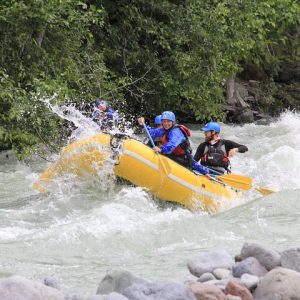
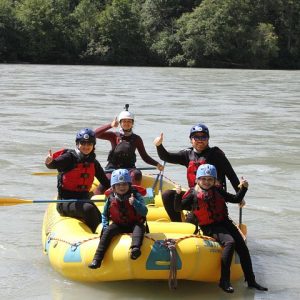
Family Friendly Cheakamus Splash Rafting
Sold by Canadian Outback Rafting Company Ltd.




Support Sailing Nahoa
At WeBoating.com, we profoundly acknowledge the unwavering dedication that Sailing Nahoa invests in crafting each and every video or voyage. Their passion for delivering exceptional ocean content shines through every frame, and it's a labor of love that deserves your attention.
We invite you to watch their captivating videos here and actively engage with their content, including their social media links above. Liking, commenting, and sharing their work goes a long way in fueling their creative fire.
We're also inviting you to explore the gear, sponsorships, and boat partnerships highlighted in the "Why We Bought This Pocket Diesel Cruiser" video description, or directly on YouTube. By engaging with these offerings or purchasing services and items, you directly support Sailing Nahoa, their collaborators, and the brands they're associated with.
To ensure you never miss an offshore update, consider visiting their official YouTube Channel to subscribe, like, and join their community directly.
If you have any feedback, corrections, or additional information about Sailing Nahoa or their videos, please use the comment form below to share your thoughts with us.
Thank you for being a part of our community and supporting the creators we cherish. Your time and support truly matter!
We've upgraded the Monaro with LiTime's 12V 165Ah dual-purpose marine lithium batteries, designed for both engine starting and deep-cycle house power.
Get 8% off LiTime batteries with our discount code: sailingnahoa8
Shop LiTime: https://litime.pxf.io/6kR9Em
#LiTimePower
⛵ NAHOA YACHTS
Years of sailing and fixing boats are shaping what we’re building next: Nahoa M, our 57-foot aluminum expedition sailing catamaran.
Specs, renders and enquiries:
https://www.nahoayachts.com/
⚓ SUPPORT THE ADVENTURE
Help us keep making these videos. Join us on Patreon for real-time updates, behind-the-scenes access and our private WhatsApp crew chat:
https://patreon.com/nahoa
SUBSCRIBE TO OUR NEWSLETTER:
https://sailingnahoa.substack.com
FOLLOW US ON INSTAGRAM:
https://www.instagram.com/sailingnahoa/
FOLLOW US ON FACEBOOK:
https://www.facebook.com/sailingnahoa
Stay Wild, Stay Free,
Ben. Ashley. Willa. Bodhi.
0:00 The High Stakes of a DIY Boat Restoration
1:30 Modernizing the Electrical Heart of the Boat
3:59 Uncovering the Truth Behind the Bilge Failure
6:40 Switching to Lithium
15:45 Mastering the Waves in a Rough West Coast Chop
24:04 Arriving at the Hidden Waterfall Oasis

Sailing Nahoa
Ben and Ashley Stobbart are currently navigating the Koro Sea while finalizing the forensics for their new aluminum fortress, the Nahoa 55 expedition ketch.
Channel Information:
Social Media Links:
Why We Bought This Pocket Diesel Cruiser Location
- Princess Louisa Inlet, British Columbia, Canada (50.1983,-123.7711)
- Jervis Inlet, British Columbia, Canada (50.0667,-123.95)
- Pender Harbor, Sunshine Coast, British Columbia, Canada (49.6264,-124.0319)
- Sechelt Inlet, British Columbia, Canada (49.6,-123.75)
- Texada Island, British Columbia, Canada (49.6667,-124.4167)
Latest Episodes from Sailing Nahoa
Explore the most recent voyages. Subscribe to the channel to never miss an update!
Nahoa M – Mechanical Space
Ben Stobbart details the aft cockpit mechanical space on the Nahoa M catamaran, featuring a swing-up door, standing headroom, and centralized machinery.
Why We Bought This Pocket Diesel Cruiser
Ben and Ashley Stobbart refit the electrical and bilge systems on their 2002 24-foot Monaro pocket diesel cruiser before taking their kids on a four-hour test run to Princess Louisa Inlet.
What Our $15,000 Boat Really Cost
Sailing Nahoa provides a line-by-line financial audit of purchasing and refitting a $15,000 boat in Vancouver, British Columbia, calculating true DIY refit expenses.