Our Dinghy SANK?! Sailing to Martinique
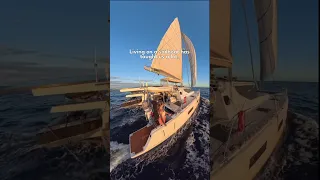
Departing the sheltered anchorage of Deshaies, Guadeloupe aboard Sailing Big Lost, Connor and his family pointed their bows south toward Terre-de-Haut in the Îles des Saintes. With their broken topping lift awaiting replacement parts in Martinique, the catamaran could not yet raise full canvas for heavy offshore sailing. Instead, the crew ran their main halyard aft as a safety line to secure the boom against falling onto the rooftop solar panels and settled into a calm 3-hour motor run down the island’s leeward coast alongside their cruising friends on the boat Mistral.
When asked about the slow progress while steering along the coast of Guadeloupe, Connor summed up the helm’s mood: “Good motoring. Wish we were sailing.” Out in the channel, dense mats of pelagic sargassum drifted along the surface, requiring vigilant lookout to avoid fouling the rudders, propellers, or engine sea strainers. After clearing the southern waters of Dominica off Scotts Head, where local kiteboarders jumped through the acceleration zone between the islands, the boat approached the mooring field off Terre-de-Haut.
Mooring Challenges and Propeller Inspection at Terre-de-Haut
Catching a mooring buoy in the French islands proved physically demanding because the local buoys lack floating pickup pennants. Connor noted the awkward setup while maneuvering the bows: “French mooring balls. They are nice and they help eliminate the damage from anchoring vessels, but they are a horrible design.” His son Finn stood at the bow with the boat hook to snag the metal eye and hold the heavy buoy while lines were threaded through: “Thankfully, Finn was on deck to help grab the ball and lift it while I ran lines through the eye. Teamwork.” Once secured, Connor took their tender across the field to assist Monica and Jesse aboard Mistral, running their port line through the mooring eye and underneath their bowsprit.
Ashore in Terre-de-Haut, the crew climbed the hill to Fort Napoléon, a stone fortress originally known as Fort Louis before its destruction by the British in 1805, and rebuilt in 1867 under Napoleon III. Back at the anchorage, Connor donned mask and snorkel to inspect a persistent vibration on the starboard side. Diving beneath the hull, he discovered vertical play in the folding blades of their Gori propeller caused by worn bushings. After contacting the manufacturer, replacement parts were scheduled for delivery down island in Grenada.
Swamped Tender in the Martinique Passage
At 5 in the morning, the crew cast off from the Saintes into the open channel bound for Saint-Pierre, Martinique. Heavy swell and swirling gusts immediately caught the towed tender astern, submerging the small craft beneath the surface. With the tender dragged down by water weight, Connor and the crew rigged a line to the electric winch, bringing the swamped hull tight against the sugar scoop to bail out the flooded interior. Reflecting on the physical effort required to empty the boat, the crew observed: “It holds a ton of water. But we can verify that it doesn’t sink.”
To prevent the tender’s bow from burying again, Connor relocated the tow bridle from the low sugar scoop cleat up to a higher cleat on the top deck. With the bow lifted clear of incoming chop, the catamaran settled into open-water sailing past Dominica, logging 7 knots in 18 knots of true wind at an angle of 82 degrees. After navigating the wind shifts and currents off the headlands, the vessel made landfall at Saint-Pierre, Martinique beneath an overhead rainbow.
Ruins, Sea Glass, and the Martinique Yole Boat Race
Anchored beneath the volcanic slope of Mount Pelée, the family went ashore to explore the stone ruins left behind by the historic 1902 volcanic eruption that leveled Saint-Pierre. Walking the black sand shoreline, the children hunted for sea glass and tumbled pottery fragments scattered among the volcanic pebbles. In town, the crew discovered Saint-Pierre hosting the traditional Martinique Yole boat race, a 40-year sailing competition featuring round-bottom hulls without keels or rudders, balanced entirely by sailors hiking out on extended wooden poles.
Before preparing for their onward voyage to Grenada, the family visited the Zoo de Martinique, located on the grounds of a 1643 sugar plantation. Walking between enclosures of monkeys and parrots, the crew examined the preserved brick foundations of the historic sugar mill, aqueduct dam, distillery, and cassava mill destroyed during the 1902 eruption.
Frequently Asked Questions
The crew had not yet replaced their broken topping lift, which had to be deferred until reaching Martinique before they could carry out heavy sailing.
Heavy chop and swirling gusts swamped the towed tender at 5 in the morning as the boat exited the shelter of the Saintes.
Connor inspected the starboard Gori folding propeller underwater, discovered vertical play from worn bushings, and contacted the manufacturer to arrange replacement parts shipped to Grenada.
Traditional yole boats have round bottoms without a keel or rudder; crew members balance outward on long wooden poles to steer and stabilize the hull.
Book a trip where this was filmed — near Martinique
Support Sailing Big Lost
At WeBoating.com, we profoundly acknowledge the unwavering dedication that Sailing Big Lost invests in crafting each and every video or voyage. Their passion for delivering exceptional ocean content shines through every frame, and it's a labor of love that deserves your attention.
We invite you to watch their captivating videos here and actively engage with their content, including their social media links above. Liking, commenting, and sharing their work goes a long way in fueling their creative fire.
We're also inviting you to explore the gear, sponsorships, and boat partnerships highlighted in the "Our Dinghy SANK?! Sailing to Martinique" video description, or directly on YouTube. By engaging with these offerings or purchasing services and items, you directly support Sailing Big Lost, their collaborators, and the brands they're associated with.
To ensure you never miss an offshore update, consider visiting their official YouTube Channel to subscribe, like, and join their community directly.
If you have any feedback, corrections, or additional information about Sailing Big Lost or their videos, please use the comment form below to share your thoughts with us.
Thank you for being a part of our community and supporting the creators we cherish. Your time and support truly matter!
What started as a smooth sail from Îles des Saintes to Martinique quickly turned into one of our wildest passages yet.
As we sailed south through the Eastern Caribbean, we were surrounded by massive mats of sargassum, battled unpredictable gusts near Dominica, and watched fearless kiteboarders tear across the waves off Scotts Head. But things really got interesting after leaving Îles des Saintes—when our old dinghy completely submerged in open water and literally sank beneath the waves.
We explored the historic Fort Napoléon, swam and checked our prop underwater (again!), and finally arrived in Saint Pierre, Martinique under a double rainbow—just in time for a traditional yole boat race and a visit to the Zoo de Martinique, nestled among the ruins of a 17th-century estate destroyed by Mount Pelée’s eruption in 1902.
It’s moments like these—chaotic, beautiful, and unforgettable—that remind us why we live this sailing life.
⚓️ Subscribe to follow our journey as we tackle the challenges of boat life, explore new destinations, and chase freedom one nautical mile at a time.
Follow along — from land to sea and back again — with Sailing Big Lost.
📸 Instagram: https://www.instagram.com/sailingbiglost/
🏝️ TikTok: https://www.tiktok.com/@sailingbiglost
🌎 Website: https://www.sailingbiglost.com
🎥 Patreon: https://www.patreon.com/c/Biglost
Thanks for Watching! We appreciate you! 💕
Don't forget to order your SBL swag at our store:
https://www.sailingbiglost.com/store
❤️ Huge thanks to our Patreons for making this journey possible!
#SailingBigLost #FamilySailing #CaribbeanSailing #BoatLife #Martinique #DinghyDrama #Sargassum #YoleBoatRace
Sailing Big Lost
Sailing Big Lost follows Conor, Kelly, Finn, and Maddie Malone from Sun Valley, Idaho, living full-time aboard their South African Vision 444 ES catamaran, Big Lost. In 2026, their channel documents transiting the Panama Canal, completing a 3,000-mile Pacific crossing, diving Tuamotu atolls, and raising teenagers offshore.
Channel Information:
Social Media Links:
Our Dinghy SANK?! Sailing to Martinique Location
- Saint-Pierre, Martinique (14.743,-61.178)
Latest Episodes from Sailing Big Lost
Explore the most recent voyages. Subscribe to the channel to never miss an update!
We Set Out to Sail the World…We Found So Much More
We set out to sail the world. We found so much more. When we traded our life on land for life aboard a sailboat, we knew we wanted to explore the world together. What we didn’t fully appreciate was how much more this adventure would give us. Friends who have become family. A community that looks o...
How Do Kids Make Friends Sailing Around the World? ⛵ #Shorts
What happens to your kids' friendships when you decide to sail around the world? We're raising two teenagers aboard our sailing catamaran, Big Lost, and one of the biggest surprises has been watching them make friends with other cruising kids. From skateboarding to swimming between boats...
After All That Chaos… This Is Why We Sail
The Malone family faces unexpected challenges in Tahiti, from strict anchoring regulations and electrical mishaps to supporting a friend through an emergency appendectomy.
What Living on a Sailboat REALLY Looks Like ⛵ #Shorts
Living on a sailboat full-time isn't always about sailing to beautiful destinations. Sometimes it's boat repairs, unexpected challenges, helping fellow cruisers, and enjoying everyday family life in French Polynesia. We're a family of four sailing around the world aboard Big Lost, s...
One Mistake. Days of Sailboat Repairs. 😅
It only took a moment to break our dinghy davits. Fixing them was another story! Changing sailing plans, coordinating repairs, fabrication, and finally testing whether our solution worked. Just another day of living aboard our sailing catamaran, Big Lost. 🎥 Watch the full episode: We Broke It. No...