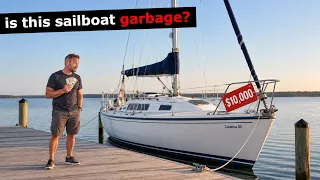
Should You Quit Your Job and Go Sailing?
Contemplating an abrupt resignation from corporate employment frequently begins late at night while scanning classified vessel listings. On Lady K Sailing, Tim Labute examines the familiar impulse among sailors to review a $40,000 sailboat in Florida, calculate accumulated home equity, and weigh pointing the bow toward the Bahamas. While modern remote work tools and improved connectivity make oceanic departures appear increasingly feasible, the transition entails navigating significant financial and mechanical demands.
Acquiring an entry-level vessel rarely presents the primary obstacle. A wide selection of older cruising boats remains available on the secondary market for less than the purchase price of a modern pickup truck. Aspiring voyagers do not require a half-million-dollar vessel or a 50-foot catamaran equipped with four refrigerators and a laundry unit. Instead, a practical 35-foot monohull powered by a functional diesel engine, rigged with dependable sails, and guided by a sound ground tackle system provides sufficient capability for offshore voyaging, provided the owner is prepared to execute repairs along the route.
Technological Shifts and the Reality of Remote Vessel Employment
Technological advances have altered the boundary separating conventional land employment from offshore voyaging over the past 20 years. Modern cruising vessels utilize efficient solar arrays, robust marine battery banks, satellite terminals, and precise digital weather routing. These improvements permit professionals to complete corporate assignments from a laptop while sitting at anchor in clear tropical anchorages. Yet as Labute stresses, transitioning to vessel life does not eliminate daily labor; rather, “buying the boat might actually be the easiest part.”
Cruisers quickly discover that stepping away from terrestrial employment simply swaps office supervisors for structural maintenance. “Your new boss is made of fiberglass, leaks occasionally, and has absolutely no respect for your weekends,” Labute explains. Daily vessel operations require the voyager to serve as marine mechanic, electrician, plumber, sailmaker, and navigator. While cruising delivers tranquil mornings where clear water makes the vessel appear suspended over sand, it routinely alternates with frustrating mechanical failures. A voyage spanning 20 miles to an island can be followed 3 days later by a failed marine head, leaving the owner upside down inside a cramped access locker with a flashlight gripped between their teeth.
Calculating Ongoing Marine Expenses Against Fixed Overhead
The primary financial question confronting prospective cruisers centers on recurring operational burn rather than initial hull acquisition. Cruising hulls demand perpetual cash flow for provisions, fuel, marine hull insurance, periodic haul-outs, antifouling bottom paint, replacement running rigging, engine components, and occasional marina dockage during severe weather systems. Labute emphasizes that unforeseen mechanical failures can prove disruptive: “The real world comes with you. Things still cost money. People get sick.” If an unexpected mechanical failure requiring $8,000 would cause financial ruin, resigning from established employment without adequate financial reserves presents significant risk.
Conversely, total living expenses often matter far more than gross annual earnings. A sailor residing aboard an outright owned $35,000 sailboat with minimal monthly utility costs can maintain far greater financial autonomy than an individual earning $250,000 annually burdened by a substantial mortgage, two car payments, property taxes, child care fees, and revolving debt. Cruising viability hinges on answering “how much money does my life cost” rather than prioritizing headline salary figures.
| Financial metric or vessel benchmark | Monetary figure | Practical cruising reality |
|---|---|---|
| Entry-level coastal cruiser | $40,000 | Used fiberglass vessel located in Florida requiring hands-on mechanical repairs |
| Outright-owned cruising yacht | $35,000 | Paid-for hull providing low ongoing monthly overhead compared to land living |
| Catastrophic repair contingency | $8,000 | Unexpected equipment breakdown that can quickly derail an underfunded sailor |
| High-income terrestrial baseline | $250,000 | Annual corporate salary heavily depleted by mortgage, child care, and car payments |
Confronting the Someday Trap and Managing Health Risks
Sailors routinely postpone passages under the assumption that future conditions will prove more accommodating. Deferring departure until mortgages are retired, children finish formal schooling, corporate promotions are secured, or vessel upgrades are finalized appears rational on an annual basis. However, perpetually postponing departures risks consuming available decades. When an individual is 35, reaching age 60 seems distant, yet physical flexibility and joint health can decline unexpectedly. While active sailors navigate into their 70s, personal health, spousal well-being, and broader economic stability are never guaranteed. Balancing the risks of premature departure against the profound risk of indefinite delay remains critical.
Building the Runway and Testing Life Aboard
Rather than abruptly handing in a corporate resignation, Labute recommends practical trial periods to evaluate real living conditions. “Before you blow up your entire terrestrial existence, test the dream,” Labute cautions. Prospective voyagers benefit from spending several consecutive weeks aboard a boat in inconvenient conditions, anchoring out rather than relying on marina amenities, cooking every meal in the galley, and observing how relationships handle three consecutive days of continuous rain within confined quarters. Cruising fundamentally mirrors routine daily life in a floating environment: “It’s still Tuesday. You’re just having Tuesday on a boat.”
Establishing a sustainable transition requires constructing a deliberate preparatory runway. Aspiring sailors should aggressively eliminate consumer debt, curb superfluous spending, acquire hands-on maintenance skills by maintaining an inexpensive starter vessel, test remote earnings capabilities, and establish cash reserves. By methodically addressing operational skills and financial burn rates, sailors can systematically progress toward offshore passages rather than letting decades slip away in theoretical contemplation.
Frequently Asked Questions
Older cruising hulls such as a 35-foot monohull can cost less than a new pickup truck, whereas the ongoing demands of continuous marine maintenance, equipment failures, and recurring cruising expenses require substantial long-term commitment.
Cruisers act as their own mechanic, electrician, plumber, rigger, refrigeration technician, and navigator, handling recurring haul-outs, bottom paint, battery upkeep, and plumbing repairs.
Living aboard an outright owned $35,000 vessel with low monthly overhead can provide greater personal freedom than earning $250,000 annually while burdened by mortgages, property taxes, two car payments, and extensive consumer debt.
Sailors should establish a preparatory runway by eliminating personal debt, acquiring mechanical skills on a modest starter vessel, testing remote earnings, and spending several weeks aboard anchoring out and enduring bad weather.
Book a trip where this was filmed — near New Providence Island



Support Lady K Sailing
At WeBoating.com, we profoundly acknowledge the unwavering dedication that Lady K Sailing invests in crafting each and every video or voyage. Their passion for delivering exceptional ocean content shines through every frame, and it's a labor of love that deserves your attention.
We invite you to watch their captivating videos here and actively engage with their content, including their social media links above. Liking, commenting, and sharing their work goes a long way in fueling their creative fire.
We're also inviting you to explore the gear, sponsorships, and boat partnerships highlighted in the "Should You Quit Your Job and Go Sailing?" video description, or directly on YouTube. By engaging with these offerings or purchasing services and items, you directly support Lady K Sailing, their collaborators, and the brands they're associated with.
To ensure you never miss an offshore update, consider visiting their official YouTube Channel to subscribe, like, and join their community directly.
If you have any feedback, corrections, or additional information about Lady K Sailing or their videos, please use the comment form below to share your thoughts with us.
Thank you for being a part of our community and supporting the creators we cherish. Your time and support truly matter!
What if you stopped waiting for retirement, quit your job, bought a sailboat, and actually went sailing?
For a lot of sailors, that idea sits in the back of their mind for years. Buy a cruising sailboat, head for the Bahamas or Caribbean, live aboard, work remotely if you have to, and trade the mortgage and commute for anchorages and ocean passages. But is the sailing dream actually realistic, or does cruising simply replace one set of responsibilities with another?
In this episode of Lady K Sailing, we talk about what it really takes to leave the normal 9-to-5 life behind and go cruising. We’ll look at affordable used sailboats, the real cost of living on a sailboat, boat maintenance, remote work, cruising expenses, and why buying the boat might actually be the easiest part.
More importantly, we tackle the question sailors rarely ask: what is waiting costing you?
If your dream is to live aboard a sailboat, sail to the Bahamas, cruise the Caribbean, retire on a boat, or simply spend more of your life sailing, this episode is about figuring out whether “someday” needs to start getting a little closer.
#Sailing #Sailboat #Liveaboard #Cruising #SailingLife #LiveaboardSailing #BahamasSailing #CaribbeanSailing #SailboatLife #Retirement #QuitYourJob #SailingDream #LadyKSailing
Lady K Swag!!! Right here: https://lady-k-sailing-shop.fourthwall.com/
Need a consult? Click here to drop a message: https://ladyksailing.com/consults/
Want to help support Lady K Sailing? Click here to become a Patron: http://www.patreon.com/ladyksailing
Or here to make a one time donation: http://www.ladyksailing.com/team-k
Follow Lady K on Facebook: https://www.facebook.com/ladyksailing
Or Instagram: https://www.instagram.com/ladyksailing/
Lady K Sailing
From the legendary Hughes 35 'Lady K' to the current catamaran 'Rome' refit, Tim Labute provides the technical gold standard for affordable cruising.
Channel Information:
Social Media Links:
Should You Quit Your Job and Go Sailing? Location
- Nassau Anchorage, Bahamas (25.0479,-77.3554)
- Exuma Cays Anchorage, Bahamas (24.25,-76.5)
- Fort Lauderdale Staging Basin, Florida (26.1224,-80.1373)
Latest Episodes from Lady K Sailing
Explore the most recent voyages. Subscribe to the channel to never miss an update!
3 Sailboats I’d Actually Buy for $5,000
Chief Editor of Practical Sailor Tim Labute breaks down the current used boat market and reviews three budget-friendly sailboats that offer real value for new cruisers.
Why Everyone Hates New Sailboats
Lady K Sailing examines modern production boat criticism, analyzing bonded structural grid liners, keel bolt engineering, and CE Category A ocean ratings.
Why 90% of Sailboats Can’t Actually Cross an Ocean
Tim Labute investigates the viral claim that 90% of sailboats cannot cross an ocean, contrasting modern production rally finishers with structural inspection realities.
The Cottage Boat! Start Your Waterfront Dream Before Moving #cottageboat #sailing #sailboat #travel
Tim Labute of Lady K Sailing outlines the cottage boat strategy, explaining how aspiring boaters can use remote work, three-year plans, and weekend commuting to start living on the water years before permanent relocation.
How Landlocked Sailors Actually Own Boats
Tim Labute outlines practical methods for owning a cruising sailboat hundreds of miles from the coast, contrasting permanent relocation with the commuter cottage boat model.