Catamaran Coaching: Tacking & Gybing in Strong Wind and Waves
Launching through beach surf into a 20-knot ocean breeze in the USA, Joyrider TV host Joseph Bennett joins his regular regular racing partner in the USA Laura for an intensive open-water catamaran coaching session. While Laura brings extensive experience as an accomplished catamaran helm on inland lakes, handling steep breaking waves and gusty offshore conditions presents an entirely different technical challenge. Stepping onto the hulls right as the surf clears, the pair immediately work on establishing steering control, coordinating rudder movements, and trimming sails before tackling high-wind maneuvers.
Launching and Steering Control
Getting clear of the beach requires immediate rudder engagement to hold course against incoming rollers. Once offshore, Joseph identifies the foundational habit needed for managing heavy helm pressure: maintaining physical control of the steering stick at all times. Catamaran helms frequently drop or fumble the tiller extension when hauling in heavy sheets, allowing the twin rudders to kick upward and inadvertently pivot the hulls head to wind.
To eliminate this vulnerability, Joseph instructs Laura on the third-hand steering technique:
“Use your third hand when you’ve got a sheet in a lot.”
By locking the tiller extension over the shoulder or clamping downward pressure across the arm, the helm frees both hands to haul the mainsheet while the rudders remain locked on course. Rather than trapezing immediately, which increases power and accelerates every movement, the crew sails in a seated position with the traveler eased to absorb unexpected gusts. As Joseph demonstrates, bearing off just 2 degrees unlocks immediate boat speed without overloading the rig.
Mastering the Upwind Tack in Heavy Waves
Tacking a lightweight catamaran through steep chop is notoriously prone to getting stuck in irons. When entering waves, heading up at the trough causes maximum hull resistance, stalling forward momentum before the bows cross the eye of the wind. Joseph emphasizes timing the tack when the bows rise clear of the water, un-cleating the mainsheet beforehand, and committing the rudders smoothly without over-turning.
During initial attempts in 20-knot winds, Laura releases the mainsheet prematurely or permits the tiller to wander across the cockpit during the crew crossing. Joseph takes the helm to demonstrate the sequential technique required for high-wind transitions:
- Un-cleat the mainsheet while holding tension before initiating any turn.
- Push the tiller extension across and rest the stick firmly against the side bar to mechanically lock the rudder angle.
- Wait for the jib to back completely against the mast before starting any movement across the trampoline.
- Release the mainsheet to run freely through the blocks, transfer across, and reset the stick on the opposite side bar.
- Ease the mainsheet generously on exit to allow the boat to bear away and build forward drive.
“The time to move across the boat is when the jib backs.”
When stalled tacks occur, Joseph coaches Laura through the reverse recovery sequence: pushing the rudders away, backing the jib to push the bows off the wind, and waiting until the hulls begin moving forward before sheeting in. As conditions freshen, Joseph observes that the breaking swell compounds the challenge, noting that the waves make it feel eight knots windier than it is.
Downwind Surfing and High-Wind Gybes
Turning downwind introduces rapid wave surfing and requires careful apparent wind management. The crew sets their course so the wind indicators sit straight across the boat, never heading above a 90-degree apparent wind angle. Bearing away down the face of waves unloads rig tension, providing the exact window needed to initiate a safe gybe.
Before throwing the boom across, Joseph brings the traveler inward toward the toe strap. As the boat accelerates down the swell, the apparent wind drops, allowing the mainsail to swing across with minimal shock load on the shrouds. During practice runs approaching the shoreline, Laura turns the wrong way toward the beach, prompting Joseph to take the helm and execute an immediate three-point tack recovery to regain sea room.
Returning to deeper water, Laura takes the tiller once more to execute a controlled high-wind gybe, keeping the rudders locked firmly against the beam as the sail swings across effortlessly.
“I got a little a little in my head with the nerves and Joe took the stick for a while and I asked him if I could do it again”
Reflecting on the session, Laura highlights how locking the tiller extension against the crossbeam eliminated erratic rudder wander, transforming an unpredictable maneuver into a stable, repeatable execution.
Onboard Coaching Metrics
| Parameter | Value | Observation |
|---|---|---|
| Base Wind Speed | 20 knots | Sustained ocean breeze during upwind and downwind drills |
| Perceived Wind Impact | 8 knots | Additional physical resistance created by steep breaking waves |
| Bearing Away Adjustment | 2 degrees | Trim adjustment required to accelerate hulls without over-powering |
| Apparent Wind Angle Limit | 90 degrees | Maximum angle maintained downwind to prevent high-speed capsizes |
Frequently Asked Questions
The third-hand technique involves locking the tiller extension over the shoulder or resting the arm across the stick with downward pressure, allowing the helm to use both hands for mainsheet handling while keeping the rudders securely locked on course.
The helm should wait until the jib backs fully against the mast before crossing the trampoline, letting the mainsheet run freely and resting the tiller extension on the crossbeam to lock the rudder angle throughout the turn.
To get moving after stalling in irons, push the rudders and boom away, back the jib to blow the bows off the wind, keep the rudders straight as backward motion stops, and only sheet in once forward momentum resumes.
Bearing away to surf down a wave reduces apparent wind speed and rig pressure, while pulling the traveler inward toward the toe strap allows the boom to swing across smoothly without slamming into the shrouds.
Book a trip where this was filmed — near Annapolis
Support Joyrider TV
At WeBoating.com, we profoundly acknowledge the unwavering dedication that Joyrider TV invests in crafting each and every video or voyage. Their passion for delivering exceptional ocean content shines through every frame, and it's a labor of love that deserves your attention.
We invite you to watch their captivating videos here and actively engage with their content, including their social media links above. Liking, commenting, and sharing their work goes a long way in fueling their creative fire.
We're also inviting you to explore the gear, sponsorships, and boat partnerships highlighted in the "Catamaran Coaching: Tacking & Gybing in Strong Wind and Waves" video description, or directly on YouTube. By engaging with these offerings or purchasing services and items, you directly support Joyrider TV, their collaborators, and the brands they're associated with.
To ensure you never miss an offshore update, consider visiting their official YouTube Channel to subscribe, like, and join their community directly.
If you have any feedback, corrections, or additional information about Joyrider TV or their videos, please use the comment form below to share your thoughts with us.
Thank you for being a part of our community and supporting the creators we cherish. Your time and support truly matter!
Strong wind, big waves and some very exciting catamaran sailing! Join me for an onboard coaching session with Laura, working on how to tack, gybe and stay in control when the conditions get challenging.
Laura is an accomplished catamaran helm and my regular racing partner when I visit the USA, but she normally sails on a lake. This time, we’re taking her helming into waves—and finding out which changes make the biggest difference.
We start with steering control and upwind sailing before tackling the tricky business of tacking a catamaran in strong wind and waves. Then we turn downwind for surfing, gust control and some increasingly exciting gybes!
Along the way, we work on:
⛵ Using your “third hand” to steer while handling the mainsheet
⛵ Preparing for a tack and keeping the rudders under control
⛵ Timing your movement and mainsheet release as the jib backs
⛵ Getting moving again after a stalled tack
⛵ Bearing away in gusts and surfing down waves
⛵ Preparing for a gybe and reducing the load in the rig
There are missed tacks, nerves, a wrong turn near the beach and some brilliant improvements as Laura puts the techniques into practice. Stay to the end for her take on what helped most.
What do you find harder in strong wind and waves—tacking or gybing? Let us know in the comments!
MORE CATAMARAN COACHING & JOYRIDER ACADEMY
https://totaljoyrider.com
SUPPORT JOYRIDER TV
JOIN ON YOUTUBE ➡️ https://www.youtube.com/@JoyriderTV/join
JOIN ON PATREON ➡️ https://www.patreon.com/joseph_bennett
00:00 Strong wind coaching with Laura
01:24 Launching and getting clear of the beach
02:58 Steering control: use your third hand
05:52 How to tack a catamaran in waves
08:19 Tacking demonstration: preparation and rudder control
12:00 Tacking practice and fixing stalled tacks
18:38 Downwind sailing in strong wind and waves
20:48 Gybing demonstration and surfing technique
25:28 Gybing practice and a wrong turn near the beach
27:55 Key lessons and Laura’s verdict
#CatamaranSailing #SailingTips #JoyriderTV
Gear I Use and Recommend
SunGod Sunglasses
https://www.sungod.co/s/eR4VYYu3/](https://www.sungod.co/s/eR4VYYu3/
Telemetry Overlay – add GPS data to your sailing videos
Use code JOYRIDERTV for discount
https://bit.ly/telemetryoverlay
Instamic Waterproof Audio
https://instamic.io/?aff=119
Xero Shoes
https://xeroshoes.com/go/joyridertv
Forward WIP – impact protection for sailing
@forwardwip
Want to be part of the action?
Upload your sailing videos to Joyrider Worldwide and get featured.
Get uploader access at https://totaljoyrider.com
About Joyrider TV
Joyrider TV is one of YouTube’s leading channels for catamaran sailing.
Videos include tutorials, maintenance guides, Q+As, race strategy and real-world sailing.
Whether you sail a Hobie, Nacra, A-Class, Prindle, Dart, Tornado, F18, F16 or more, you’ll find practical, no-nonsense advice to help you sail faster, safer and with more confidence.
---
#catsailing #sailboat #joyridertv

Joyrider TV
Joseph Bennett: The high-performance 'Joyrider' mastering 26-knot catamaran runs in Vassiliki, Greece, while redefining budget DIY racing for the global community.
Channel Information:
Social Media Links:
Catamaran Coaching: Tacking & Gybing in Strong Wind and Waves Location
- USA (36.8529,-75.978)
Latest Episodes from Joyrider TV
Explore the most recent voyages. Subscribe to the channel to never miss an update!
How to Rig a 6:1 Downhaul Without Twists | Catamaran Sailing #Shorts
Joseph Bennett explains the sequence for reeving a 6:1 catamaran downhaul cleanly, aligning top and bottom blocks at 90 degrees to eliminate twists.
How to WIN a World Championship Race | Nacra 15 POV
What does it take to WIN a race at the Nacra 15 World Championships? Jump onboard FRA 362 with French sailors Anahita Fontanille and Léo Jean-Albert as they race to victory in Race 5 of the 2026 Nacra 15 World Championships in Plymouth, UK. But this isn't just onboard racing footage. Through...
Why Does Your Catamaran Point Higher on One Tack? | Live Q+A
Joseph Bennett breaks down why beach catamarans point higher on one tack than the other, diagnosing foil damage, mast rotation, rudder rake, and chop direction to restore symmetric upwind performance.
How fast is too fast? Nacra 20 FCS
Lake Como, The Fastest Production Foiling Catamaran. Over 30 knots top speed. ➡️ Master Catamaran Sailing – Faster Stop guessing. Start improving. • 18 structured modules • 120+ lessons • From beginner to confident sailor Boat handling. Power control. Racing. All explained clearly. Get insta...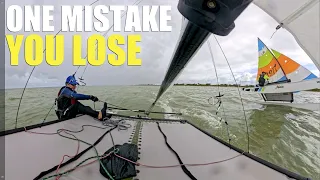
Hobie 16 Race Training — Just Two Boats and Two Buoys
Joe Bennett and Gerardo run two solo Hobie 16 catamarans through intense two-lap match races near Progreso, Mexico, dialing in starting tactics, mark roundings, and trapeze handling in 10 knots of breeze and an incoming squall.