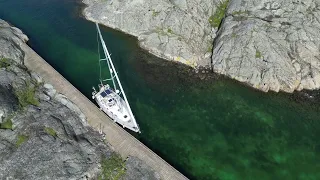
Norway to Portugal Part 3 Episode 21
A sudden squall swept over Makkum just as Jayne and Mike prepared to cast off aboard their Najad 405, Loon’s Lace, featured on GoneSailingCA – Loon’s Lace. Facing gusty 20 to 25-knot winds that easily outstripped early forecasts, the crew motored through the 5-meter buoyed channel onto the open IJsselmeer to begin their southward coastal voyage toward Brittany.
Motor sailing at 6 knots under overcast skies, they decided against dropping anchor in the chop and pushed directly for Enkhuizen, docking safely before crossing the Markermeer toward the heart of Amsterdam.
Battering Across the Markermeer to Sixhaven
Departing Enkhuizen the following morning, Mike chose to bypass a congested marina fuel dock to avoid close-quarters maneuvering in brisk winds. While the sheltered basin registered 20 knots, the open waters of the Markermeer quickly delivered a sustained 30 knots directly on the nose. The resulting head seas turned the 30-mile run to Sixhaven into a grueling 8-hour motor sail, sending steep waves crashing over the coachroof and drenching the watch standers.
Upon reaching the northern entrance to Amsterdam, Loon’s Lace navigated under a roadway bridge, cleared the lock, and approached the compact basin of Sixhaven directly opposite Central Station. Having phoned ahead for mooring guidance, Mike followed the harbor master’s tight docking instructions:
“Turn to port and then turn to starboard as quick as you can.”
Slipping between timber pilings into a 4-meter box mooring, the vessel gently nudged an adjacent neighbor who stepped out onto deck to take the docking lines. Jayne and Mike spent a well-earned lay day crossing the channel on the free passenger ferry, exploring Rembrandts at the museum, completing maintenance on the steering rudder, and waiting for prevailing southwest winds to ease before heading down the North Sea coast toward Rotterdam.
Crossing the Maas Shipping Channel from IJmuiden
Clearing the Netherlands through the sea locks at IJmuiden, Loon’s Lace turned south toward Rotterdam. The crew departed several hours ahead of slack water, battling the initial ebb to ensure a 7-hour southerly tidal push down the coast. As they neared the heavily trafficked Maas approach outside Rotterdam by the MN1 fairway buoy, Mike made contact on VHF channel 03 with Maas Control to request transit clearance while steering course 225 at 6.6 knots:
“Yes, sir, you can proceed. Just advise when you’re doing your crossing.”
With shore radar monitoring their movement, the crew crossed the main channel while maintaining a careful lookout for commercial traffic, dodging an inbound Stena Line ferry, a massive CMA CGM container ship, and an LNG tanker overtaking from astern. Once clear of the Rotterdam fairway, the breeze faded to 1.5 knots, and an opposing tidal stream slowed their speed over ground to 4.8 knots.
Trading off 5-hour watches under clear night skies, they passed Dunkirk’s south cardinal buoy at dawn and swept past Calais on the French shore, with the White Cliffs of Dover clearly visible on the starboard horizon. After a continuous 27-hour engine run, they dropped anchor in sand between Cap Gris-Nez and Cap Blanc-Nez, dining on potato salad and hot sweet corn while checking the fuel system after a minor engine hiccup, before enduring a rolly swell through the night.
Motor Sailing to Cherbourg and the Alderney Race
Leaving Cap Gris-Nez, the crew faced an adverse 2-knot tidal flow, motor sailing at 3.8 knots under full main and jib along the French coast toward Cherbourg, an open stretch of 150 miles. Gentle breezes under 12 knots provided smooth passage conditions, though Mike had to steer wide of an active dredging vessel working over an offshore gravel bank in the darkness.
Arriving in Cherbourg after nightfall, they secured to the marina visitor dock opposite a public park animated by a live samba band, noting the extreme tidal range where the floating fuel pontoon dropped 20 feet below the high-water quay. Departing Cherbourg the following afternoon at 1300 hours, they harnessed Normandy’s powerful tidal surge, catapulting Loon’s Lace along at 9.3 knots over the ground toward Cap de la Hague.
However, rounding into the Alderney Race, true wind speeds of 15 to 20 knots collided directly against a fierce 4-knot current, rearing up steep standing waves. With reefs tucked into both the mainsail and jib, the violent motion took its toll. Jayne and Mike opted to break their passage and divert into Braye Harbour on Alderney in the Channel Islands, securing to a heavy mooring buoy at slack water to rest before contacting immigration authorities.
Fast Reaches Past the Casquets to Tidal Roscoff
After resting in Braye Harbour, Loon’s Lace cast off past the rocky reef of the Casquets. Shutting down the engine, Mike unrolled the genoa and hoisted the full mainsail to catch a 10-knot beam wind. Boosted by 4 knots of favorable tide, the yacht surged effortlessly across the English Channel at speeds between 8 and 10 knots under a starry canopy.
Reaching the rocky Brittany coast near Roscoff at 07:00, the crew spent 3 to 4 hours holding offshore in choppy waters, prudently waiting for daylight before tackling the intricate, rock-strewn approach. Once inside, they tied up at the newly built outer marina, navigating past pontoon pilings swept by a 3-knot current. At low tide, the massive granite seawalls of Roscoff stood exposed, alongside a travel lift hoisting vessels 60 feet out of the water. Going ashore, Jayne and Mike walked into the historic Vieux Port de Roscoff for fresh ham sandwiches.
Running Chenal du Four to Brest Marina
Taking advantage of a high-water slack tide, Loon’s Lace departed on the final 70-mile leg toward Brest. Motor sailing along the rugged Brittany coastline, they entered the Chenal du Four past Trézien on the port hand, with Ushant standing guard offshore to starboard. Although foul currents eventually checked their pace down to 4.5 knots, the crew maintained steady progress until closing on Brest in thick fog and deteriorating visibility.
Operating navigation lights and sounding acoustic fog signals to avoid passing ferries, fishing vessels, and catamarans, they entered Brest harbor and contacted the marina office. Staff member Annette provided direct berthing guidance:
“Come in, turn right, and park on the big wharf.”
Tied up securely alongside the quay, Mike tackled essential rigging maintenance. Having ordered a replacement masthead transducer from the local U-Ship chandlery, he went aloft in a boatswain’s chair to swap out their erratic 2006 Raymarine ST60 Plus wind instrument for a plug-and-play replacement. That evening, Jayne and Mike walked through damp streets to Maison de l’Océan, celebrating their arrival in Brittany over a seafood dinner of fresh turbot, cod, giant prawns, and mussels, guided home in the rain beneath their red Cherbourg umbrella.
Passage Metrics and Navigation Log
| Passage Leg | Recorded Speed / Distance | Conditions & Navigation Notes |
|---|---|---|
| Makkum to Enkhuizen | 6 knots motor sailing | 20 to 30-knot gusts, 5-meter buoyed channel across IJsselmeer |
| Enkhuizen to Amsterdam | 30 miles (over 8 hours) | 30 knots on the nose, steep head seas, 4-meter box mooring at Sixhaven |
| IJmuiden to Cap Gris-Nez | 6.6 knots across Maas channel | Course 225 crossing on VHF 03, 1.5-knot calm, 27 hours engine run |
| Cap Gris-Nez to Cherbourg | 150 miles (3.8 knots) | Motor sailing against 2-knot tide, winds under 12 knots, 20-foot tidal drop |
| Cherbourg to Alderney | 9.3 knots over ground | 15 to 20 knots true against 4-knot Alderney Race tide, mooring refuge |
| Alderney to Roscoff | 8 to 10 knots speed | 10-knot beam wind under genoa and main, 4-knot favorable tide past Casquets |
| Roscoff to Brest | 70 miles (4.5 knots foul tide) | High slack departure, Chenal du Four past Trézien, thick fog at Brest Marina |
| Brest Masthead Refit | Vintage 2006 instrument | Replaced Raymarine ST60 Plus masthead transducer from U-Ship aloft |
Frequently Asked Questions
The crew motor sailed into 30 knots of wind directly on the nose for over 8 hours, battling steep waves before clearing the lock into Amsterdam.
Near the MN1 buoy, Mike contacted Maas Control on VHF channel 03 requesting to cross on course 225 at 6.6 knots, maintaining separation from container ships, ferries, and tankers.
Wind speeds over 15 knots blowing against a 4-knot tidal stream generated violent standing waves in the Alderney Race, prompting the crew to pick up a mooring in Braye Harbour to rest.
Arriving at 07:00, they waited offshore for 3 to 4 hours in choppy tidal currents until sunrise to safely negotiate the complex, rock-strewn channel.
Mike climbed the mast at Brest Marina to replace their failing 2006 Raymarine ST60 Plus wind transducer with a new plug-and-play unit purchased from U-Ship.
Book a trip where this was filmed — near Amsterdam

Support GoneSailingCA - Loon’s Lace
At WeBoating.com, we profoundly acknowledge the unwavering dedication that GoneSailingCA - Loon’s Lace invests in crafting each and every video or voyage. Their passion for delivering exceptional ocean content shines through every frame, and it's a labor of love that deserves your attention.
We invite you to watch their captivating videos here and actively engage with their content, including their social media links above. Liking, commenting, and sharing their work goes a long way in fueling their creative fire.
We're also inviting you to explore the gear, sponsorships, and boat partnerships highlighted in the "Norway to Portugal Part 3 Episode 21" video description, or directly on YouTube. By engaging with these offerings or purchasing services and items, you directly support GoneSailingCA - Loon’s Lace, their collaborators, and the brands they're associated with.
To ensure you never miss an offshore update, consider visiting their official YouTube Channel to subscribe, like, and join their community directly.
If you have any feedback, corrections, or additional information about GoneSailingCA - Loon’s Lace or their videos, please use the comment form below to share your thoughts with us.
Thank you for being a part of our community and supporting the creators we cherish. Your time and support truly matter!
In part 3 sailing from Norway to Portugal we depart Makkum in a rainstorm, enjoy gales of wind crossing the IJsselmeer & Markermeer to tie up in downtown Amsterdam. We exit The Netherlands at Ijmuiden on the North Sea, dodging big ships past Rotterdam, to sail overnight to Cap Gris Nez on France's Brittany Coast. The tides at Roscoff amaze us, Cherbourg is a culinary highlight, Alderney’s Braye Harbour, in the Channel Islands makes a welcome refuge from wind & waves, from where we sail on to rainy Brest, and plan our crossing of notorious Biscay Bay, to Galacia, Spain.

GoneSailingCA - Loon’s Lace
Come sailing with Jayne and Mike on their Niagara 35 Phantasia II and their new boat premiering in 2019, Loon’s Lace, a Najad 405. We make our home on the shore of Lake Ontario and love to sail down east and are in the progress of sailing an Atlantic Circle from Newfoundland to the Azores, Ireland, Scotland, Scandinavia ... and home. Find us on Facebook @GoneSailingCA and see us on our web site, http://gonesailing.finnevans.ca to follow us as we go!
Channel Information:
Social Media Links:
Norway to Portugal Part 3 Episode 21 Location
- Brest Marina, Brest, France (48.3835,-4.4855)
- Makkum, Friesland, Netherlands (53.0556,5.4022)
- Sixhaven Marina, Amsterdam, Netherlands (52.3833,4.9042)
- Cap Gris-Nez, Pas-de-Calais, France (50.8711,1.5836)
- Port Chantereyne, Cherbourg, France (49.6455,-1.6155)
- Braye Harbour, Alderney, Channel Islands (49.7222,-2.2033)
- Port de Plaisance de Roscoff, France (48.725,-3.985)
Latest Episodes from GoneSailingCA - Loon’s Lace
Explore the most recent voyages. Subscribe to the channel to never miss an update!
Norway to Portugal Part 3 Episode 21
Jayne and Mike navigate Loon’s Lace from Makkum through the IJsselmeer and Markermeer to Amsterdam, dodging North Sea shipping and wild tides to reach Brest, France.
Norway to Portugal Part 1
I don't think I can say it any better than this text borrowed from Visit Sweden's web site. Hope you enjoy the video! Mike "Bohuslän – a gem on the idyllic west coast of Sweden Stretching along the west coast of Sweden from Gothenburg to the Norwegian border, Bohuslän is a seaside pa...
Gonesailing LoonsLace Episode 18
July of 2023 - We had just crossed the North Sea from Shetland, to officially enter Norway in the city of Bergen. We'll spend a week at the dock in Bergen, Norway's second largest city, exploring and just relaxing. From Bergen we sail north to visit spectacular Sognefjord, towering valleys...
Loon’s Lace Atlantic Circle – Part 5 Scandinavia to Portugal’s Algarve
A zoom video from this years Toronto International Boat Show of Jayne and I talking about our sail down from Norway to Lagos, Portugal. This season we departed from Wector Yachting near Stathelle, Norway, and sailed to Porsgrunn on May 17th, attending their party & parade for Norwegian National...
GoneSailing Loon’s Lace Episode 17
2023 North Sea summer cruise with Jayne & Mike on their Najad 405 Loon's Lace. We start sailing into Loch Laxford in Northern Scotland, round Cape Wrath to Loch Eribol then sail to Hoy Sound, Stromness and Pierowall in the Orkneys. From Orkney we'll ride the tide into North Haven on Fa...