
We're Sailing to Norway - Part 2
Paul and Sheryl Shard tie up along the historic town quay in Bergen before navigating 90 miles inland along Norway’s Sognefjord to the mountain village of Flåm for Distant Shores TV. Arriving in western Norway during a clear summer weather window, the crew uses the urban stop to provision from the local fish market, reunite with longtime Norwegian cruising friends, and inspect coastal aquaculture facilities before entering the deep fjord systems.
Bergen Dockage and Mount Fløyen
Bergen serves as the primary maritime crossroads for vessels entering the western fjords. Docked directly at the town quay along the historic Bryggen wharf, the crew found municipal moorage surprisingly accessible despite Norway’s reputation for high living costs. Water and shore power connections were included right in the harbor basin.
Norwegian cruising companions Annette, Alf Gunnar, and their son Martin drove across the mountains from Oslo to join the voyage. Upon arrival, the visitors discovered that parking an automobile in central Bergen cost significantly more than mooring an offshore cruising sailboat along the historic waterfront.
“I think we paid something like $30 a night in right in the middle of Bergen town tied up at the town key.”
Paul Shard
To assess the surrounding topography, the crew rode Scandinavia’s funicular railway up Mount Fløyen, ascending to 320 meters above sea level in a 5-minute transit. The summit provides clear vistas over the commercial harbor, the recreational docks, and the complex island approaches leading seaward.
Salmon Aquaculture in Protected Channels
Cruising north from Bergen through sheltered coastal channels, the crew arranged an inspection tour of an active marine salmon farm. Norway accounts for one third of global farmed salmon production, relying on clean tidal currents and deep island channels that shield net pens from heavy offshore ocean swell.
The visited installation comprises six floating cages housing 100,000 salmon per pen, representing 600,000 fish at a single facility. Feed pellets are transferred through central pneumatic pipes that rotate like lawn sprinklers across the pens every few minutes. Computerized dosing systems calculate feeding volume while submerged underwater cameras monitor pellet consumption on the seabed to prevent overfeeding. Translating the biological efficiency of marine aquaculture, Annette highlighted the conversion ratios: the feed volume required to yield 65 kilos of salmon fillet produces 20 kilos of chicken or 13 kilos of pork.
Navigating the Depths of Sognefjord to Flåm
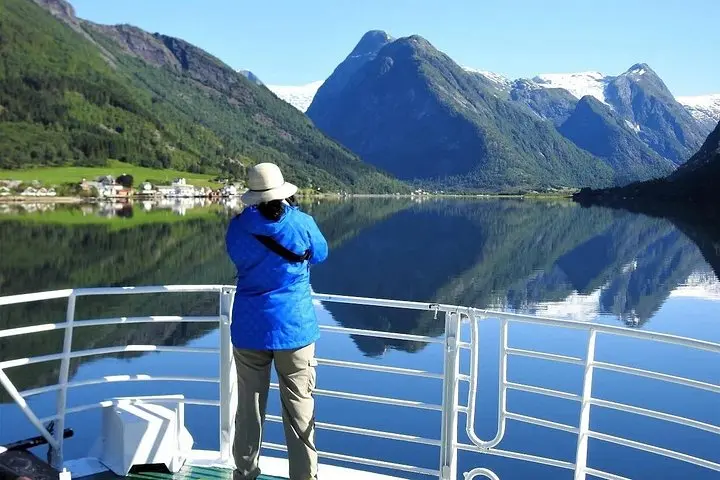
Departing at 6:00 AM under bright summer sunlight, the sailboat entered Sognefjord, the longest fjord in Europe, stretching 126 miles inland from the Atlantic coast. The waterway is characterized by extreme bathymetry, plunging to maximum depths of 1,300 meters—over five times the average depth of the North Sea.
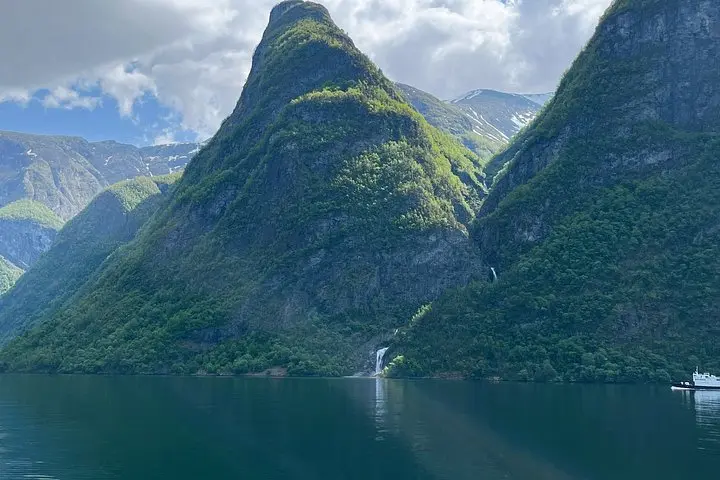
Cruising along vertical rock faces where meltwater cascades down sheer mountain walls, the vessel frequently operated beyond the depth limits of onboard navigational instruments. Even a couple of boat lengths off the rock walls, depths exceeded 200 meters, rendering conventional echo sounders ineffective.
“Even two or three boat lengths away from the cliffs, we’re off soundings, meaning it’s more than 200 m deep, which is the limit of our echo sounder.”
Sheryl Shard
Taking advantage of flat calm conditions, Sheryl dove into the cold surface layer for a freshwater swim directly adjacent to cliffs plunging 400 meters straight down. After 13 hours underway covering 82 miles of deep water transit, the sailboat reached the inner terminus of the fjord branch at Flåm.
“I’m really proud of being Norwegian today. This has been a great day. I have never been on the fjords and seen the mountains like this, so this has been a totally new experience and I just love it.”
Annette
The Flåm Railway and Mountain Switchbacks
From the harbor docks at Flåm, the crew boarded the Flåm Railway, one of Europe’s steepest standard gauge rail lines. Built between 1924 and 1940 over a construction span of 16 years, the track ascends almost 900 meters into the mountains to Myrdal over a 1 to 18 gradient, negotiating 20 tunnels carved through solid granite.
Rather than descending by train, the crew transported rental bicycles to the upper terminus to navigate the historic railway construction road down the Flamsdalen valley. The upper descent consists of loose gravel, large stones, and sharp switchbacks that required cautious brake control and occasional walking before widening into smoother pastoral tracks along the river basin below.
Viking Heritage and Stegastein Hiking
In nearby Gudvangen, the crew explored a living history Viking settlement where Norwegian reenactors maintain historical trades, traditional boatbuilding methods, and summer encampments. Established with 12 tents and 500 visitors 9 years prior, the project expanded to accommodate 500 reenactors and 5,000 visitors alongside a resident community of 70 craftspeople.
Following their time in Flåm, the crew anchored in front of a private summer home on the fjord belonging to Siri, a dancer they met at the Bergen police station while securing clearance formalities. At 61° north latitude—comparable to Anchorage, Alaska—the temperate Gulf Stream allows rich hillside vegetation. Climbing trails leading toward the Stegastein viewpoint, the group hiked mountain paths overlooking the deep fjord waters before sailing back out into western Norway’s coastal network.
| Cruising Metric & Landmark | Recorded Data |
|---|---|
| Bergen Town Quay Dockage | $30 per night with water and electricity |
| Mount Fløyen Summit Elevation | 320 meters via 5-minute funicular |
| Sognefjord Maximum Depth | 1,300 meters (echo sounder off soundings at 200 meters) |
| Sognefjord Total Length | 126 miles inland |
| Aquaculture Farm Capacity | 600,000 salmon across 6 pens (100,000 per pen) |
| Flåm Railway Elevation Gain | 900 meters over 1 to 18 gradient through 20 tunnels |
| Fjord Passage Latitude | 61° north latitude |
Frequently Asked Questions
Mooring at the historic town quay in central Bergen cost approximately $30 per night, which included access to fresh water and electrical hookups.
Sognefjord reaches depths of up to 1,300 meters, with depths exceeding 400 meters right along vertical rock walls, leaving standard marine echo sounders off soundings past 200 meters.
The Flåm Railway ascends almost 900 meters from fjord level with a steep 1 to 18 gradient, passing through 20 tunnels over a line built between 1924 and 1940.
A typical coastal salmon farm visited by the crew contained 600,000 fish across six pens, utilizing computerized pneumatic pellet delivery pipes and underwater cameras to monitor feeding efficiency.
Book a trip where this was filmed — near Bergen
Support Distant Shores TV
At WeBoating.com, we profoundly acknowledge the unwavering dedication that Distant Shores TV invests in crafting each and every video or voyage. Their passion for delivering exceptional ocean content shines through every frame, and it's a labor of love that deserves your attention.
We invite you to watch their captivating videos here and actively engage with their content, including their social media links above. Liking, commenting, and sharing their work goes a long way in fueling their creative fire.
We're also inviting you to explore the gear, sponsorships, and boat partnerships highlighted in the "We're Sailing to Norway - Part 2" video description, or directly on YouTube. By engaging with these offerings or purchasing services and items, you directly support Distant Shores TV, their collaborators, and the brands they're associated with.
To ensure you never miss an offshore update, consider visiting their official YouTube Channel to subscribe, like, and join their community directly.
If you have any feedback, corrections, or additional information about Distant Shores TV or their videos, please use the comment form below to share your thoughts with us.
Thank you for being a part of our community and supporting the creators we cherish. Your time and support truly matter!
In Part 2 of our Flashback Series, we continue sailing in Norway, this time exploring the Sognefjord, the longest fjord in the country stretching 112 nautical miles inland, passing impressive waterfalls as we sail to the end to the picturesque village of Flam, where we ride a historic train to great heights, then make a hair-raising bike ride back down again! Nearby, we visit a camp where Norwegians spend the summer living in traditional ways to keep the culture alive, then anchor in front of the summer home of local friends who take us hiking in the hills where they claim there are trolls 🧌. Do we see any? Watch to find out!
00:00 Intro
01:21 Bergen Norway
03:46 Cost of cruising in Norway
07:02 Fish-farm salmon visit
09:52 Come sail with us in the Grenadines
11:20 Into the Sognefjord
12:52 Swimming in the Fjord
15:05 Proud Norwegian
16:05 When friends visit the boat
17:06 Flam mountain train trip
18:49 Biking in the fjord
21:37 Viking village
22:55 Meeting Siri & a Troll
27:37 Siri Interpretive dance
#sailingnorway #sognefjord #historictrains
Distant Shores TV
Join award-winning documentary filmmakers Paul and Sheryl Shard as they manage their first hybrid-powered aluminum flagship, Distant Shores IV, in Bermuda in 2026.
Channel Information:
Social Media Links:
We're Sailing to Norway - Part 2 Location
- Flåm Harbor, Sognefjord, Norway (60.8631,7.1132)
- Bergen Harbor, Vestland, Norway (60.3971,5.3245)
- Gudvangen, Nærøyfjord, Norway (60.8797,6.8407)
Latest Episodes from Distant Shores TV
Explore the most recent voyages. Subscribe to the channel to never miss an update!
Route Planning: Sailing from Martinique to the Grenadines | EP 281
Paul and Sheryl Shard map out an offshore passage sailing Martinique to the Grenadines, detailing trade wind weather charts, customs clearance in Saint Lucia, and day-sail legs.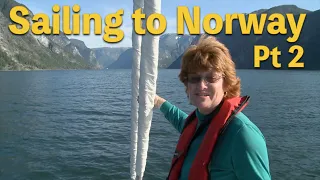
We’re Sailing to Norway – Part 2
Paul and Sheryl Shard navigate inland along Norway's Sognefjord to Flam, documenting Bergen town quay dockage, commercial salmon aquaculture, the steep Flam Railway, and cycling mountain switchbacks.
We’re going to Norway
In this, the first episode of our new Flashback Series, we share video footage of a previous cruise we made to Norway aboard Distant Shores II never shown on YouTube before, along with real time commentary recorded recently while at anchor off the Isle on Wight on the south coast of England aboard D...
TransAtlantic – Cooking at Sea in Foul Weather | Ep 277
This time on Distant Shores we make a 2-week passage across the Atlantic Ocean, a first-time experience for our crew members, Noel and Tracey. Along the way we show how we deal with squalls and handle meal preparation as the yacht rolls in large seas on this challenging east to west transatlantic cr...
Beware of ORCAS! Part 2: Sailing SOUTH through Orca Territory to Portugal | Ep 276
This time on Distant Shores we head south through Orca territory keeping alert and close to shore for safety, then sailing further offshore for the nights. It's 350 miles of dangerous waters until we reach Cascais - near Lisbon. From there we head offshore to safer waters bound for the Canary I...