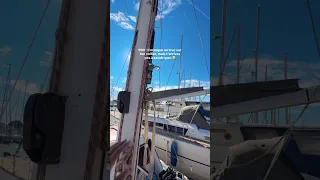
GRAND-VOILE SUR ENROULEUR … le piège à éviter ?
At the harbor of Port-de-Bouc, Fabien from Coraille En Voyage returns dockside to his former sailboat, a classic Dufour 35 named Petit Corail. Meeting with professional rigger Gill from Sudrigging to plan upcoming rigging work on his 15-meter schooner, Fabien also reunites with Petit Corail’s current owner, Cyril, to troubleshoot a persistent mainsail furling issue that has jammed the rig.
Between catching up with cruising friend Benjamin—who is outfitting his own boat for passages toward Corsica, Sardinia, and the Canaries—the crew focuses on diagnosing why the in-mast furling mainsail refuses to roll smoothly inside the mast extrusion.
Diagnosing In-Mast Furling Mainsail Jams
Two years after transferring Petit Corail to Cyril, Caro, Meril, and Roxane, Fabien inspects the mainsail setup. On in-mast furling systems, incorrect main halyard tension frequently causes mechanical binding. Over-tensioning the halyard pulls an unnatural crease or hollow along the luff at the base of the sail, forcing the cloth to bunch and jam when rolled into the mast cavity. Conversely, insufficient tension leaves the fabric slack, spoiling the sail’s aerodynamic profile.
The standard adjustment procedure requires tensioning the halyard until the crease begins to form, then easing tension until the cloth smooths out. On Petit Corail, however, Cyril found that correct settings repeatedly slipped under load. Inspection confirmed the line had aged and lost its dimensional stability. As Fabien explains, “unlike a mooring line which must be elastic to absorb shocks, a halyard must be as inelastic as possible to allow for precise adjustments.”
Stitching a Messenger Line for Internal Mast Routing
Replacing an internal mast halyard presents a high-stakes mechanical challenge: if the messenger disconnects inside the mast tube, re-threading a new line becomes exceptionally difficult. To prevent this failure, Fabien avoids relying solely on adhesive tape to join the old and new cordage.
Instead, the crew sews the bitter ends securely together before pulling the run through the masthead sheave box. As Fabien demonstrates during the rigging process, “You pass the needle through the first one, then you pass the needle through the second one. Actually, you do that 5 or 6 times, tie a knot, and at least that way it’s solid.” Once the structural stitching is knotted, a layer of tape wraps the splice simply to prevent edges from catching on internal hardware during transit.
Rehoisting the Sail and Tuning Boom Geometry
With the new low-stretch halyard drawn down through the mast base, the crew slides the mainsail luff back into the furling groove. Proper geometry is critical during reassembly: the boom topping lift must be slackened so the boom can rest at its natural position toward the bimini.
Aligning the spar is essential, noting that “the boom has a nice 90-degree angle” relative to the mast. Once the halyard is brought under controlled winch tension, the mainsail shape is restored. The sail rolls smoothly into the extrusion and deploys cleanly by hand without sticking, leaving Cyril ready to set sail once more.
Frequently Asked Questions
The main halyard had been tensioned too tightly, creating a crease along the base of the sail that bunched up when rolled into the mast. In addition, the old halyard had become elastic over time, causing it to lose proper tension settings.
Tighten the halyard until a visible crease appears along the base of the sail, then ease it gently until the sail smooths into a fair shape. The line must remain inelastic to hold this adjustment.
Pulling a halyard through a mast can separate tape joints, dropping the line inside the mast extrusion. Sewing the ends together with five or six needle passes and a knot creates a strong connection, with tape added only to prevent snagging.
The boom topping lift should be slackened and the boom positioned at roughly a 90-degree angle to the mast before setting the halyard under winch tension.
Book a trip where this was filmed — near Provence

Support Coraille En Voyage
At WeBoating.com, we profoundly acknowledge the unwavering dedication that Coraille En Voyage invests in crafting each and every video or voyage. Their passion for delivering exceptional ocean content shines through every frame, and it's a labor of love that deserves your attention.
We invite you to watch their captivating videos here and actively engage with their content, including their social media links above. Liking, commenting, and sharing their work goes a long way in fueling their creative fire.
We're also inviting you to explore the gear, sponsorships, and boat partnerships highlighted in the "GRAND-VOILE SUR ENROULEUR … le piège à éviter ?" video description, or directly on YouTube. By engaging with these offerings or purchasing services and items, you directly support Coraille En Voyage, their collaborators, and the brands they're associated with.
To ensure you never miss an offshore update, consider visiting their official YouTube Channel to subscribe, like, and join their community directly.
If you have any feedback, corrections, or additional information about Coraille En Voyage or their videos, please use the comment form below to share your thoughts with us.
Thank you for being a part of our community and supporting the creators we cherish. Your time and support truly matter!
Coucou les copains ! ⛵😊
RENDEZ VOUS AU CROUESTY A ARZON LE samedi 31 octobre !!! entre 10H et 12h et 14H et 16H sur le stand SVB
Comme promis, voici les liens utiles :
⚓ **Notre formation pour apprendre à naviguer** : https://www.voiliercoraille.com
🛠️ **Le site de Gilles et Sud Rigging**, pour tout savoir sur le gréement : https://www.sud-rigging.com/
Un grand merci à tous pour votre soutien et bonne navigation ! 💙
Montage : Fabien,Céanie et Framboise
Musiques:Fabien Lafiandra www.youtube.com/fabguitar38
Merci à Scott Buckley pour ses fantastiques musiques . On ne les utilise pas sur toutes nos vidéos mais si vous aimez la belle musique n'hésitez pas à aller écouter :
www.scottbuckley.com.au'With These Hands' by Scott Buckley - released under CC-BY 4.0. www.scottbuckley.com.au-----
----------Want to learn to sail? You will find the online training to learn navigation and life on board as well as all the guides on our website and take advantage:https://www.voiliercoraille.com/See you soon
Coraille En Voyage
Voilier, TUTOS, voyages et Aventures ! C'est avec un grand plaisir qu'on partage nos différents voyages, astuces et tutos sur le voilier et le bateau en général ! Alors... EMBARQUEZ et BIENVENUE a bord !!! Sailboat, Boat, Adventures! It is with great pleasure that we share our various trips, tips and tutorials on the sailboat and the boat in general! So .. . GET ON BOARD and WELCOME aboard !!!
Channel Information:
Social Media Links:
GRAND-VOILE SUR ENROULEUR … le piège à éviter ? Location
- Port-de-Bouc, Bouches-du-Rhône, France (43.4031,4.9807)
Latest Episodes from Coraille En Voyage
Explore the most recent voyages. Subscribe to the channel to never miss an update!
🌶️ BLACK CHILI WEEK IS ON ! 🔥
C’est LE moment de se faire plaisir et de préparer la prochaine saison de navigation ! ⛵️ Avec SVB marine, on vous annonce le lancement de la plus grosse opération promo de l’année sur leur site ! 📅 Attention, les offres sont disponibles jusqu’au 30 novembre seulement ! 🎁 Et on vous a réservé un...
Devine où c’est ! 🌍
En rentrant des îles Canaries, nous avons dû faire escale à El Jadida, au Maroc, pour nous abriter du mauvais temps 🌊 Une escale imprévue qui nous a permis de découvrir le Maroc pour la toute première fois ! 🇲🇦 Nous en avons profité pour partir explorer un endroit assez incroyable : une lagune pro...
AU SECOURS, le bateau prend l’eau ! Heureusement, les copains arrivent
Fabien and Céanie tackle sailboat deck hatch reglazing, manage flooded dinghy bailing following heavy harbor rains, and engineer a convertible sit-stand bunk inside the cabin of Voilier Coraille 2.
Parce qu’en bateau, on développe parfois notre propre langage ! ⛵️
Pas besoin de crier d’un bout à l’autre du bateau, ni de réveiller tout le mouillage… Un petit signe, et le message est passé ! 🤫⛵️ Avec le temps, on a créé nos petits codes pour communiquer à distance, surtout dans les moments où on préfère garder le calme autour de nous. Et finalement, c’est dev...
On pensait simplement préparer le démâtage… mais le bateau en avait décidé autrement ! 🫣
Avant de pouvoir sortir le mât, il faut tout préparer. Au programme : enlever les bômes, les lazy bags, les lazy jacks et bien sûr, toutes les voiles. Sauf que… évidemment, rien ne se passe jamais exactement comme prévu en bateau ! 🙃 On s’est rendu compte que notre génois était complètement coincé...