Installing Handles on our Boat - S04E05 | Building Wilda
Inside an unassuming workshop shed outside Melbourne, Victoria, Australia, the ambitious shell-up completion of a 44-foot performance cruising catamaran reaches an essential operational milestone. Axel and Iuliana, the dedicated Swedish-Romanian team behind Building Wilda, are systematically transforming a bare Schionning Wilderness 1340 platform into a self-sufficient blue-water expedition multihull. Having recently cut and fitted a composite galley sink unit, the builders begin Episode S04E05 by sealing the perimeter cutout with high-density thickened epoxy to form an impenetrable moisture barrier before turning their engineering focus toward one of the most critical safety systems aboard any offshore vessel: heavy-duty handholds and grab rails.
Navigating an offshore catamaran under sail demands continuous physical security. Whether dropping off the crest of an eight-foot Southern Ocean swell or moving between hulls in heavy weather, the crew requires immediate, bulletproof points of contact. Over several demanding workshop days, Axel and Iuliana tackle the end-to-end process of laying out, fabricating, customizing, and through-bolting marine-grade 316 stainless steel handrails across companionway companion stairs and the exposed exterior coachroof. The project demonstrates the exacting composite boatbuilding standards demanded when integrating high-load mechanical hardware into advanced cored laminates.
Companionway Handrails: Ergonomic Layout and Symmetry Across Seven-Meter Bridgedeck
For the Building Wilda crew constructing the Schionning Wilderness 1340 catamaran Wilda, precision composite boatbuilding inside their shed near Melbourne, Victoria, Australia requires solving complex spatial challenges across a beam spanning more than seven meters. Transitioning from the expansive bridgedeck saloon down into the working living quarters of each hull presents a distinct ergonomic hazard while underway. The descent into the port hull leads directly past the head and shower compartment, while the starboard companionway mirrored opposite provides access to the master stateroom. Establishing secure handrails along these companionway bulkheads is vital to prevent slips and falls as crew members transition between levels.
Because the port and starboard companionways are separated by seven meters of bridgedeck floor, establishing visual symmetry by eye is virtually impossible. Axel and Iuliana overcome this challenge by establishing fixed structural baselines tied directly to the stair treads. By indexing the lower mounting stanchion against the second tread and triangulating the upper stanchion into the bulkhead corner, they ensure both 316 stainless steel handrails maintain an identical parallel pitch relative to the steps. Comprehensive dry-fit trials confirm natural grip angles before pilot holes are drilled through the sandwich bulkheads for the subsequent potting sequence.
Composite Fastener Potting: Core Excavation and Thickened Epoxy Plugs
Throughout the Building Wilda odyssey, fabricating the Schionning Wilderness 1340 catamaran Wilda adheres to the uncompromising principles of high-performance composite boatbuilding developed outside Melbourne, Victoria, Australia. When bolting heavy deck hardware to structural sandwich panels, standard mechanical fasteners cannot simply be torqued against a low-density core. Compressing structural foam or end-grain balsa under the clamping force of a through-bolt crushes the delicate core material, causing localized skin delamination and structural failure. Even more hazardous is the risk of water intrusion: should a deck seal weep, moisture will migrate into the core, initiating widespread structural rot.
To eliminate these vulnerabilities, Axel and Iuliana employ the industry-standard “drill-fill-drill” potting methodology. Initial pilot holes are drilled through the composite laminate, followed by excavating the internal core material radially outward to create an annular cavity between the structural fiberglass skins. This cavity is thoroughly cleared of core dust before being injected with an epoxy slurry heavily thickened with colloidal silica and structural high-density microfibers. Cured overnight into an unyielding solid composite bushing, clearance holes are redrilled through the epoxy plug, ensuring clamping loads transmit entirely into outer fiberglass skins while the core remains permanently isolated from water.
Coachroof Decoring Forensics: Hardwood Veneer and Balsa Core Excavation
Topside progress on Building Wilda and the Schionning Wilderness 1340 catamaran Wilda highlights the meticulous nature of custom composite boatbuilding in Melbourne, Victoria, Australia. Moving from the interior to the exterior coachroof, Axel and Iuliana prepare to mount heavy-duty safety grab rails along the cabin top to serve as primary lifelines when moving forward in turbulent seas. To ensure every mounting aperture is drilled perfectly perpendicular to the crowned cabin profile, Axel utilizes a custom black drill guide fabricated on their workshop 3D printer.
The structural composition of the Wilderness 1340 coachroof presents unique forensic complexities. To achieve exceptional stiffness across compound curvatures without adding excess weight, the designer specified a specialized sandwich panel featuring an end-grain balsa core flanked on both sides by hardwood structural veneers beneath the outer fiberglass laminates. During an inspection of the drilled and pre-filled roof holes, the builders discovered that one mounting aperture had not achieved complete epoxy filling. Rather than compromising on a weather deck, Axel used hand chisels to excavate the defective filler and stubborn wood veneer back to pristine structural fiberglass before refilling with thickened epoxy.
Hydraulic Pipe Bending: Conforming 316 Stainless Rails to Deck Crown
In the workshop of Building Wilda, completing the Schionning Wilderness 1340 catamaran Wilda demands versatile metalworking skills alongside composite boatbuilding expertise in Melbourne, Victoria, Australia. When dry-fitting the exterior stainless steel grab rails to the coachroof, Axel encountered an immediate mechanical challenge. The handrails featured factory-welded mounting flanges that were perfectly flat and aligned in a single plane, whereas the catamaran coachroof possesses a distinct structural camber designed to shed green water offshore.
Attempting to force flat handrail stanchions down against the crowned coachroof using fastener torque would induce severe localized pre-stress into the composite skins and distort the mounting bases, inevitably leading to seal failure. Axel borrowed an industrial hydraulic pipe bender, positioning the stainless steel rail within radiused dies and pumping the manual ram in subtle increments to induce controlled plastic deformation. Introducing a gentle longitudinal curvature along the central span aligned the mounting flanges flush against the coachroof contour, ensuring the grab rail sits naturally without mechanical strain.
Bedding, Backing Plates, and Fastener Customization
The installation phase on Building Wilda for the Schionning Wilderness 1340 catamaran Wilda underscores the rigorous standards of modern composite boatbuilding practiced outside Melbourne, Victoria, Australia. With all apertures potted and dry-fits verified, the builders prepare the surfaces for permanent installation. Axel and Iuliana thoroughly vacuum away all composite swarf and degrease the mounting footprints with solvent to guarantee optimal adhesion for the bedding compound.
Watertight security is achieved using Sikaflex marine polyurethane adhesive sealant, applied generously under each flange and around fastener shanks to guarantee continuous squeeze-out. On the interior underside of the composite deck, Axel installs heavy-duty backing plates to distribute dynamic shock loads across a wide area of the inner fiberglass skin. When inventory bolts proved excessively long, threatening to bottom out against internal cabinetry, Axel measured, cut each fastener to length with a cutoff wheel, and chamfered the threads. Bedded and torqued under the watchful eye of boatyard canine Cookie, the handrails stand rock-solid.
Systems Integration and Blue-Water Preparedness
Every structural fitting completed on Building Wilda brings the Schionning Wilderness 1340 catamaran Wilda closer to open-water autonomy through disciplined composite boatbuilding in Melbourne, Victoria, Australia. Handrails may appear to be straightforward deck fittings, but within the context of a high-performance multihull, their successful integration represents a vital link in vessel seaworthiness. Wilda is designed not merely for coastal hops, but for demanding passages across the rough waters of Bass Strait and extended global voyages.
The installation of topside safety rails dovetails directly into the broader systems architecture of the catamaran. Future phases will see the installation of a 3kW+ rigid solar arch over the cockpit and the integration of Axel’s custom retractable electric auxiliary propulsion drives. Because the electric drive system utilizes custom lifting pods with hydrodynamic hull-lids to eliminate drag under sail, crew mobility on deck and through companionways must be effortless and fail-safe. By unhesitatingly re-potting flawed core cavities and customizing hardware, the crew ensures their vessel meets commercial survey standards before launching into Port Phillip Bay.
Schionning Wilderness 1340 Hardware & Composite Potting Matrix
Detailed engineering documentation on Building Wilda for the Schionning Wilderness 1340 catamaran Wilda provides valuable benchmarks for modern composite boatbuilding projects in Melbourne, Victoria, Australia. The following table synthesizes the vessel design parameters, composite fastener potting protocols, and stainless steel hardware standards utilized during the handrail installation in Episode S04E05.
| Engineering Category | Technical Specification & Construction Standard |
|---|---|
| Vessel Model & Architecture | Schionning Wilderness 1340x Performance Cruising Catamaran (13.40 m LOA, 6,500 kg Lightship) |
| Construction Facility | Workshop Shed, Greater Melbourne, Victoria, Australia |
| Hull & Deck Composite Core | Structural foam sandwich & hardwood veneer-reinforced end-grain balsa core |
| Handrail Hardware Material | Heavy-gauge 316 marine-grade austenitic stainless steel (molybdenum-enhanced) |
| Deck Camber Adaptation | Controlled hydraulic pipe bending to match compound coachroof crown profile |
| Drilling Alignment Tooling | Custom 3D-printed perpendicular drill guide designed by Axel |
| Core Potting Standard | Oversized hole, radial core excavation, high-density colloidal silica epoxy plug |
| Watertight Sealant & Bedding | Sikaflex marine polyurethane adhesive sealant with continuous perimeter squeeze-out |
| Load Distribution Mechanism | Heavy-gauge internal structural backing plates & oversized load-bearing washers |
| Energy & Propulsion Integration | Integrated with 3kW+ rigid solar arch and custom retractable electric auxiliary drives |
Frequently Asked Questions
The following frequently asked questions address core technical inquiries regarding the Building Wilda project, Schionning Wilderness 1340 catamaran Wilda, composite boatbuilding practices, and handrail installation in Melbourne, Victoria, Australia.
The Schionning Wilderness 1340x is an Australian performance cruising catamaran engineered for high-speed passage-making. With a 13.40m LOA and 6,500kg displacement, Wilda pairs foam-sandwich composite construction with a zero-emission solar-electric propulsion setup.
Builders drill an oversized hole, excavate internal core to create an annular cavity, and fill it with thickened epoxy. Once cured, a clearance hole is drilled through the solid epoxy, isolating the core from moisture and compressive crushing.
Marine-grade 316 stainless contains molybdenum, offering superior resistance to pitting and crevice corrosion from saltwater chlorides compared to 304, ensuring structural longevity in harsh marine environments.
Wilda’s curved coachroof uses balsa core faced with thin hardwood veneers beneath fiberglass skins. During decoring, this tough veneer resisted rotary tools, requiring Axel to chisel away incomplete filler before re-potting.
Backing plates spread dynamic mechanical loads over a broad area of the inner composite skin, preventing point-load stress fractures or laminate crushing under extreme offshore loads.
Wilda features retractable electric motor pods and hydrodynamic hull-lids with a 3kW+ solar arch. Companionway and deck handrails ensure safe crew movement under high-speed sail without engine noise or vibration.
Following completion in Melbourne and sea trials in Port Phillip Bay and Bass Strait, Axel and Iuliana plan an open-ended global circumnavigation powered entirely by the Sun, Wind, and Sea.
Support Building Wilda
At WeBoating.com, we profoundly acknowledge the unwavering dedication that Building Wilda invests in crafting each and every video or voyage. Their passion for delivering exceptional ocean content shines through every frame, and it's a labor of love that deserves your attention.
We invite you to watch their captivating videos here and actively engage with their content, including their social media links above. Liking, commenting, and sharing their work goes a long way in fueling their creative fire.
We're also inviting you to explore the gear, sponsorships, and boat partnerships highlighted in the "Installing Handles on our Boat - S04E05 | Building Wilda" video description, or directly on YouTube. By engaging with these offerings or purchasing services and items, you directly support Building Wilda, their collaborators, and the brands they're associated with.
To ensure you never miss an offshore update, consider visiting their official YouTube Channel to subscribe, like, and join their community directly.
If you have any feedback, corrections, or additional information about Building Wilda or their videos, please use the comment form below to share your thoughts with us.
Thank you for being a part of our community and supporting the creators we cherish. Your time and support truly matter!
Wilda is a Schionning Wilderness 1340 sailing catamaran. She is being finished in a shed outside Melbourne. Wilda will be powered by the Sun, the Wind and the Sea...
This youtube channel is our way of sharing this project with friends, family and those interested in our adventure of building her and getting her into the water!
We are newbies to filming and video editing, but learning as we go.
We appreciate your kind and/or constructive comments, suggestions and feedback and we'd be happy to see that you like, subscribe and share our videos! Thank you!
For our youtube videos, we use royalty-free music from Artlist: https://artlist.io
Should you like to keep an eye on the progress of our build, please follow us on Instagram:
https://www.instagram.com/buildingwilda/
And on Facebook:
https://www.facebook.com/BuildingWilda/
Or visit our webpage:
https://www.buildingwilda.com
If you are here, you probably enjoy watching our videos and maybe you feel like you want to be part of our journey.
So, we created this page https://www.buymeacoffee.com/buildingwilda to help you support Building Wilda!
Building Wilda
Join Axel and Iuliana of Building Wilda as they document their high-authority shell-up completion of a Schionning Wilderness 1340x performance catamaran.
Channel Information:
Social Media Links:
Installing Handles on our Boat - S04E05 | Building Wilda Location
- Melbourne Boat Building Shed & Workshop, Victoria, Australia (-37.8136,144.9631)
- Port Phillip Bay Marine Grounds, Victoria, Australia (-38.05,144.85)
Latest Episodes from Building Wilda
Explore the most recent voyages. Subscribe to the channel to never miss an update!
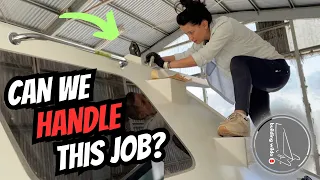
Installing Handles on our Boat – S04E05 | Building Wilda
Axel and Iuliana of Building Wilda engineer and install 316 stainless steel handrails on their Schionning Wilderness 1340 catamaran in Melbourne, mastering epoxy potting and hydraulic bending.
Galley Sink Installation on our boat – S04E04 | Building Wilda
Wilda is a Schionning Wilderness 1340 sailing catamaran. She is being finished in a shed outside Melbourne. Wilda will be powered by the Sun, the Wind and the Sea... This youtube channel is our way of sharing this project with friends, family and those interested in our adventure of building her a...
Bamboo Tables – Installation on our Boat (with Pedestal and Base) – S04E03 | Building Wilda
Wilda is a Schionning Wilderness 1340 sailing catamaran. She is being finished in a shed outside Melbourne. Wilda will be powered by the Sun, the Wind and the Sea... This youtube channel is our way of sharing this project with friends, family and those interested in our adventure of building her a...
Filling in the gaps…. S04E02 | Building Wilda
Wilda is a Schionning Wilderness 1340 sailing catamaran. She is being finished in a shed outside Melbourne. Wilda will be powered by the Sun, the Wind and the Sea... This youtube channel is our way of sharing this project with friends, family and those interested in our adventure of building her a...
NEW beginnings. UPDATES and short BOAT TOUR. BOAT WORK continues | S04E01 – Building Wilda
Wilda is a Schionning Wilderness 1340 sailing catamaran. She is being finished in a shed outside Melbourne. Wilda will be powered by the Sun, the Wind and the Sea... This youtube channel is our way of sharing this project with friends, family and those interested in our adventure of building her a...