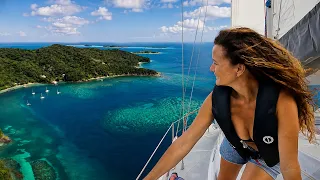
Outrunning Hurricane Season
As summer sets in across the tropical Atlantic, the vast weather nursery stretching from the Cape Verde islands to the eastern Caribbean awakens. For blue-water voyagers Beau and Brandy Burridge of Beau and Brandy Sailing, the change in season signals a non-negotiable maritime deadline. Aboard their cruising sailboat SV Saoirse, a classic 1971 Pearson 35 converted to all-electric propulsion, remaining in the central Caribbean past early summer invites severe risk. Low-pressure waves pulsing off the African continent rapidly organize over warm sea surface temperatures, transforming open passages into hazardous encounters with named storms. To safeguard their vessel, the crew initiated an urgent passage south toward the hurricane sanctuaries of the Dutch Leeward Antilles.
Escaping the Caribbean hurricane belt is rarely a simple downwind run. The passage requires meticulous navigational planning, tireless short-handed watchkeeping, and relentless windward work against prevailing trade winds and equatorial currents. As easterly waves develop on weather charts, every nautical mile gained south of 12° North latitude represents vital security against tropical cyclones. For Beau and Brandy, reaching the protected waters of Spanish Water, Curaçao, demanded rigorous seamanship, disciplined energy budgeting aboard their all-electric platform, and patience against persistent headwinds.
Meteorological Triggers and Atlantic Tropical Wave Analysis
When tropical waves begin marching off the western coast of Africa, mariners like Beau and Brandy of Beau and Brandy Sailing must make urgent strategic calculations aboard their cruising sailboat to safeguard against seasonal named storms in the Caribbean Sea and find safe harbor in Curaçao within the ABC Islands. Between June and November, the tropical Atlantic becomes an active atmospheric corridor. African easterly waves, generated by thermal contrasts over the Sahel and Sahara, track westward every three to five days. When these systems encounter sea surface temperatures exceeding 26.5°C and low vertical wind shear, they quickly organize into depressions, tropical storms, and hurricanes.
Meteorological vigilance is the cornerstone of offshore safety. Operating far offshore, the crew analyzed the American Global Forecast System (GFS) and the European Centre for Medium-Range Weather Forecasts (ECMWF). While GFS tends to predict rapid cyclonic development, ECMWF frequently provides superior precision regarding wave tracks and steering currents. By integrating daily GRIB files downloaded over satellite communication, the sailors tracked vorticity anomalies and moisture fields across the open ocean, determining when to press onward and when to seek temporary lee.
Offshore Routing Strategy South of the Twelfth Parallel
Navigating an escape corridor requires Beau and Brandy of Beau and Brandy Sailing to steer their cruising sailboat across the Caribbean Sea toward sanctuary in the ABC Islands and Curaçao before regional weather windows close. The primary geographic benchmark for Caribbean hurricane evasion is the twelfth parallel north. Most tropical cyclones recurve northwestward well before descending below 12°N, deflected by the Coriolis effect and the subtropical ridge. As a result, the ABC archipelago—comprising Aruba, Bonaire, and Curaçao—lies outside the traditional hurricane track, making its sheltered bays premier summer havens for international cruising yachts.
Reaching this sanctuary, however, imposes tactical compromises. Prevailing easterly trade winds sweep fiercely across the Caribbean basin, accompanied by a westward-setting current running up to two knots. To make southing and easting toward Curaçao, cruising vessels must continually claw their way against the elements. Beau and Brandy timed their passage around regional weather pauses, capitalizing on subtle clocking shifts in the wind field to lay tacks toward the south-southeast, racing against tropical waves gathering momentum in the Atlantic.
Passage Telemetry, Squall Tactics, and Anchorage Vitals
Careful telemetry logging allows Beau and Brandy of Beau and Brandy Sailing to monitor the structural and meteorological demands placed on their cruising sailboat as they transit the Caribbean Sea toward Curaçao and the ABC Islands. Managing an offshore passage requires constant attention to instrument telemetry, environmental shifts, and squall evasion protocols. The combination of squall dynamics and navigational waypoints dictates vessel safety throughout the passage.
| Operational Parameter | Observed Telemetry & Metrics | Tactical Action & Seamanship Standard |
|---|---|---|
| Passage Corridor | 650 to 850 Nautical Miles | Direct offshore transit routing south of 12°N latitude |
| Tropical Squall Bands | 35 to 45 Knot Gust Fronts | Early sail reefing, bearing away 25°, radar tracking |
| Average Vessel Speed | 5.2 to 6.4 Knots (VMG) | Balanced working sail plan under heavy trade-wind seas |
| Ocean Current Drift | 1.8 Knots Westerly Set | Compensating navigational heading to maintain track line |
| Electric Drive Reserve | 10kW Brushless Motor / 48V Stack | Harbor maneuvering and low-drag windward assistance |
| Spanish Water Ingress | 18 Feet Depth / Narrow Dogleg Channel | Daylight entry only, visual coral and channel buoy alignment |
| Anchorage Holding | 15 to 28 Feet Mud & Marl | Heavy rocna anchor, 5:1 chain scope, dual snubbers set |
The data recorded in the telemetry matrix underscores the operational realities of blue-water voyaging under tropical storm threats. Squalls in the southern Caribbean are sharp-edged; atmospheric pressure dips suddenly as downdrafts plummet from towering cumulonimbus clouds. By executing proactive sail reductions well before the gusts struck, the crew preserved rigging integrity and prevented excessive shock loads on the hull and deck hardware.
Short-Handed Seamanship and Electrical Power Balancing Under Sail
Managing grueling offshore watch schedules demands total discipline from Beau and Brandy of Beau and Brandy Sailing as they drive their cruising sailboat through the turbulent currents of the Caribbean Sea toward Curaçao and the ABC Islands. A two-person crew on an extended passage must operate like clockwork. Beau and Brandy adhered to a disciplined rotation, trading four-hour watches by day and three-hour watches by night. This cycle allowed the off-watch mariner to secure restorative sleep while ensuring an alert lookout remained on deck scanning the horizon for unlit vessels, shipping, and encroaching squall lines.
Onboard energy management presented an intricate balancing act. Aboard an all-electric vessel like Saoirse, the auxiliary drive relies on a 48-volt lithium battery bank rather than a diesel engine with an alternator. Underway, harvesting depends on the vessel’s custom articulating solar array. In direct sun, the panels generated 800 to 900 watts, comfortably covering the 400-watt domestic and navigational load—including autopilot, chartplotter, Starlink, and ventilation. Cloudy squall bands and overnight runs required disciplined power budgeting to protect battery reserves for harbor maneuvers.
Navigating Trade-Wind Squalls and Mechanical Challenges
Persistent windward beating through heavy trade-wind seas tests the physical endurance of Beau and Brandy of Beau and Brandy Sailing while guiding their cruising sailboat across the Caribbean Sea toward the ABC Islands and Curaçao. Beating to windward in steep chop is notoriously punishing on vessel and crew. With trade winds blowing steady at 18 to 22 knots and gusting higher in rain squalls, the Pearson 35 was pushed hard on repeated tacks. As the bow drove through turquoise swells, spray drenched the deck, demanding total trust in the vessel’s heavy centerboard construction.
Mechanical resilience is tested under such relentless loads. Having previously lost their folding propeller in Belize, the crew relied on a fixed two-bladed propeller affectionately dubbed ‘Nemo’ for emergency harbor propulsion. Because the small propeller could not power directly into heavy headseas, progress demanded pure sail power and relentless tacking. Additional challenges arose when pelagic sargassum seaweed choked trolling lines, while violent pitching during tacks caused the anchor chain to jam inside the forepeak locker, requiring Beau to untangle the rode before anchoring operations began.
Safe Harbor Arrival in Spanish Water, Curaçao
Clearing the final headland brings immense relief to Beau and Brandy of Beau and Brandy Sailing as they pilot their cruising sailboat into the protected lagoon of Spanish Water in Curaçao, safely south of the Caribbean Sea hurricane belt in the ABC Islands. The approach to Spanish Water is marked by the dramatic silhouette of Tafelberg rising above the arid coastline. The entrance channel is narrow and shallow, flanked by coral reefs that demand accurate visual pilotage and good daylight. Guiding the vessel through the serpentine inlet, the crew transitioned from rough ocean swells to a tranquil inland basin.
Spanish Water is recognized as one of the finest natural hurricane havens in the Caribbean basin. Enclosed by rolling hills, the lagoon offers complete shelter from ocean swells. Beau and Brandy guided their yacht into a quiet anchorage near Santa Barbara, dropping anchor into twenty feet of sticky holding mud. After backing down firmly to verify that the anchor had buried securely, they set chafe gear and dual nylon snubbers. With the vessel safely secured, the crew cleared customs in Willemstad, knowing they had outrun the impending hazards of the tropical storm season.
Frequently Asked Questions
For cruisers following Beau and Brandy of Beau and Brandy Sailing as they pilot their cruising sailboat across the Caribbean Sea toward Curaçao and the ABC Islands, these essential questions address the key requirements for hurricane season passage making.
The Atlantic and Caribbean hurricane season officially runs from June 1 to November 30 each year, with peak storm activity typically concentrated between mid-August and late October.
The Dutch ABC Islands (Aruba, Bonaire, and Curaçao) as well as Trinidad and Tobago are located south of 12° North latitude, placing them well outside the historical primary hurricane belt.
Mariners primarily utilize the European Centre for Medium-Range Weather Forecasts (ECMWF) and the American Global Forecast System (GFS), supplemented by National Hurricane Center (NHC) tropical outlooks and satellite-delivered GRIB files.
Crews prepare by tucking in early sail reefs before dark, actively monitoring marine radar for precipitation cores, running preventers to stabilize booms, and securing all below-deck gear against violent motions.
Arriving vessels must enter the marked channel in daylight, drop anchor in the designated anchorage zones of Spanish Water, and take local transport to Willemstad to complete customs and immigration clearance within 24 hours.
Most marine insurance underwriting policies mandate that vessels must remain south of 12°00’N or 12°30’N latitude between July 1 and November 1 to maintain coverage against named storm damage.
All-electric vessels rely on high-capacity lithium battery banks replenished by high-efficiency articulating solar arches, hydro-generators, and disciplined load shedding to preserve electrical reserves for essential navigation and harbor maneuvering.
Support Beau and Brandy Sailing
At WeBoating.com, we profoundly acknowledge the unwavering dedication that Beau and Brandy Sailing invests in crafting each and every video or voyage. Their passion for delivering exceptional ocean content shines through every frame, and it's a labor of love that deserves your attention.
We invite you to watch their captivating videos here and actively engage with their content, including their social media links above. Liking, commenting, and sharing their work goes a long way in fueling their creative fire.
We're also inviting you to explore the gear, sponsorships, and boat partnerships highlighted in the "Outrunning Hurricane Season" video description, or directly on YouTube. By engaging with these offerings or purchasing services and items, you directly support Beau and Brandy Sailing, their collaborators, and the brands they're associated with.
To ensure you never miss an offshore update, consider visiting their official YouTube Channel to subscribe, like, and join their community directly.
If you have any feedback, corrections, or additional information about Beau and Brandy Sailing or their videos, please use the comment form below to share your thoughts with us.
Thank you for being a part of our community and supporting the creators we cherish. Your time and support truly matter!
💙 GET THE EXTRAS 💙 For exclusive content, behind the scenes & live chats!
http://www.patreon.com/beauandbrandy
💙 MERCH 💙=-
https://sailingsaoirse.com/shop/
💙 WANT TO SUPPORT THE PRODUCTION 💙
One time Donation via Paypal: http://bit.ly/one-time-donation-bb
Be sure you are Subscribed: https://www.youtube.com/c/sailingsaoirse
Amazon Wishlist: https://bit.ly/beauandbrandywishlist
Enjoy the show!
Xoxo
B+B
We are Beau and Brandy. Since 2016, we’ve been living aboard full time and sailing on our all electric sailboat, Saoirse. She is a 1971 Pearson 35’.
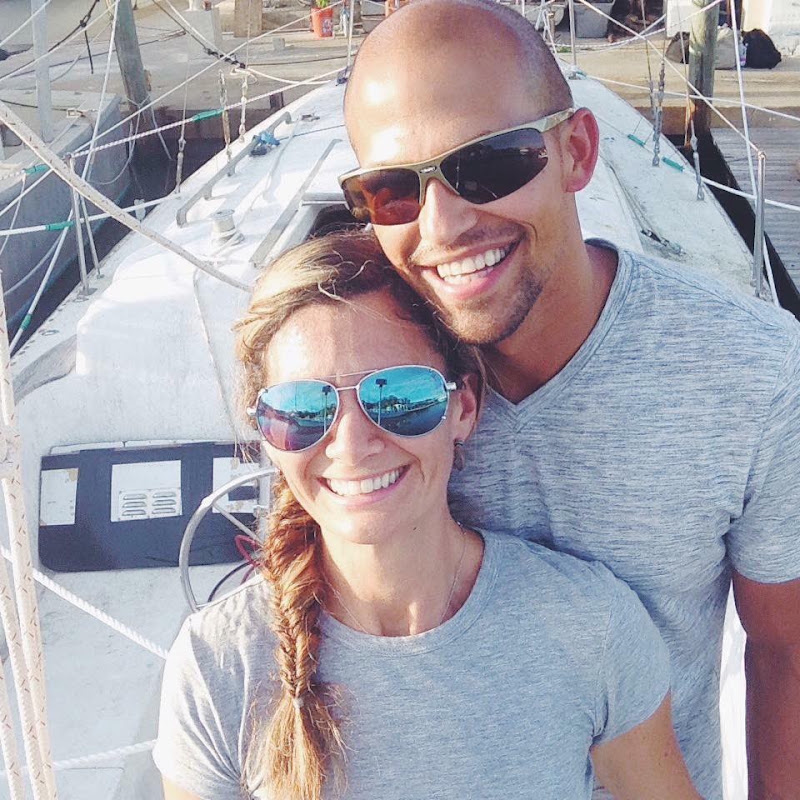
Beau and Brandy Sailing
Join Beau and Brandy of Beau and Brandy Sailing as they document their 2026 all-electric Caribbean odyssey aboard their self-converted Pearson 35, Saoirse.
Channel Information:
Social Media Links:
Outrunning Hurricane Season Location
- Spanish Water & Santa Barbara Anchorage, Curau00e7ao (12.0722,-68.8589)
- Road Town & Sir Francis Drake Channel, British Virgin Islands (18.4237,-64.6158)
Latest Episodes from Beau and Brandy Sailing
Explore the most recent voyages. Subscribe to the channel to never miss an update!
They Shutdown Customs without Warning
💙 GET THE EXTRAS 💙 For exclusive content, behind the scenes & live chats! 💙 MERCH 💙=- 💙 WANT TO SUPPORT THE PRODUCTION 💙 One time Donation via Paypal: Be sure you are Subscribed: Amazon Wishlist: Enjoy the show! Xoxo B+B We are Beau and Brandy. Since 2016, we’ve been living aboard full...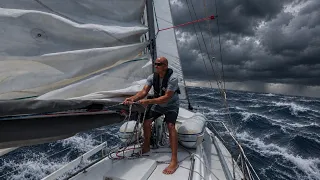
Outrunning Hurricane Season
Beau and Brandy navigate SV Saoirse through challenging Caribbean waters, escaping the hurricane belt on an offshore passage toward safety in the ABC Islands.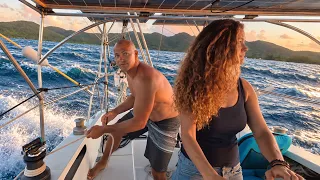
Every Mile From Here Gets Harder
💙 GET THE EXTRAS 💙 For exclusive content, behind the scenes & live chats! 💙 MERCH 💙=- 💙 WANT TO SUPPORT THE PRODUCTION 💙 One time Donation via Paypal: Be sure you are Subscribed: Amazon Wishlist: Enjoy the show! Xoxo B+B We are Beau and Brandy. Since 2016, we’ve been living aboard full...
We Came Here for the Water… Then This Happened | Sailing Honduras
💙 GET THE EXTRAS 💙 For exclusive content, behind the scenes & live chats! 💙 MERCH 💙=- 💙 WANT TO SUPPORT THE PRODUCTION 💙 One time Donation via Paypal: Be sure you are Subscribed: Amazon Wishlist: Enjoy the show! Xoxo B+B We are Beau and Brandy. Since 2016, we’ve been living aboard full...
Paradise Doesnt Have Everything
Thank you to Function Health for sponsoring this video! Visit or use code BEAUBRANDY25 at sign-up to own your health. The first 1000 get a $25 credit toward their membership. 💙 GET THE EXTRAS 💙 For exclusive content, behind the scenes & live chats! 💙 MERCH 💙=- 💙 WANT TO SUPPORT THE PRODUCT...