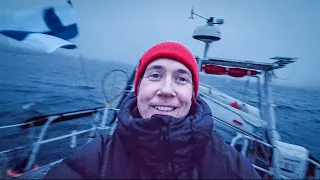
Dodging Icebergs In Greenland Is Fun Until It Isn't
Tied alongside a heavy steel workboat barge in the harbor of Qaqortoq on the southwest coast of Greenland, the expedition crew aboard Alluring Arctic Sailing readied their Garcia Nouanni 43 cutter Lumi for sea. The rugged barge served local sheep farms, hauling livestock and heavy machinery through the fjords toward the slaughterhouse each autumn, while a ramp door gave direct dockside access to Lumi’s deck. After filling water tanks, loading provisions, and stowing supplies for a passage estimated at 3 to 4 weeks toward Iceland, four crew members prepared to head south toward Prince Christian Sound and Europe.
Departure from Qaqortoq brought immediate excitement mixed with the uncertain reality of high-latitude passage planning. As the lines were cast off, the crew faced the winding channels ahead. Discussing their immediate course, Guido remarked honestly: “Where we are going to, I don’t know.” Once underway, the vessel motored into heavy coastal banks where navigation quickly demanded constant vigilance.
Restricted Inner Channels and Dense Arctic Fog
Entering the protected inner channels of southern Greenland, cold mist closed in rapidly, cutting visibility down to roughly 100 meters. Massive icebergs drifted across the narrow fairways, including a substantial frozen block that choked the primary passage, leaving only a tight sliver of open water between grounded ice and the rocky shore. The crew held Lumi steady in mid-channel, scanning the gray fog bank where towering ice formations remained invisible until the vessel drew near.
While small bits of bergy water posed little structural danger in calm air, larger bergs required continuous radar tracking. Underway, daily shipboard routines continued around the helm, from wool socks paired with Crocs on deck to pots of hot red curry simmering in the galley. As Lumi approached the anchorage near the island hot springs, heavy rain set in for the first time all summer, complicating an already delicate approach among shifting ice.
Low-Water Docking and Thermal Pools at Uunartoq Island
Finding a safe overnight hold at Uunartoq Island proved challenging. With no steady breeze to pin the ice in place, shifting tidal currents threatened to push massive icebergs directly into the anchorage. Juho weighed the danger of dropping hook in the bay, cautioning: “The problem is the water is going to go down like 2 m.” To avoid an iceberg snagging their anchor chain overnight, the crew elected to bring Lumi alongside the small wooden pier instead.
Tidal drop presented its own hazards. At low water, the depth off the pier receded to roughly a meter of water, leaving a clearance of only 30 to 40 centimeters beneath Lumi’s hull. The vessel’s centerboard configuration made the stop feasible, requiring only 20 centimeters of water beneath the forward 2 meters of the bow. As Juho observed after securing the dock lines: “Good to have a centerboard boat because this wouldn’t be possible otherwise.”
Before taking shelter from the rain, Juho rigged a wing foil to catch a localized squall across the cove. Afterward, the crew walked inland across the uninhabited island toward the natural thermal pools. Unlike the sulfuric springs of Iceland, the water at Uunartoq bubbled clear and completely odorless directly from the ground. Soaking in the third thermal pool overlooking the ice-strewn fjord, Juho noted: “I feel it’s like a really good temperature cuz in Iceland a lot of the hot springs are like too hot.” The crew relaxed with a strict ration of 4 beers per person before retreating aboard as the evening tide ebbed.
Harbor Defenses and Historic Relics at Nanortalik
Continuing southward, Lumi reached Nanortalik, Greenland’s southernmost major town, known in Greenlandic as the place of polar bears. The approach brought sunny skies and warmer summer temperatures, but entering the small craft harbor required careful piloting. A barrier of surface buoys and a submerged cable spanned the harbor entrance, engineered to keep drifting icebergs out of the basin while restricting passage to craft drawing under 1 meter.
Ashore, the crew explored relics from the region’s historic whaling past. Two large cast-iron blubber pots remained preserved on the shoreline, where oil was rendered before the global extraction of subterranean petroleum. While commercial whaling historically devastated local populations of gray and white whales, Nanortalik now stands as a rugged outpost known for extreme coastal katabatic gales.
High-Speed Fog Navigation and Submerged Growlers
Departing Nanortalik to resume the passage toward Iceland, coastal tranquility dissolved into thick maritime fog. Just outside the harbor, the crew spotted a dense growler whose submerged blue mass plunged 4 to 5 meters beneath the surface. Juho warned of the structural threat: “This is exactly the size of a small growler that you don’t want to run into while crossing from Greenland to Iceland.” At speeds of 4 to 5 knots, a direct collision with such dense ice could severely compromise an offshore hull.
As the wind built, Lumi accelerated to a steady 7 knots on a broad reach through blinding whiteout. Autopilot navigation became hazardous; watchstanders retained only 3 to 4 seconds to visually identify an unmapped block of ice, disengage the helm drive, and alter course. While broadband radar painted major icebergs at ranges of 300 meters, smaller hard growlers remained undetectable beneath surface clutter. To regain control in strengthening gusts, the crew aggressively shortened canvas until the working sail area was trimmed down. Juho reported: “We reduced it all the way down to a handkerchief.” Even under the heavily reefed scrap of cloth, Lumi maintained 5 knots through the fog-bound archipelago.
| Operational metric | Recorded value |
|---|---|
| Onboard crew | 4 persons |
| Passage duration to Iceland | 3 to 4 weeks |
| Minimum visual range in fog | 100 meters |
| Pier low tide drop | 2 meters |
| Hull water clearance at low water | 30 to 40 centimeters |
| Bow forward minimum draft | 20 centimeters |
| Submerged ice growler depth | 4 to 5 meters |
| Critical hull collision threshold | 4 to 5 knots |
| Radar iceberg detection range | 300 meters |
| Autopilot ice avoidance window | 3 to 4 seconds |
| Vessel speed under storm canvas | 5 knots |
| Vessel speed reaching in fog | 7 knots |
Frequently Asked Questions
The crew tied alongside the heavy barge in Qaqortoq because it offered direct door access to the deck while loading provisions for a 3 to 4 week voyage to Iceland, sharing harbor space with equipment used for autumn sheep roundups.
SV Lumi utilized its lifting centerboard design to moor alongside the shallow pier, floating safely with only 30 to 40 centimeters of water beneath the hull and requiring only 20 centimeters of water under the forward 2 meters of the bow.
Unlike the sulfur-heavy hot springs in Iceland, the thermal pools on Uunartoq Island are completely odorless and maintain a comfortable bathing temperature directly overlooking floating icebergs in the fjord.
The harbor entrance at Nanortalik is fitted with surface buoys securing a submerged cable that physically blocks icebergs from entering, restricting access to boats drawing less than approximately 1 meter.
Growlers can extend 4 to 5 meters underwater without showing up on marine radar, giving watchstanders sailing at 7 knots only 3 to 4 seconds of visual warning to turn off the autopilot and steer clear of an impact.
Support Alluring Arctic Sailing
At WeBoating.com, we profoundly acknowledge the unwavering dedication that Alluring Arctic Sailing invests in crafting each and every video or voyage. Their passion for delivering exceptional ocean content shines through every frame, and it's a labor of love that deserves your attention.
We invite you to watch their captivating videos here and actively engage with their content, including their social media links above. Liking, commenting, and sharing their work goes a long way in fueling their creative fire.
We're also inviting you to explore the gear, sponsorships, and boat partnerships highlighted in the "Dodging Icebergs In Greenland Is Fun Until It Isn't" video description, or directly on YouTube. By engaging with these offerings or purchasing services and items, you directly support Alluring Arctic Sailing, their collaborators, and the brands they're associated with.
To ensure you never miss an offshore update, consider visiting their official YouTube Channel to subscribe, like, and join their community directly.
If you have any feedback, corrections, or additional information about Alluring Arctic Sailing or their videos, please use the comment form below to share your thoughts with us.
Thank you for being a part of our community and supporting the creators we cherish. Your time and support truly matter!
New print sale! Get 10% off all my photo prints at http://art.alluringarctic.com until October 13th. I’ve added new photos from this summer in Greenland along with some returning favorites. Every order directly helps me keep making these videos and goes towards our future adventures!
Thanks for watching!
Not into the prints? You can support at http://patreon.com/alluringarctic or at https://www.alluringarctic.com/support
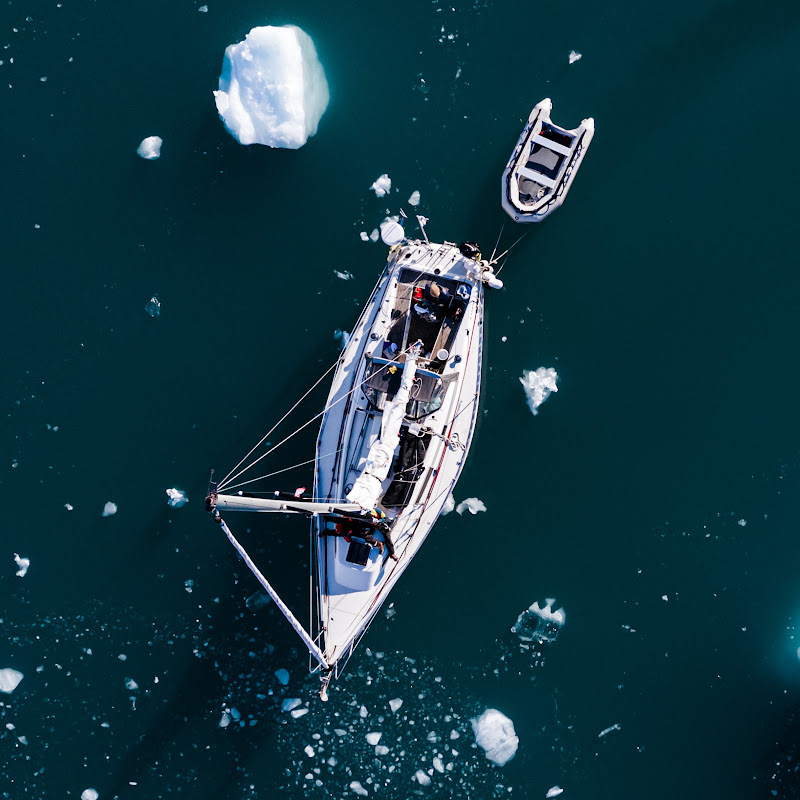
Alluring Arctic Sailing
Join Juho and Sohvi of Alluring Arctic Sailing as they document their high-authority 2026 Arctic odyssey aboard their aluminum Garcia Nouanni 43, Lumi.
Channel Information:
Social Media Links:
Dodging Icebergs In Greenland Is Fun Until It Isn't Location
- Qaqortoq, Greenland (60.7183,-46.0358)
- Uunartoq Hot Springs, Greenland (60.5075,-45.3336)
- Nanortalik Harbor, Greenland (60.1428,-45.2417)
Latest Episodes from Alluring Arctic Sailing
Explore the most recent voyages. Subscribe to the channel to never miss an update!

Across the North Atlantic from Iceland to the Faroe Islands
Juho Karhu navigates SV Lumi on a 380-nautical-mile passage from Iceland to the Faroe Islands, battling confused North Atlantic seas and strong tides.
Sailing from Greenland to Iceland Across the North Atlantic
Juho Karhu and crew make a 600-mile North Atlantic passage from Greenland to Iceland aboard SV Lumi, dealing with icebergs, fog, a total electrical blackout from a stuck starter key, and docking in the volcanic Westman Islands.
Sailing This Insane Shortcut THROUGH Greenland
Juho Karhu and his crew dodge open-ocean icebergs, test polar bear defenses, and battle adverse tides through Greenland's Prince Christian Sound (Ikeraswak) before docking alongside a Fin Sailor 34 at an abandoned World War II weather station.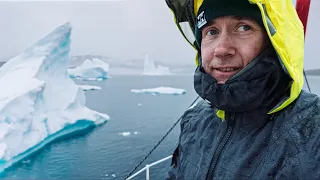
Dodging Icebergs In Greenland Is Fun Until It Isn’t
Moored to a livestock barge in Qaqortoq, SV Lumi readies for departure south toward Cape Farewell, dodging drifting icebergs in dense fog and stopping at Uunartoq.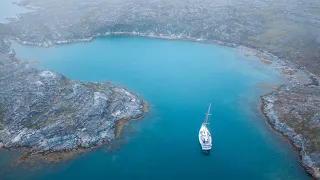
Squeezing Into an Impossibly Tiny Cove (Greenland)
New print sale! Get 10% off all my photo prints at until October 13th. I’ve added new photos from this summer in Greenland along with some returning favorites. Every order directly helps me keep making these videos and goes towards our future adventures! Thanks for watching! Not into the prints? ...