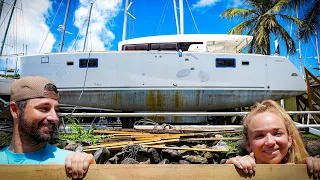
BOATS and HOSE...Clamps | Ep.107
On the hard at Spice Island Marine Services in Grenada, Rafael “Raff” Echemendia and Sascha Meyers of Spear It Animal face a packed slate of technical refit projects before preparing their monohull for sale. Inside the head, a series of gelcoat patches over structural epoxy fiberglass repairs have failed to cure, remaining tacky to the touch and stalling the installation of newly built bathroom countertops. Rather than letting the setback stall the shipyard work, the crew pivots between topside fiberglass painting, stainless deck hardware resealing, and chemical descaling of the vessel’s diesel cooling loop.
Working in the tropical heat of the southern Caribbean as hurricane season draws toward its close, the pair balances intricate chemistry with brute-force mechanical troubleshooting. With local marine supply stores closed for a holiday in Grenada and daily rain squalls rolling across the boatyard, every project demands ingenuity, salvaged fittings, and methodical patience.
Troubleshooting Uncured Gelcoat over Epoxy Fiberglass
The interior refit hit an immediate roadblock when a dozen gelcoat repair spots inside the head and walk-in shower refused to harden. While the gelcoat cured normally against neighboring factory polyester surfaces, every patch placed over recent epoxy fiberglass lamination remained soft enough to scrape away with a fingernail. The crew diagnosed the failure as an interaction with amine blush, a waxy, water-soluble byproduct that migrates to the surface during epoxy curing and inhibits free-radical polyester polymerization.
“For some reason, the gelcoat anywhere we did a little fiberglass patch did not dry on top of that fiberglass. It only dried on top of the existing gelcoat.”
— Rafael Echemendia
To eliminate surface contamination, the crew scrubbed each repair zone with fresh water to dissolve water-soluble amine salts before following with an alcohol wipe. Rather than risking all twelve areas at once, Sascha recommended testing a single countertop section. Raff custom-tinted TotalBoat waxed gelcoat to match the weathered hull laminate, adding subtle drops of yellow for warmth and minute specks of brown pigment on toothpicks before catalysing the batch with 17 drops of methyl ethyl ketone peroxide (MEKP) to promote a rapid cure.
After allowing the patch to cure overnight, initial dry sanding across 320, 600, 800, 1000, and 1500 grit sandpaper appeared promising. However, cleaning the sanded area with alcohol revealed the underlying truth: the gelcoat came away in gummy chunks rather than fine composite dust. Following consultations with technical representatives at TotalBoat, the team identified two viable solutions: applying a barrier coat of two-part epoxy primer such as TotalProtect prior to gelcoat, or grinding out the epoxy entirely to rebuild the laminate using polyester resin.
Restoring the Deck Dock Box in Tropical Squalls
Up on deck, a custom fiberglass dock box required complete refinishing. Cut down and bonded to the cabin top five years earlier, the box had suffered heavy chalking and peeling paint under continuous tropical sun exposure. Wind had caught an unlatched lid during past passages, tearing the rivets from its mounting hinges and leaving the enclosure unhinged.
The restoration required systematic surface preparation:
- Disassembling the damaged stainless steel hinges and unfastening hardware.
- Leveling deteriorated coatings across flat sections using an orbital palm sander loaded with 320 grit abrasive paper.
- Scrubbing tight corners and molded recesses by hand to eliminate loose paint edges.
- Applying a two-stage wash with de-waxer and surface prep solvent, wiping and cleaning repeatedly to lift trapped sanding dust and oily residue.
- Perimeter masking with blue tape along deck boundaries to preserve adjacent gelcoat.
With local chandleries closed for a holiday in Grenada, the crew lacked high-density foam rollers. Working with short-nap rollers, Raff thinned TotalBoat Wet Edge topside paint—a one-part polyurethane coating—using mineral spirits on a digital scale. By blending 0.75 ounces of mineral spirits into 10 ounces of paint, he achieved a 7 percent reducer mixture that enabled the enamel to flow out smoothly without orange peel texture.
Although sudden rain showers interrupted the drying cycle of both the first and second coats, the polyurethane finish cured hard without moisture spotting. For the third and final application on the heavily weathered lid, the crew unfastened the panel and moved it into shaded shelter below deck, avoiding the need to battle wind-whipped tarps in the boatyard.
Polishing and Re-Bedding Deck Stanchions
Water intrusion around perimeter deck penetrations prompted a complete overhaul of the vessel’s lifeline stanchions. Leaking fasteners had allowed rainwater to weep down interior bulkheads, staining cabin cabinetry and softening plywood backing plates. With lifelines dismantled, Raff restored each stainless steel stanchion base plate using a pneumatic die grinder equipped with polishing pads and metal compound, cutting through oxidation until the metal achieved a mirror finish.
Rebedding required coordinated teamwork between deck and cabin. After cleaning fastener holes and degreasing mating surfaces with alcohol, Raff applied generous beads of 3M 4200 polyurethane sealant around the base flanges and through-bolt holes. The crew deliberately selected UV-resistant 4200 over permanent 3M 5200 adhesive, ensuring the hardware can be disassembled for future servicing without tearing core laminate.
“Tell you what, if I ever buy a boat, if I see in the title stanchions were just caulked, I don’t care however much it costs, it’s worth it.”
— Rafael Echemendia
Down below, Sascha squeezed into cramped interior lockers, maneuvering wrenches over awkward 1/4-inch plywood reinforcement strips to secure backing nuts while Raff held bolt heads stationary on deck. Cleaning accumulated grime from the fastener threads proved essential, allowing nuts to spin smoothly into place and ensuring adequate torque across the sealing flange.
Descaling the Yanmar Diesel Raw Water Cooling Loop
As darkness fell over Spice Island Marine, attention turned to preventative propulsion maintenance on the auxiliary engine: a Yanmar 4JH4HTE 110-horsepower turbocharged marine diesel. Over months of tropical cruising, seawater deposits, mineral scale, and marine growth accumulate inside the cooling circuits, restricting heat transfer and threatening engine overheating. To dissolve the buildup without dismantling the heat exchanger, the crew prepared a chemical flush using Barnacle Buster concentrate mixed at a 1:4 ratio with fresh water (two parts concentrate combined with eight parts water in a plastic bucket).
Constructing a closed circulation loop required creative plumbing improvisation from spare boatyard inventory:
“Basically, when it comes to plumbing, you need five boxes of random parts, pumps, adapters, and fittings because out of those five boxes, you will find three random fittings that will make something work one day.”
— Rafael Echemendia
The team assembled a standalone 12-volt circulation pump rated at two and a half gallons per minute. Connecting the pump’s 3/4-inch outlet to the engine’s 1-1/4-inch raw water intake hose required stepping through an inline filter and adapting to an salvaged 1-5/16-inch PVC bilge pump adapter wrapped in Teflon tape. Raff applied controlled heat from a heat gun to soften the stiff, wire-reinforced intake hose before seating the fitting.
While cinching down the plumbing, an old hose clamp sheared under torque, reinforcing an essential blue-water safety standard: every hose connection below the waterline requires dual hose clamps. Powering the circulation pump presented another field challenge; with no dedicated bench supply nearby, the crew connected alligator clips directly to heavy 4/0 battery cables at the alternator and engine block ground.
When the pump failed to push fluid through the engine block, the crew identified two issues. The initial wiring had run the pump in reverse, and once reversed, the flexible vanes of the engine’s raw water pump impeller blocked fluid flow. Raff dismantled the pump cover plate, sliced through the compressed rubber vanes of the spent impeller with a razor knife, and extracted the core. With the impeller cavity cleared, the little 12-volt pump established a steady flow through the cooling passages.
Sealing the Cooling Loop and Freshwater Flushing
During the early stages of circulation, the crew noticed the chemical level in the supply bucket steadily diminishing. Tracing the engine’s cooling lines revealed the cause: an auxiliary cooling hose branching off the aftercooler and heat exchanger fed lubricating seawater directly into the propeller shaft seal, allowing the acid solution to drain overboard into the yard. Raff clamped and kinked the shaft seal supply hose, sealing the closed loop and containing the Barnacle Buster solution.
The chemical mixture circulated continuously through the cylinder block and heat exchanger for two hours. When inspected under boatyard lights, the effluent exhibited only a mild yellow tint rather than dark marine residue, indicating that regular freshwater flushing had kept the Yanmar internal passages relatively clean. To neutralize the acid and protect delicate copper-nickel heat exchanger tubes, the crew disconnected the suction line and flushed five consecutive buckets of fresh water through the engine, unkinking the shaft line to ensure every circuit was thoroughly rinsed.
Working until midnight, Raff lubricated and seated a brand-new raw water pump impeller, torqued the front cover plate, and reconnected all reinforced cooling hoses. With the Yanmar cooling circuit fully restored, the deck stanchions watertight, and the topside dock box gleaming under fresh polyurethane paint, the crew completed the day’s maintenance push before departing for the Fort Lauderdale Boat Show.
Technical Refit & Maintenance Specifications
| Component / System | Technical Specification | Operational Detail |
|---|---|---|
| Propulsion Unit | Yanmar 4JH4HTE | 110-horsepower turbocharged marine diesel engine |
| Descaling Solution | Barnacle Buster Concentrate | 1:4 dilution ratio (2 parts chemical to 8 parts fresh water) |
| Flushing Pump | 12-volt auxiliary pump | Two and a half gallons per minute circulation flow rate |
| Circulation Duration | 2 hours runtime | Closed-loop descaling followed by 5 buckets fresh water flush |
| Deck Enclosure Paint | TotalBoat Wet Edge | One-part polyurethane thinned 7 percent with mineral spirits |
| Deck Hardware Bedding | 3M 4200 | UV-resistant polyurethane sealant on polished stanchion bases |
| Laminate Sanding Steps | Silicon carbide abrasives | Progressive grit sequence: 320, 600, 800, 1000, and 1500 |
Frequently Asked Questions
The gelcoat remained soft because amine blush—a water-soluble oily byproduct that surfaces during epoxy curing—inhibited the polyester gelcoat reaction, requiring an epoxy primer barrier coat like TotalProtect or a total grind-out to bare laminate.
Because marine supply stores were closed, the crew blended 0.75 ounces of mineral spirits into 10 ounces of TotalBoat Wet Edge one-part polyurethane paint, establishing a 7 percent reducer mixture to ensure smooth leveling without orange peel texture.
The crew mixed Barnacle Buster concentrate at a 1:4 ratio with fresh water (combining two parts chemical concentrate with eight parts fresh water) to flush salt scale and marine growth from the Yanmar 4JH4HTE cooling loop.
Chemical solution drained out because an auxiliary cooling hose branching from the heat exchanger and aftercooler fed directly into the propeller shaft seal, spilling fluid onto the ground until the line was kinked and clamped shut.
The crew selected 3M 4200 polyurethane sealant because it provides high UV resistance and a watertight deck seal without the permanent bonding strength of 3M 5200, allowing stanchions and fasteners to be removed for future maintenance.
Book a trip where this was filmed — near Grenada





Support Spear It Animal
At WeBoating.com, we profoundly acknowledge the unwavering dedication that Spear It Animal invests in crafting each and every video or voyage. Their passion for delivering exceptional ocean content shines through every frame, and it's a labor of love that deserves your attention.
We invite you to watch their captivating videos here and actively engage with their content, including their social media links above. Liking, commenting, and sharing their work goes a long way in fueling their creative fire.
We're also inviting you to explore the gear, sponsorships, and boat partnerships highlighted in the "BOATS and HOSE...Clamps | Ep.107" video description, or directly on YouTube. By engaging with these offerings or purchasing services and items, you directly support Spear It Animal, their collaborators, and the brands they're associated with.
To ensure you never miss an offshore update, consider visiting their official YouTube Channel to subscribe, like, and join their community directly.
If you have any feedback, corrections, or additional information about Spear It Animal or their videos, please use the comment form below to share your thoughts with us.
Thank you for being a part of our community and supporting the creators we cherish. Your time and support truly matter!
Get a free 8-count Sample Pack of LMNT’s most popular drink mix flavors with any purchase at http://drinklmnt.com/sia
🎥 Video Explaing our Boat Situation ⬇️-
https://www.youtube.com/watch?v=JRKwfJzmJks
🎥 Video showing how it's suppose to be possible to Gelcoat over Epoxy- (to be fair, we didn't wait a week like they did in this video so it still may be possible with the proper prep and time)- check it out and let us know where we went wrong!⬇️
https://www.youtube.com/watch?v=UUxzWEAZ8Vs&t=610s
💙💚 Become a Patron!- https://www.patreon.com/Spearitanimal
👕 MERCH- https://www.spearitanimals.com/shop
💻 WEBSITE: https://www.spearitanimals.com
📸 INSTAGRAM: https://www.instagram.com/spear_it_animal/
📹 FACEBOOK: https://web.facebook.com/spearitanimal?_rdc=1&_rdr
#restoration #renovation #sailing #boating #refit

Spear It Animal
Join Raff and Sascha of Spear It Animal as they document their high-authority 'Hurricane Resurrection' project: Rebuilding a capsized Lagoon 450S from the hull up.
Channel Information:
Social Media Links:
BOATS and HOSE...Clamps | Ep.107 Location
- Spice Island Marine Services, True Blue, Grenada (12.0075,-61.765)
Latest Episodes from Spear It Animal
Explore the most recent voyages. Subscribe to the channel to never miss an update!
BOATS and HOSE…Clamps | Ep.107
At Spice Island Marine Services in Grenada, Raff and Sascha tackle raw water descaling on their Yanmar diesel, troubleshoot uncured gelcoat patches over epoxy, roll and tip the deck dock box, and re-bed leaking lifeline stanchions.
The Refit BEFORE the Refit…All This Work Just to Say Goodbye! | Ep.106
At the Spice Island boatyard in Grenada, Raff and Sascha Echemendia pause preparations on their hurricane-damaged catamaran to complete an extensive master bathroom refit on their 2006 Beneteau Cyclades 50, SV Dead Dolphin, prior to its sale.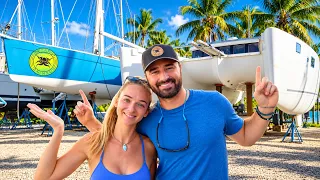
Two Boats One Yard 🛠️ | Ep.105
Rafael Raff Echemendia and Sascha Meyers manage a dual vessel boatyard refit in Florida, overhauling running gear, windlass motors, and structural composites.
The Truth about the GIVEAWAY…What Happened & What’s Next? l Ep. 104
Get a free 8-count Sample Pack of LMNT’s most popular drink mix flavors with any purchase at ⛵️ Link to the Boat Listing!- 💙💚 Become a Patron!- 👕 MERCH- 💻 WEBSITE: 📸 INSTAGRAM: 📹 FACEBOOK: