It Took 4 Years…But We Now Have ? | Product Review | Sailing Zephyr
Aboard the Beneteau Oceanis 43 Zephyr, James and Natalie unboxed an essential piece of refrigeration gear that they had sailed without for four continuous years: a SetPower TC75 portable dual-zone fridge and freezer. Having completed two Atlantic crossings and cruised through the Mediterranean, Caribbean, Panama, and Colombia relying on minimal cold storage, the crew of Sailing Zephyr brought the 75-liter unit onto the vessel to evaluate its real-world cooling performance, daily power draw, and sea-going durability.
For a crew accustomed to cruising without onboard ice, the arrival of dedicated cold compartments marked a substantial practical upgrade in their galley logistics. Having endured years of warm provisions in tropical anchorages, the ability to store frozen provisions and produce chilled goods transformed daily routines aboard the yacht while preparing for upcoming offshore passages.
Dual-Zone Capacity and Reversible Lid Configuration
The unboxed TC75 model provides 75 liters of internal volume arranged in a dual-zone layout, allowing the crew to operate separate fridge and freezer zones or configure both compartments as dedicated freezers. Natalie highlighted the modular lid construction, pointing out: “These Lids are actually reversible you can lift this lid up detach it turn it around if you want the lid to be opening from the opposite side.”
Weighing 48 pounds or 22 kilos empty, the unit incorporates an easy-lift closing mechanism and built-in interior illumination on either side that activates when the compartments are opened. The digital control panel displays temperatures in both Celsius and Fahrenheit, enabling the compressor system to pull internal temperatures down to -18 degrees Celsius or 0 degrees Fahrenheit.
Electrical Power Consumption and Marine Compatibility
Managing energy reserves remains a central operational priority aboard Zephyr. When actively maintaining steady interior temperatures, the unit draws approximately half an amp, consuming around 70 watts during normal operation. The unit is supplied with a dedicated 12-volt or 24-volt DC power cable alongside an AC-to-DC power adapter, providing flexible electrical connections between battery banks and shore connections.
The durable plastic housing offers sufficient structural strength to double as auxiliary cabin seating when needed. With dog Flint resting alongside the newly installed equipment, the crew noted that the reliable cooling performance fulfilled a foundational liveaboard necessity that the vessel had lacked across multiple long-distance ocean voyaging routes.
Tie-Down Limitations and Nighttime Controls
Despite positive initial impressions, James detailed several practical design constraints encountered during boat installation. Examining the chassis, James explained: “for me probably the biggest con is the handles or should I say lack of handles on the side of the unit.” The molded exterior recesses offer minimal purchase, and James stressed that “not being able to thread something through the handles to secure the unit down is a bit disappointing.”
Securing heavy equipment against violent vessel motions at sea requires dependable lashings, presenting a challenge that the crew must resolve prior to open-water passages. Additionally, James noted the absence of an included insulating transit cover for tropical sun protection, as well as unlit adjustment buttons that force the watchstander to adjust temperature settings and toggle between Max and Eco modes by memory in darkness.
| Specification | Metric or Feature | | – | – | | Capacity | 75 liters (with 65-liter model alternate) | | Empty Weight | 48 pounds (22 kilos) | | Power Consumption | Half an amp (around 70 watts) | | Cooling Range | Down to -18 Celsius (0 Fahrenheit) | | Power Inputs | 12-volt or 24-volt DC plus AC adapter |
Frequently Asked Questions
The unit provides 75 liters of internal dual-zone storage and weighs approximately 48 pounds or 22 kilos, while SetPower also manufactures an alternate 65-liter model.
While maintaining target temperature aboard the sailboat, the unit draws approximately half an amp or around 70 watts.
The TC75 is supplied with a 12-volt or 24-volt DC power cable alongside an included AC-to-DC power adapter.
James noted shallow molded side handles that prevent threading tie-down straps to secure the unit against boat motion, a lack of an insulating cover, and buttons that lack backlighting at night.
Book a trip where this was filmed — near Vancouver



Support Sailing Zephyr
At WeBoating.com, we profoundly acknowledge the unwavering dedication that Sailing Zephyr invests in crafting each and every video or voyage. Their passion for delivering exceptional ocean content shines through every frame, and it's a labor of love that deserves your attention.
We invite you to watch their captivating videos here and actively engage with their content, including their social media links above. Liking, commenting, and sharing their work goes a long way in fueling their creative fire.
We're also inviting you to explore the gear, sponsorships, and boat partnerships highlighted in the "It Took 4 Years…But We Now Have ? | Product Review | Sailing Zephyr" video description, or directly on YouTube. By engaging with these offerings or purchasing services and items, you directly support Sailing Zephyr, their collaborators, and the brands they're associated with.
To ensure you never miss an offshore update, consider visiting their official YouTube Channel to subscribe, like, and join their community directly.
If you have any feedback, corrections, or additional information about Sailing Zephyr or their videos, please use the comment form below to share your thoughts with us.
Thank you for being a part of our community and supporting the creators we cherish. Your time and support truly matter!
Sailing Zephyr
James and Natalie: The Australian duo who traded desk jobs for a 20,000 NM odyssey, currently navigating a major vessel transition after a project-defining 13-month hiatus.
Channel Information:
Social Media Links:
It Took 4 Years…But We Now Have ? | Product Review | Sailing Zephyr Location
- Burrard Inlet, North Vancouver, British Columbia, Canada (49.321094,-123.1451082)
Latest Episodes from Sailing Zephyr
Explore the most recent voyages. Subscribe to the channel to never miss an update!
We Finally Fixed the Worst-Looking Part of Our Boat Ep. 277
After months of projects, upgrades, and hard work, Zephyr 2.0 is finally starting to become the boat we’ve always dreamed of. This episode takes us to the Bahamas where James tackles one of the biggest transformation projects yet. Out goes the tired old lazy bag and in comes a beautiful new custom ...
We Somehow Made It To The Bahamas…Then The Boat Work Started – Ep.276
In our last episode we splashed the boat and moved her to a new marina… and now somehow we’re already in the Bahamas?! Things moved fast after that. My dad flew out to help James bring our new catamaran all the way from a freezing North Carolina down to the Bahamas. Unfortunately the cameras didn’t...
Our New Boat Finally Hits The Water – Ep. 275
After weeks of preparation, stress, and problem-solving, our new Fountaine Pajot Venezia 42 finally goes back in the water for the very first time. In this episode, James prepares the boat for launch day, checks the systems once she splashes, and attempts the first proper move to a new marina… even...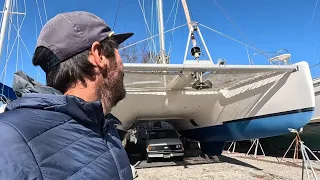
The Reality of Getting This Boat Ready – Ep. 274
After 13 months away from sailing, stepping back into boat life has been a lot more intense than expected. In the last episode, we shared our return to YouTube after selling our Beneteau Oceanis 43 and buying an older boat in hopes of building a more sustainable future on the water. But the realit...
We Disappeared For 13 Months…Then This Happened – Sailing Zephyr – Ep. 273
After 13 months away from Youtube and life at sea, we are finally back.....and heaps has changed. We didn't plan to be gone this long, yet stepping away from sailing has turned into a much bigger pause than expected. Over the past year we sold out Beneteau Oceanis 43, stepped back from life...