🔴 LIVE - Sailing Around The World Without Stopping [Day 41]
Underway across the South Pacific Ocean on day 41 of his solo nonstop circumnavigation, Oliver Widger guides the cutter-rigged Pacific Seacraft 40 Phoenix do Mar through moderate offshore swells near 11 degrees south latitude. The easing conditions offer a welcome reprieve after three or four relentless days of violent slamming into head seas, where structural impacts shuddered through the hull every five minutes. The sudden calm allows Widger to survey mechanical systems, monitor standing rigging, and confirm a major milestone in boat maintenance: “The bilge pump is fixed.”
The bilge issues began earlier in the voyage when seawater leaked past the forward anchor locker, cascading down into the vessel’s lowest compartments. The influx stirred up remnant fiberglass grit, wire clippings, and construction dust left behind from months of refit labor. After multiple cycles of clearing clogs and flushing the bilges with clean seawater, Widger reports that the accumulated shipyard debris has finally washed out of the suction lines, leaving the primary electric pumping system clear and dependable ahead of higher-latitude routing.
Deck Aerodynamics and Structural Inspections
Sailing close-hauled under a single-reefed mainsail and a partially furled genoa, Phoenix do Mar tracks steadily across the tropical swells. Widger deliberately de-powers the sail plan to protect the rig from unexpected squall bursts while maintaining an active sea-kindly pace. Explaining his conservative sail configuration, Widger remarks, “I reduce the sails to a point where the boat is almost underpowered.” This cautious approach ensures that when trade wind gusts barrel through during off-watch intervals, the heavy-displacement cutter holds course without rounding up or stressing masthead fittings.
An unusual acoustic phenomenon has accompanied the vessel throughout the day. A resonant, whistling vibration radiates from the rig whenever the apparent wind strikes at specific angles. Tracing the sound aloft, Widger determined that airflow across an open aperture at the boom’s aft fitting acts like a flute. As he describes the aerodynamic harmonic, “That hum is from the opening at the end of the boom and the wind that’s crossing over it is making that hum.”
The physical demands of offshore solo navigation have also left physical marks on the skipper. Widger continues to manage a painful injury along the lateral edge of his foot sustained several days prior, though he confirmed his joint mobility remains functional. Assessing the injury with pragmatic detachment, he observes, “My ankle is pretty much totally fine. My foot I am pretty sure I fractured the side of my foot.” Because the bone trauma does not compromise his ankle joint or his ability to balance on the pitching deck, he continues his deck duties and winch work unimpeded.
Cabin Routine, Energy Autonomy, and the Shipboard Stowaway
Down below in the humid interior, Widger prepares a evening meal consisting of rehydrated freeze-dried mushroom pasta. The galley routine provides a moment to inspect internal joinery, check navigation instruments, and reflect on simple offshore staples. Tasting the reconstituted meal, Widger jokes, “It definitely needs some hot sauce.” Despite the utilitarian diet, shipboard energy management remains completely stable.
With cloudless skies prevailing across the tropical latitudes, the deck-mounted solar array maintains full battery capacity without requiring supplemental inputs. Widger notes that his hydrogenerator has remained secured on its bracket, spared from unnecessary underwater drag and mechanical wear. As Widger explains his energy surplus, “I have not even been using the hydrogenerator which is nice.” The solar array recovers total system draw by late afternoon each day, supported further by keeping the electric refrigeration unit powered down to eliminate phantom base loads.
Rest patterns underway require constant adaptation to shifting squalls and barometric changes. After enduring a marathon 30 hours awake during the prior heavy-weather front to monitor the Hydrovane self-steering gear and hand-steer through unpredictable chop, Widger celebrated an uninterrupted 11 hours of restorative sleep in his main cabin berth. Reflecting on the relief of resting in fresh sheets after days on the cockpit sole, Widger notes, “I slept in my bed last night and it was magic.” Under steady conditions, he averages 6 to 7 hours of sleep, waking intermittently to inspect the horizon, monitor the AIS receiver, and verify compass headings.
The long passage, however, marked a bittersweet loss in shipboard company. A small stowaway beetle that had survived unnoticed since departure passed away after 40 days at sea. Widger had carefully checked on the insect daily, replenishing tiny scraps of food in a designated container. Acknowledging the creature’s improbable journey, Widger reflects, “That beetle made forty days at sea with us.”
Fuel Conservation and Southern Ocean Forensics
As Phoenix do Mar approaches higher latitudes, Widger exercises strict discipline regarding resource consumption. Out of 115 gallons of diesel fuel stowed in the vessel’s primary and auxiliary tanks, Widger has consumed only 3 gallons across the first 41 days of the voyage. The auxiliary engine has remained switched off for 15 consecutive days, as Widger preserves every drop of diesel for the diesel-fired cabin heater awaiting operation in the freezing gales of the Southern Ocean.
Yet Widger remains clear-eyed about the mechanical realities of circumnavigating without shore support. Anticipating harsh temperatures below 40 degrees south, Widger notes, “In the last 41 days, I have used maybe three gallons of diesel.” He adds candidly, “I think the diesel heater will likely break before I run out of diesel.” Rather than relying solely on continuous cabin warmth, he relies on thermal layering and foul-weather gear to withstand damp sea spray and freezing cabin condensation.
The 41 days at sea have served as a comprehensive shakedown for the vessel’s rigging, keel attachments, and self-steering gear. The Pacific Seacraft 40 has encountered nearly every points of sail, testing chafe gear and sail leads under both light trade winds and heavy squalls. Widger notes with confidence, “I have now sailed for a long period of time in all angles to the wind.” This extensive testing has exposed minor wear points early, allowing him to reinforce running rigging and inspect deck hardware before confronting the low-pressure depressions of the Southern Ocean.
Passage Tactics and the Approach to Cape Horn
With roughly 4 weeks of ocean sailing remaining before his planned arrival at Cape Horn, Widger is evaluating heavy-weather survival tactics. Unlike the full-keeled vessel piloted by circumnavigator Jerome, the fin-keeled hull of the Pacific Seacraft 40 points closer to the wind and delivers faster speeds through open ocean swells. However, the prospect of encountering 40-foot seas in the high latitudes demands rigorous tactical planning.
Widger carries a 600-foot spool of braided line designed for trailing astern as a drogue or deploying a parachute sea anchor from the bow. While some offshore skippers deploy drogues off the transom to slow down surfing speeds, Widger notes the hazard of stern lines washing back into the Hydrovane windvane rudder and tearing steering gear off the transom. To maintain alternative heavy-weather options, Widger reinforced both bow cleats with heavy backing plates prior to departure, allowing Phoenix do Mar to lie safely to a parachute sea anchor and drift downwind until the worst of a storm front passes.
Provisioning for the circumnavigation represents another monumental preparation. To sustain the solo voyage through an estimated 7 to 8 months without touching land, Widger provisioned the hull with dry stores, canned staples, and dehydrated provisions. In total, Widger confirms, “I packed about 2 million calories for the trip.” Supported by two manual emergency hand pumps for freshwater desalination should the electric watermaker fail, the vessel maintains multiple redundancies for every critical survival system.
Documenting the passage on Sailing With Phoenix | Oliver, Widger maintains that confronting the ocean’s unforgiving nature is the ultimate test of resilience. Dismissing suggestions to avoid the Southern Ocean by taking sheltered routes, Widger declares, “Life is all about passing through dangerous waters.” With sails trimmed and systems tested, Phoenix do Mar drives steadily southward across 11 degrees south, pressing deeper into the vast expanses of the South Pacific.
Passage Metrics and Boat Systems (Day 41)
| System Metric | Passage Reading | Operational Notes | | :— | :— | :— | | Underway Duration | 41 days | Continuous nonstop solo passage from Washington | | Vessel Latitude | 11 degrees South | Sailing south across the South Pacific Ocean | | Diesel Consumed | 3 gallons | Burned during early departure maneuvering | | Total Diesel Capacity | 115 gallons | Preserved for Southern Ocean cabin heating | | Auxiliary Engine Status | 15 days idle | Engine held in reserve for calms or emergencies | | Stowaway Survival | 40 days | Hitchhiking beetle survived 40 days at sea | | Trailing Storm Line | 600 feet | Spooled line for trailing drogue or sea anchor | | Food Provisions | 2 million calories | Dehydrated pasta, canned provisions, and dry rations | | Estimated Cape Horn ETA | 4 weeks | Projected arrival depending on high-latitude systems |
Frequently Asked Questions
On Day 41, Oliver Widger is sailing through the South Pacific Ocean near 11 degrees south latitude, having successfully resolved an earlier bilge pump clog and reporting fully charged solar battery banks.
Oliver has consumed only 3 gallons of diesel out of 115 gallons total capacity across the first 41 days, preserving the fuel supply to power a diesel cabin heater in the Southern Ocean.
The hum is an aerodynamic vibration caused by wind blowing across an opening at the aft end of the boom, creating a resonance similar to blowing air across the mouth of a bottle.
Oliver carries a 600-foot spool of line and has installed heavy backing plates on his bow cleats to deploy a parachute sea anchor, offering an alternative to trailing drogues that might foul the windvane.
The hitchhiking beetle survived 40 days aboard the vessel, with Oliver checking on it daily and providing food scraps until it passed away on Day 40.
Support Sailing With Phoenix | Oliver
At WeBoating.com, we profoundly acknowledge the unwavering dedication that Sailing With Phoenix | Oliver invests in crafting each and every video or voyage. Their passion for delivering exceptional ocean content shines through every frame, and it's a labor of love that deserves your attention.
We invite you to watch their captivating videos here and actively engage with their content, including their social media links above. Liking, commenting, and sharing their work goes a long way in fueling their creative fire.
We're also inviting you to explore the gear, sponsorships, and boat partnerships highlighted in the "🔴 LIVE - Sailing Around The World Without Stopping [Day 41]" video description, or directly on YouTube. By engaging with these offerings or purchasing services and items, you directly support Sailing With Phoenix | Oliver, their collaborators, and the brands they're associated with.
To ensure you never miss an offshore update, consider visiting their official YouTube Channel to subscribe, like, and join their community directly.
If you have any feedback, corrections, or additional information about Sailing With Phoenix | Oliver or their videos, please use the comment form below to share your thoughts with us.
Thank you for being a part of our community and supporting the creators we cherish. Your time and support truly matter!
I'm now in the Southern Hemisphere!
GoFundMe - Sailing around the world for Klippel-Feil syndrome (KFS)
https://gofund.me/fa5f4f2f7
📍 Live Tracker
https://www.predictwind.com/gps-tracking/sailing-with-phoenix
👕 Official Merch
https://sailingwithphoenix.myspreadshop.com/
🌐 All My Links
https://beacons.ai/sailing_phoenix
https://www.twitch.tv/sailing_with_phoenix
https://instagram.com/sailing_with_phoenix
https://tiktok.com/@sailing_with_phoenix
https://facebook.com/sailing.with.phoenix
#Sailing #Nonstop #AroundTheWorld

Sailing With Phoenix | Oliver
From liquidating his 401(k) to solo global loops, join Oliver and his cat Phoenix as they prepare for a 30,000-mile non-stop circumnavigation.
Channel Information:
Social Media Links:
🔴 LIVE - Sailing Around The World Without Stopping [Day 41] Location
- SV Phoenix do Mar - South Pacific Ocean (11°S) (-11,-115)
Latest Episodes from Sailing With Phoenix | Oliver
Explore the most recent voyages. Subscribe to the channel to never miss an update!
🔴 LIVE – Sailing Around The World Without Stopping [Day 41]
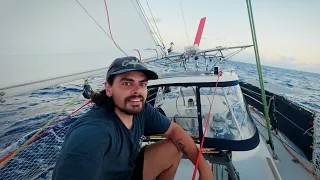
Underway on day 41 of his solo nonstop circumnavigation aboard Phoenix do Mar, Oliver Widger enters the South Pacific at 11 degrees south, managing sail trim, bilge debris, diesel reserves, and passage preparations for Cape Horn.
Day 40 sailing around the world without stopping.Thanks @prAna for providing me with all my clothes
Underway on a solo non-stop circumnavigation aboard Phoenix do Mar, Oliver Widger manages cooling offshore conditions and evaluates passage apparel.
Day 39 sailing around the world without stopping
Underway on day 39 of his solo non-stop circumnavigation aboard Phoenix do Mar, Oliver Widger checks in from offshore with an honest update on daily shipboard life.
Day 38
On Day 38 of his solo circumnavigation, Oliver Widger navigates the challenges of night sailing, fixing unraveled rigging on the exposed bow and deploying a hydrogenerator.
Day 37 at sea sailing around the world without stopping.
On Day 37 at sea sailing around the world without stopping, solo sailor Oliver Widger experiments with doing laundry using ocean water and detergent sheets.