🔴 LIVE - I'm in the Doldrums | Sailing Around the World Without Stopping [Day 20]
Twenty days into his solo nonstop circumnavigation aboard the Pacific Seacraft 40 Phoenix do Mar, Oliver Widger drifts through the equatorial heat of the Pacific Doldrums roughly 700 miles offshore. Broadcasting live from the cockpit on Sailing With Phoenix | Oliver, Widger confronts the challenges of light air, sudden squalls, and cabin temperatures climbing well above 90 degrees. The voyage, which commenced from Port Townsend, Washington, on October 2, 2026, aims to complete a 30,000-mile non-stop circumnavigation around the world without assistance or resupply.
In the heart of the equatorial calms, managing interior temperature aboard Phoenix do Mar presents an immediate physical hurdle. Cooking even a single warm meal elevates the cabin to furnace-like heat, making the interior unlivable for hours afterward. Despite the intense sunlight, running an air conditioning unit remains impossible due to the electrical limitations of an off-grid solar setup. Widger relies on solar panels to generate daily electrical needs for navigation electronics, running lights, and communication systems. The onboard refrigerator acts as the vessel’s single largest power consumer, laboring constantly against the tropical ambient heat. To maintain personal stamina while navigating the stifling conditions, Widger frequently opens the refrigerator—opening it as many as 20 times in a single day—to chill a wet cloth towel that he wears wrapped around his neck.
Surviving weeks in an exposed cockpit requires practical solutions for physical endurance. Widger highlights the value of an onboard marine bean bag, an addition recommended independently by two experienced offshore sailors prior to departure. Both Jerome Ran, who completed a nonstop circumnavigation, and Christy from Kraken Sails urged Widger to carry a heavy-duty bean bag. Although initially skeptical of dedicating deck space to the cushion, Widger credits their unprovoked advice with providing practical body support and relief during long watches in the cockpit.
A Sudden Squall and the 360-Degree Wind Shift
As Widger monitors the sluggish air from the cockpit, a sudden tropical squall approaches across the Pacific water, unleashing a downpour. Rather than viewing the sudden weather disruption as an unwelcome event, Widger welcomes the deluge as an opportunity to give Phoenix do Mar a freshwater bath. Days of ocean sailing coat deck hardware, standing rigging, running lines, and solar arrays in a thick crust of salt, accelerating corrosion and material breakdown. Even heavy-duty equipment like his newly installed Hydrovane self-steering system faces rapid cosmetic and mechanical degradation under offshore conditions.
The rain quickly forces Widger to scramble across the deck to secure open hatches before taking refuge in the cockpit under a cascading sheet of water. The sudden squall wreaks havoc on the localized wind field. Within minutes, the ambient breeze twists through a complete circle, scattering the vessel’s heading and leaving the canvas shaking violently. Widger notes the volatile behavior of tropical squalls: “The squall completely changes the wind directions too.” The localized pressure system drags the wind through a full 360-degree rotation before the driving rain subsides, leaving Phoenix do Mar trapped in an abrupt, absolute calm.
The temporary breeze generated by the leading edge of the squall dissipates as rapidly as it arrived, dropping wind speeds down to a feeble 2 knots. The abrupt shift leaves Widger soaked from head to toe, monitoring sails that have suddenly lost all aerodynamic pressure while rolling heavily across leftover ocean swells.
The Frustration of Light Air and Sail Slap
In the dead air of the Doldrums, a solo mariner faces one of the most frustrating dilemmas in offshore voyaging: deciding whether to keep canvas hoisted in the hope of catching elusive breaths of wind, or dropping the sails entirely to prevent structural damage. When wind speeds drop between 2 and 6 knots, ocean swells continue to toss the 40-foot hull from side to side. Without steady wind pressure to keep the sails filled, the sails back-wind violently with every roll, slamming across the rig with explosive reports.
Widger explains the destructive mechanics of this relentless motion on the yacht’s rig: “No wind will eat through sails and rigging and all that stuff. So, it is just Anyways, long story short, it is this constant battle between do I leave him up or do I take him down?” The violent motion stretches sail cloth, strains batten pockets, chafes halyards, and imposes severe shock loads on standing rigging. Spending hours attempting to coax forward progress in dying breezes often results in nothing more than unnecessary gear wear.
The calm conditions exact an equally grueling psychological toll. Widger maintains his daily routines by keeping his clocks set strictly to Pacific Standard Time, aligning his internal schedule with west coast reference points. Under the intense tropical heat, physical exertion leads to rapid fluid depletion, prompting Widger to consume substantial volumes of water enhanced with Liquid IV hydration packets. Between sail adjustments and routine boat checks, the waiting game demands an uncommon degree of patience from a sailor accustomed to continuous physical work.
Solitary Life, Marine Debris, and Southern Ocean Ambitions
While scanning the calm horizon roughly 700 miles offshore, Widger observes a noticeable accumulation of floating marine debris. Over a span of just 5 days in the equatorial Pacific, he identifies discarded plastic water bottles, floating commercial fishing buoys, and even a waterlogged rain boot drifting past the hull. The volume of floating refuse contrasts sharply with his previous passage from Oregon to Hawaii, during which he encountered only two or three pieces of debris across open ocean.
Despite the isolation of the open sea, Widger remains focused on the broader trajectory of his 30,000-mile voyage. Ahead lies the formidable challenge of rounding Cape Horn and traversing the Southern Ocean. Widger deliberately planned his departure to ensure an arrival in the higher southern latitudes during the austral summer, a strategy calculated to minimize the risk of encounters with drifting icebergs. Unlike coastal cruising vessels, Phoenix do Mar will bypass the Panama Canal completely, navigating south through the full length of the Pacific Ocean to round Cape Horn into Drake Passage.
Maintaining mental clarity and physical resilience over an estimated voyage of 8 to 9 months requires strict attention to rest. Widger firmly rejects the rigid 30-minute polyphasic sleep schedules adopted by many solo racing sailors, warning that artificial sleep restriction poses fatal risks offshore. “The biggest danger to solo sailors is sleep deprivation. That is how people die,” Widger emphasizes. Instead of forced short catnaps, he allows his body to rest for extended periods whenever conditions permit, having logged sleep sessions as long as 12 hours when the vessel is trimmed and settled in steady conditions. His intuitive awareness remains attuned to the motions of the boat, waking automatically if the vessel becomes overpowered or wanders off course. As Widger reflects on the strategic mindset demanded by solo voyaging, he observes: “I have to think very far ahead because this is an endurance thing.”
Rigging Architecture, Daily Checks, and Technical Discipline
Managing a 40-foot cutter offshore requires an intimate understanding of sail balance and heavy weather safety. Phoenix do Mar relies on three primary sails: a mainsail hoisted on the spar, a forward staysail mounted on the inner forestay, and a large genoa set at the headstay. When tropical calms give way to sudden squalls or building trade winds, reefing the mainsail becomes essential to depower the rig, maintain balanced helm control, and prevent the vessel from becoming overpowered.
To maintain safe passage, Widger inspects weather forecasts roughly 7 times a day, tracking evolving low-pressure systems and storm developments across the Pacific basin. Although anticipating potential 30-foot to 50-foot seas in the Southern Ocean, he approaches heavy weather with deliberate preparation rather than fear, maintaining confidence in the sea-keeping design of his Pacific Seacraft 40. Technical self-sufficiency extends to critical mechanical spares; having overhauled nearly every component of the vessel’s diesel auxiliary before departure, Widger carried a dedicated replacement starter motor to ensure redundancy in remote waters.
As the sun sets and evening brings cooler temperatures to the cockpit, Widger reflects on the raw simplicity of solo voyaging: “Keep the boat sailing, you know, keep the boat sailing and that’s it.” The broadcast draws to a close as the camera battery level drops to 5 percent and then 1 percent under the sweltering heat, prompting Widger to sign off from the cockpit and return his full attention to trimming his sails through the night.
Frequently Asked Questions
Because running an air conditioner would consume far too much solar power, Oliver cools down by soaking cloth towels, chilling them inside the boat’s refrigerator, and draping them around his neck.
When winds drop down to two knots in ocean swells, the sails lose aerodynamic pressure and back-wind violently with every roll of the hull, causing severe sail slap that strains stitching, rigging, and cloth.
Rather than adhering to rigid thirty-minute polyphasic catnaps, Oliver sleeps whenever conditions allow, logging up to 12 hours of rest when the boat is balanced while relying on instinct to wake if the rig becomes overpowered.
Experienced nonstop circumnavigator Jerome Ran and Kraken Sails sailmaker Christy independently urged Oliver to carry a bean bag for essential comfort and physical support in the cockpit during extended offshore watches.
Departing from Port Townsend, Washington, Phoenix do Mar is sailing south through the Pacific Ocean to round Cape Horn into the Southern Ocean, deliberately avoiding the Panama Canal to complete a nonstop circumnavigation.
Support Sailing With Phoenix | Oliver
At WeBoating.com, we profoundly acknowledge the unwavering dedication that Sailing With Phoenix | Oliver invests in crafting each and every video or voyage. Their passion for delivering exceptional ocean content shines through every frame, and it's a labor of love that deserves your attention.
We invite you to watch their captivating videos here and actively engage with their content, including their social media links above. Liking, commenting, and sharing their work goes a long way in fueling their creative fire.
We're also inviting you to explore the gear, sponsorships, and boat partnerships highlighted in the "🔴 LIVE - I'm in the Doldrums | Sailing Around the World Without Stopping [Day 20]" video description, or directly on YouTube. By engaging with these offerings or purchasing services and items, you directly support Sailing With Phoenix | Oliver, their collaborators, and the brands they're associated with.
To ensure you never miss an offshore update, consider visiting their official YouTube Channel to subscribe, like, and join their community directly.
If you have any feedback, corrections, or additional information about Sailing With Phoenix | Oliver or their videos, please use the comment form below to share your thoughts with us.
Thank you for being a part of our community and supporting the creators we cherish. Your time and support truly matter!
On October 2nd 2026 I began a 30,000 mile solo nonstop circumnavigation of the planet aboard my Pacific Seacraft 40, "Phoenix do Mar", meaning Phoenix of the Sea in Portuguese. Departing from Port Townsend, Washington, this voyage will cross the world’s most remote oceans in one continuous passage and take up to eight months to complete. Follow along as I attempt one of the greatest challenges in sailing.
GoFundMe - Sailing around the world for Klippel-Feil syndrome (KFS)
https://gofund.me/fa5f4f2f7
📍 Live Tracker
https://forecast.predictwind.com/tracking/display/SY_Phoenix/
👕 Official Merch
https://sailingwithphoenix.myspreadshop.com/
🌐 All My Links
https://beacons.ai/sailing_phoenix
https://www.twitch.tv/sailing_with_phoenix
https://instagram.com/sailing_with_phoenix
https://tiktok.com/@sailing_with_phoenix
https://facebook.com/sailing.with.phoenix
#Sailing #Nonstop #AroundTheWorld

Sailing With Phoenix | Oliver
From liquidating his 401(k) to solo global loops, join Oliver and his cat Phoenix as they prepare for a 30,000-mile non-stop circumnavigation.
Channel Information:
Social Media Links:
🔴 LIVE - I'm in the Doldrums | Sailing Around the World Without Stopping [Day 20] Location
- Phoenix do Mar in the Pacific Doldrums (8.5,-118)
Latest Episodes from Sailing With Phoenix | Oliver
Explore the most recent voyages. Subscribe to the channel to never miss an update!
Day 38
On Day 38 of his solo circumnavigation, Oliver Widger navigates the challenges of night sailing, fixing unraveled rigging on the exposed bow and deploying a hydrogenerator.
Day 37 at sea sailing around the world without stopping.
On Day 37 at sea sailing around the world without stopping, solo sailor Oliver Widger experiments with doing laundry using ocean water and detergent sheets.
Day 36 sailing around the world without stopping
Crossing the equator at 4:00 a.m. on Day 36 of his solo non-stop circumnavigation, Oliver Widger becomes a shellback aboard Phoenix do Mar, offering ceremonial toasts to Poseidon and his vessel before sailing south.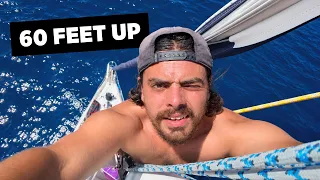
Solo Mast Climb 27 Days Into My Around the World Voyage
Twenty-seven days into a solo nonstop circumnavigation aboard Phoenix do Mar, Oliver Widger braves severe ocean squalls, repairs chafe on his headsails, and completes a solo masthead rigging inspection while battling motion sickness.
Day 34 lol not 35 sailing around the world with out stopping
Deep offshore on Day 34 of a solo circumnavigation, Oliver Widger hails a close-passing fishing vessel running without AIS, only to find the crew watching his social media.