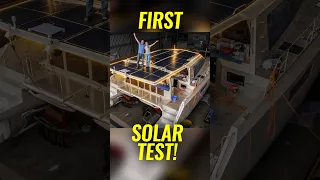
FIRST SOLAR TEST….Too Good To Be True??? (Pt. 2) Aluminum Catamaran Build 93
A sudden thunderstorm rolled across the boatyard just as Brian Trautman and the crew finished masking the hardtop roof of Delos 2.0, soaking every taped seam and bringing the exterior refit to an abrupt halt. With weeks of work invested in mounting custom flexible panels across the 53-foot aluminum catamaran for Sailing SV Delos, any moisture trapped beneath the perimeter sealant risked peeling and long-term water intrusion beneath the cells.
The perimeter caulking serves as the critical barrier keeping water out from the edges of the panels, and proper adhesion requires bone-dry surfaces on both the boat structure and the panel laminates. Rather than gambling on wet tape, the crew pulled every strip of masking off, waited for the aluminum coachroof to dry completely, and restarted the taping process from square one.
Marine Deck Caulking and Clean Seam Lines
Once the hardtop roof dried out and fresh masking tape was laid around every panel edge, Brian Trautman tackled perimeter sealing alongside Simon and Nikki from Open Water Solar. The team selected Sequex 290 DC Pro marine deck caulking—the durable polyurethane compound used between teak deck planks. The formulation provides strong UV resistance, paintability, and the ideal viscosity for laying continuous beads along panel borders.
Applying the black sealant proved messy and physically demanding. Brian dressed in all-black caulking shorts to avoid ruining clothes, while the crew tooled each bead smoothly using gloved fingertips. Because black polyurethane smears effortlessly on aluminum surfaces, cleanliness was paramount. The crew cycled through four boxes of gloves, constantly discarding pairs the instant compound touched a finger, while relying on double gloving, rolls of tape, and alcohol wipes to keep the surrounding metal rails clean.
As the caulking firmed up, peeling back the tape revealed crisp, clean black borders framing the cells. Any stray contact on bare metal was cleaned immediately with alcohol wipes before it could cure, preserving the clean lines of the expedition catamaran.
Series Soldering and Simon’s Ice Thermal Barrier
With perimeter waterproofing underway, the crew transitioned to electrical assembly, preparing small jumper leads and tinning exposed copper terminals across the array. Rather than connecting panels in parallel, the roof array was wired into series strings where voltage compounds progressively from panel to panel.
Brian explained the electrical engineering principles dictating the series configuration: “We’re jacking up the voltage because as voltage comes up, current goes down, good old Ohm’s law.”
Running the strings in series drives operating voltages higher while keeping current around 6 amps. Keeping amperage low eliminates the need for thick, heavy copper cabling across the roof, reducing both vessel weight and resistive power losses. The series architecture also avoids the severe power penalties and backfeeding issues that parallel systems suffer when sails or spars cast shadows across individual cells.
To protect the delicate cells from excessive heat during soldering, Simon implemented a practical field technique. Placing a small block of ice on the copper busbar just beyond the solder point created a thermal sink, absorbing excess heat before it could migrate down the copper ribbon and damage the silicon cells. The thermal barrier enabled Brian and Simon to make solid, high-integrity solder joints across hundreds of connections without compromising panel life.
Welded Conduits and Polyurethane Junction Box Potting
Managing electrical wiring on an aluminum yacht requires careful isolation to prevent chafe and corrosion. Weeks earlier, the build team welded two longitudinal aluminum conduit pipes directly onto the hardtop roof. Rather than stringing loose wire across the deck, positive and negative conductors from each panel cluster—referred to as home runs—route directly through these tubes.
Brian highlighted the clean exterior routing: “Instead of letting those wires run loose all over the roof, we welded two aluminum pipes to keep everything tidy and protected.”
Using a vacuum to draw pull lines through the internal pipes, the crew pulled positive and negative pairs through precise slits (marked for strings such as 32 and 33) located adjacent to each group. The cables run inside the aluminum tubes toward the aft end of the coachroof, where they drop down into the hulls, achieving a weather-tight run with zero deck penetrations.
Across the roof, Nikki fixed small junction boxes over every individual solder joint. Once positioned, each enclosure was potted with a two-part polyurethane casting compound. The liquid compound features very low viscosity, allowing it to penetrate every crevice around the soldered copper leads, while curing into a tough, permanently flexible solid that flexes as the boat moves and the panels expand and contract in variable temperatures.
Working against a rapid 10-minute pot life, Nikki and Brian drew the compound into syringes and injected each box from the bottom up to expel trapped air bubbles. Snapping the toothed cover caps in place forced a controlled margin of compound through the vent holes, confirming 100 percent filling and complete moisture protection.
Bench Testing High-Voltage Strings in the Boatyard
Before connecting wiring to the main electrical locker, Brian and Simon performed preliminary electrical verification on each isolated circuit with a digital multimeter. Despite the boat resting inside a shaded industrial shed with panels coated in construction dust, the largest series group wired for the 250V controllers measured 175 volts, aligning closely with its 180-volt target.
Additional string tests across the roof recorded open-circuit readings of 100 volts, 105 volts, and 200 volts across the various group geometries. Testing current under diffused ambient shed lighting yielded 2 amps on a 600-watt cluster—roughly one-third of the array’s full 6-amp direct-sun rating, confirming that every soldered series joint was conducting properly.
The roof array is divided into eight independent circuits, paired with eight dedicated MPPT solar charge controllers. The equipment is divided symmetrically between the hulls, with four controllers installed in the port engine room and four controllers in the starboard engine room, maximizing redundancy and solar harvest efficiency.
Weight Efficiency and Flush Architectural Integration
When Karin inspected the completed hardtop, the seamless aesthetic of the bonded array immediately stood out: “The thing that I think is kind of the most impressive, I mean, the power is amazing, but just like you just can’t see that they’re here.”
Unlike conventional cruising yachts that mount bulky glass solar panels on tall stainless steel arches—such as Calico Skies in the same boatyard, which carries 1500 watts on an elevated second-story frame over an 11-meter hull—the custom installation on Delos 2.0 maintains a flush, walkable coachroof. The low-profile textured panels preserve panoramic sightlines, reduce windage aloft, and leave the deck surface fully functional for crew relaxation.
The structural advantage lies in dramatic weight reduction. The entire 6,000-watt flexible panel array on Delos 2.0 weighs only 160 kilos. Achieving equivalent 6,000-watt output using conventional 400-watt rigid glass framed panels would have imposed approximately 317 kilos (nearly 700 pounds) on the roof, excluding the additional stainless steel mounting hardware required to secure glass modules.
Commissioning Engine Room Breakers and Initial Yield
To conclude the initial installation phase, Brian entered the port engine room to switch on the primary DC circuit breakers and verify solar charging into the onboard battery bank.
Engaging the port breakers brought the digital monitoring console online immediately. Inside the covered shed, the solar yield display registered 319 watts of charging output. On-screen diagnostics showed the four port-side MPPT charge controllers operating in real time: string F, situated near the open rear doorway of the shed and routed to controller number two, produced 300 watts, while controller number four, connected to panels situated deep in the dark interior of the building, registered only minimal trickle current.
The test proved that every soldered series string, welded pipe conduit, and potted junction box was fully operational, establishing a robust 6,000-watt off-grid energy foundation for the expedition catamaran.
| Metric | Specification |
|---|---|
| Total Solar Array Capacity | 6,000 watts |
| Roof Array Weight (Flexible Panels) | 160 kilos |
| Equivalent Rigid Glass Panel Weight | 317 kilos (approx. 700 pounds) |
| Series String Operating Current | 6 amps (nominal) |
| Initial Bench String Test Voltage | 175 volts (on 180-volt target circuit) |
| Port-Side Indoor Solar Bench Yield | 319 watts (300 watts on controller number two) |
| MPPT Charge Controllers | 8 units (4 per engine room) |
| Polyurethane Potting Compound Pot Life | 10 minutes |
Frequently Asked Questions
The crew installed 6,000 watts of custom flexible solar panels across the hardtop roof, divided into eight separate series circuits to maximize off-grid power generation.
The entire 6,000-watt flexible panel array on Delos 2.0 weighs 160 kilos. Conventional 400-watt rigid glass framed panels delivering equivalent wattage would weigh roughly 317 kilos (almost 700 pounds) before factoring in aluminum or stainless steel mounting racks.
Wiring the panels in series raises system voltage up to 175 to 200 volts while keeping string current around 6 amps. Higher voltage reduces required copper cable thickness and prevents the power degradation associated with partial sail shading on parallel systems.
Perimeter panel seams were sealed using Sequex 290 DC Pro marine deck caulking. Electrical junction boxes were potted with an ultra-low viscosity, flexible two-part polyurethane compound injected via syringe within a 10-minute pot life to prevent water ingress.
Book a trip where this was filmed — near Gold Coast
Support Sailing SV Delos
At WeBoating.com, we profoundly acknowledge the unwavering dedication that Sailing SV Delos invests in crafting each and every video or voyage. Their passion for delivering exceptional ocean content shines through every frame, and it's a labor of love that deserves your attention.
We invite you to watch their captivating videos here and actively engage with their content, including their social media links above. Liking, commenting, and sharing their work goes a long way in fueling their creative fire.
We're also inviting you to explore the gear, sponsorships, and boat partnerships highlighted in the "FIRST SOLAR TEST….Too Good To Be True??? (Pt. 2) Aluminum Catamaran Build 93" video description, or directly on YouTube. By engaging with these offerings or purchasing services and items, you directly support Sailing SV Delos, their collaborators, and the brands they're associated with.
To ensure you never miss an offshore update, consider visiting their official YouTube Channel to subscribe, like, and join their community directly.
If you have any feedback, corrections, or additional information about Sailing SV Delos or their videos, please use the comment form below to share your thoughts with us.
Thank you for being a part of our community and supporting the creators we cherish. Your time and support truly matter!
Want to get behind the scenes of the build with early & ad free content, meetups, and more? Join the inner tribe at http://patreon.com/svdelos
This is an episode that I couldn't be happier to share with you guys. Our solar system has been one of my favorite projects of the whole build. I just find this technology so incredibly fascinating, and it's been such a joy to bring it all together. We've been pushing the envelope in a lot of different ways with some of the tech on the boat, but these panels are just SO freaking cool. I honestly think it's one of the most impressive things we've put on Delos 2.0. In last week's episode, we gave you an overview of some of the technology behind these very unique panels and putting them on the roof. (If you missed part 1 last week, make sure and check that one out first: https://youtu.be/-HXE2T1LBPU ). And now in this week's episode we're ready to make the magic happen- it's time to wire everything up and test it for the very first time!
Learn more about this amazing solar technology:
https://openwaterssolar.com
Our 3d printer we're obsessed with: https://amzn.to/45ONHxH
Interested in getting your own Delos Explorer 53?
https://svdelos.com/delos2
You can find all the camera gear we use, our must have cruising essentials, tools, recommended reading, safety gear, and more at our amazon storefront!
https://svdelos.com/amazon
Watch our 4 part docu-series:
https://80northseries.com
Protect yourself from the sun!
https://svdelos.com/rashguards
Support Our Videos- Send Us Love
http://svdelos.com/beer
http://patreon.com/svdelos
We're completing our sail around the world, so there's plenty more to see! Your support will fund better camera gear, internet to upload videos, and of course creative lubricants to smooth the editing process :)
http://svdelos.com/newsletter - Subscribe to our free newsletter
http://instagram.com/svdelos - Behind the scenes.
http://facebook.com/svdelos - Like us on Facebook
http://svdelos.com/gear/ - Support us buy a sweet Delos T-shirt!
Sailing SV Delos
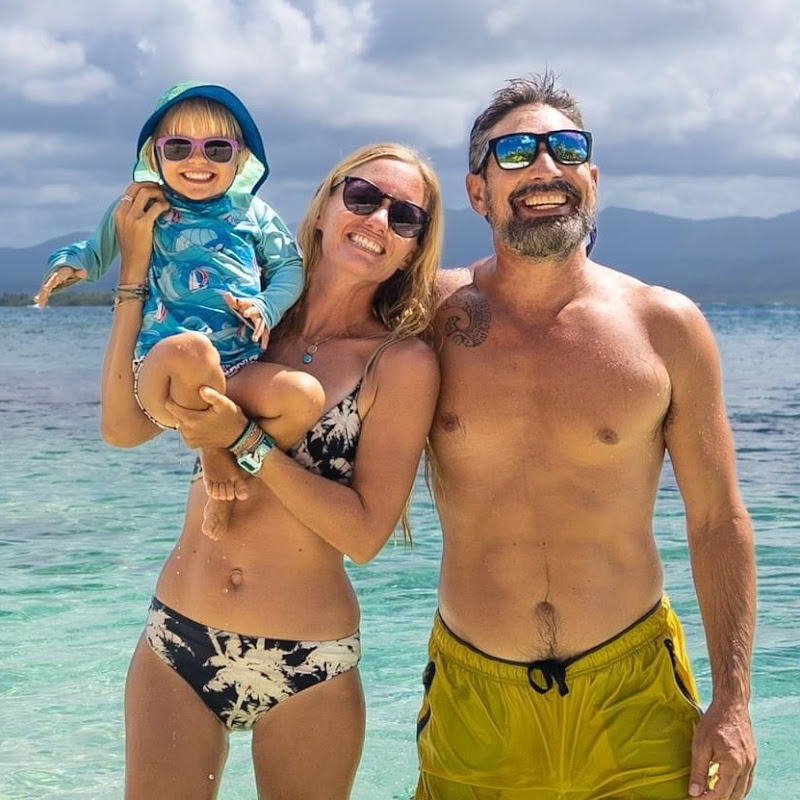
Brian, Karin, and Sierra: The 'Delos Tribe' is pioneering the future of hybrid expedition sailing with Delos 2.0, a custom 53ft aluminum catamaran currently completing its build in Australia.
Channel Information:
Social Media Links:
FIRST SOLAR TEST….Too Good To Be True??? (Pt. 2) Aluminum Catamaran Build 93 Location
- Redland City Marina, Queensland, Australia (-27.5756,153.2844)
Latest Episodes from Sailing SV Delos
Explore the most recent voyages. Subscribe to the channel to never miss an update!
We Turned It On…THIS HAPPENED 🤪 Building Our Own Aluminum Catamaran Pt. 96
Brian Trautman tests Delos 2.0's hydronic chilled-water air conditioning, troubleshooting an engine room plumbing backflow and bilge flooding.
The TRANSFORMATION We’ve Been Waiting For 😱
Watch the full episode here: If you've been following along for a few years, you'll remember one of our first longer experiences on a catamaran with our friends Warren & Erica. It was great to get a feel for life onboard, but there was one thing that solidified the decision for Sierr...
The TRANSFORMATION We’ve Been Waiting For 😱 Building Our Own Aluminum Catamaran Pt. 95
Brian Trautman and Karin Syrén install custom 3/8-inch offshore trampolines on Delos 2.0 in Queensland, configure galley digital switching on CAN bus keypads, and inspect custom electro-polished standing rigging adapters.
Is This Completely Ridiculous?
Brian Trautman and Karin Syrén expand their custom lighting installation aboard Delos 2.0, balancing the KISS sailing mantra against playful design creativity.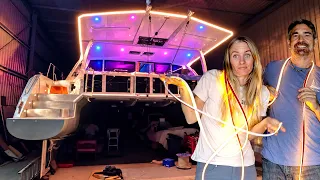
Is This Completely Ridiculous? Building Our Own Aluminum Catamaran Pt. 94
Brian Trautman and Karin Syrén advance the Delos 2.0 catamaran build in Queensland, Australia, installing addressable Lumitec RGBW lighting, custom 3D printed Starlink deck mounts, polished galley pot clamps, and Rutgerson escape hatches.