[HOW TO] Can you DESIGN your Electrical YOURSELF? | Windpuff's Rebuild [S1 Ep 40]
Stripped down to the bare fiberglass hull, the classic 1966 Alberg 30 SV Windpuff presents a clean slate for modern offshore electrification. Rebuilding a vessel from the bare glass requires determining component locations, conductor gauges, and precise circuit pathways before pulling a single cable through the bilges. Because an improperly sized marine electrical installation carries severe fire risks, planning the entire installation in advance according to rigorous safety codes remains paramount. Aboard the project vessel documented by Rigging Doctor, Herb Benavent underscores this foundational principle directly: “In my opinion, the right way is following ABYC standards for electrical.”
Navigating the American Boat and Yacht Council guidelines ensures that every breaker, switch, and conductor operates within strict thermal and electrical thresholds. Treating marine battery capacity like stored fuel illustrates the danger: high-density energy discharged uncontrollably through undersized wiring will ignite bulkheads in seconds. Rather than relying on guesswork, Benavent models the entire vessel schematic in specialized marine modeling software prior to installing hardware.
Five Distinct Voltages on a Single Schematic
Modern marine refits often demand multiple voltage domains operating simultaneously within a compact fiberglass hull. On SV Windpuff, the electrical architecture integrates five separate voltage systems across AC and DC domains. Managing high-power traction banks alongside sensitive navigational electronics requires absolute isolation and disciplined common grounding to prevent cross-system damage.
| Voltage rail | circuit system | connected equipment | | 48V | DC propulsion and storage | 50 kWh battery bank | | 24V | DC auxiliary | Step-down converters | | 12V | DC house instruments | navigation and lighting | | 110V | AC distribution | outlets and appliances | | 220V | AC high-draw | Induction cooking and chargers |
Balancing two alternating current rails with three direct current rails introduces notable installation risks. Tying different voltages together incorrectly can introduce 48V power into delicate 12V instrumentation, frying expensive electronics instantly. In addition, alternating current safety depends on proper grounding paths to ensure residual current devices and thermal breakers trip immediately during a fault. Establishing every connection on a single unified schematic ensures that isolation barriers, step-down converters, and busbars remain organized before any physical wiring begins.
Conductor Sizing and Decimal Voltage Drop Precision
Selecting wire sizes on cruising boats involves balancing conductor weight, physical routing flexibility, and electrical resistance. Traditional marine electrical installations frequently rely on printed lookup charts, such as classic Blue Sea sizing tables. While useful for general guidance, static tables leave substantial room for human calculation error.
A primary pitfall involves miscalculating total circuit length. A technician installing a navigation instrument located 10 feet from a distribution panel might assume the circuit run is 10 feet. However, electricity must travel along both positive and negative legs. If an installer routes a 50 ft wire bundle through bulkheads and leaves service slack, the positive conductor spans 50 feet and the return negative conductor spans 50 feet, producing a 100 ft total circuit loop. Sizing a conductor for a 10-foot run when the current actually travels 100 feet creates severe voltage sag and dangerous thermal buildup.
Benavent emphasizes how digital schematic tools resolve these routing dilemmas: “The program takes away all the guesswork and all the stupid mistakes you could make.” Rather than guessing at margins, the software calculates exact voltage drops down to decimal precision. On circuits serving non-critical loads, an installer can safely specify an 8% voltage drop to reduce copper gauge and lower installation costs. Conversely, sensitive electronics and refrigeration compressor motors require minimal voltage sag, as excessive voltage drops cause electric motors to draw elevated amperage and overheat.
Heavy DC propulsion systems present another physical challenge: maneuvering massive 4/0 conductors through cramped cabinetry. Thick four-ought cable behaves like rigid metal pipe, resisting bends through tight bulkheads. By calculating equivalent parallel conductors, an installer can substitute multiple smaller, flexible cables to carry equivalent current safely. Digital modeling evaluates how thermal dissipation changes when parallel cables are tightly bundled versus physically separated, ensuring the wiring remains cool under sustained propulsion loads.
Strategic Component Sourcing and Equipment Sizing
Equipping a modern offshore electric sailboat requires sourcing specialized equipment that balances charging velocity with project expenditure. With SV Windpuff incorporating a substantial 50 kWh battery bank at 48V, dockside replenishment requires significant charging capacity. Recharging that 50 kWh bank overnight during a brief marina stop demands immense shore power throughput.
Traditional commercial marine options can prove prohibitively expensive. Standard 48V marine chargers delivering 25 amps cost roughly $800 each. Delivering sufficient charging amperage to replenish the 50 kWh bank overnight would require eight individual chargers at $800 each. While evaluating alternatives within comprehensive digital equipment databases, Benavent identified high-capacity EG4 charging units capable of delivering identical charging power using just two units, saving nearly $7,000 on battery charger hardware alone.
Reflecting on discovering alternative equipment through automated component libraries, Benavent noted: “I came across this program called Wireframe, which has all the rules built into it.” With direct access to component specifications and dynamic pricing enables builders to compare competing manufacturers, verifying compatibility between solar panels, charge controllers, and battery banks before placing orders.
Bulkhead Space Modeling and Sustainable Energy Budgets
Physical geometry often dictates the success of a vessel refit. On compact vessels like the 1966 Alberg 30, bulkhead surface area and access depth remain strictly limited. Equipment that functions well on paper may fail to fit within available locker dimensions.
Benavent notes the reality of maritime naval architecture: “I always joke that boats are just compromises that happen to float because everything you do is a detractor from some other factor that you wanted it to have.” Digital layout boards allow boatbuilders to position scale dimensions of chargers, inverters, and fuse blocks on virtual bulkheads. Determining component layouts in advance prevents costly repositioning and ensures proper working clearance around high-current fuses and disconnects.
Sizing renewable generation and battery storage realistically prevents common offshore disappointments. Early voyaging aboard the 1968 Morgan 45 SV Wisdom began with modest resources: 100 watts of solar panels paired with 200 amp hours of 48V lead-acid batteries. While that basic setup propelled the vessel across ocean passages, expanding onboard power demands required upgrading the array to 300 watts upon reaching the Azores. Modeling realistic household loads—such as running induction cooktops, ventilation fans, or air conditioning for 8 hours during overnight rest—reveals exact battery capacities and solar arrays required for self-sufficiency without needing emergency equipment shipments in remote ports.
Frequently Asked Questions
Boat owners should follow American Boat and Yacht Council (ABYC) standards, which establish strict rules for wire gauge selection, overcurrent protection placement, grounding, and thermal management.
Marine wire sizing depends on the complete round-trip conductor length, adding both the positive feed and the negative return. Sizing solely based on one-way physical distance results in severe voltage drops and overheated wiring.
Using a unified schematic to map separate 12V, 24V, 48V, 110V, and 220V circuits ensures proper isolation, correct step-down converters, and dedicated common grounding to prevent cross-voltage component failures.
Heavy 4/0 conductors are extremely rigid and difficult to bend through bulkheads. Running calculated parallel conductors provides flexible routing while carrying equivalent electrical current safely when thermal dissipation is accounted for.
Support Rigging Doctor
At WeBoating.com, we profoundly acknowledge the unwavering dedication that Rigging Doctor invests in crafting each and every video or voyage. Their passion for delivering exceptional ocean content shines through every frame, and it's a labor of love that deserves your attention.
We invite you to watch their captivating videos here and actively engage with their content, including their social media links above. Liking, commenting, and sharing their work goes a long way in fueling their creative fire.
We're also inviting you to explore the gear, sponsorships, and boat partnerships highlighted in the "[HOW TO] Can you DESIGN your Electrical YOURSELF? | Windpuff's Rebuild [S1 Ep 40]" video description, or directly on YouTube. By engaging with these offerings or purchasing services and items, you directly support Rigging Doctor, their collaborators, and the brands they're associated with.
To ensure you never miss an offshore update, consider visiting their official YouTube Channel to subscribe, like, and join their community directly.
If you have any feedback, corrections, or additional information about Rigging Doctor or their videos, please use the comment form below to share your thoughts with us.
Thank you for being a part of our community and supporting the creators we cherish. Your time and support truly matter!
↓WIREFRAME↓
https://usewireframe.com/?ref=riggingdoctor
↓HERBY'S BOOK↓
https://amzn.to/4r0ERW8
▸ JOIN OUR PATREON: https://www.patreon.com/riggingdoctor
▸ HERBY'S BOOK: https://amzn.to/4r0ERW8
▸ MATERIALS NEEDED FOR THIS PROJECT: https://a.co/6y07tiz
▸ MERCHANDISE: Coming soon!
▸ SUBSCRIBE DIRECTLY with us so you never miss an episode: https://www.riggingdoctor.com/subscribe
Windpuff needs a full electrical system planned out and built. To do it correctly, you want to follow the rules and guidelines laid out by ABYC. Using Wireframe, you can design and build the entire system with the program keeping you on the right track, and checking that everything is ABYC compliant.
If you are building an entire system from scratch, checking that your current setup is compliant, or adding something new to your boat, Wireframe will guide you through all the steps and outline all the safety components that you need to do the installation the right way the first time!
If you have any projects, be sure to use our link for TotalBoat: https://www.TotalBoat.com/riggingdoctor . It's the stuff we use on our own boat and it helps out the channel :-)
↓BINGE WATCH↓
BINGE WATCH FROM THE BEGINNING: https://youtube.com/playlist?list=PLlDgR504BxwnlEhveyFpjTUi6LLA4_s4L
▸ OUR BOAT (1968 Morgan 45): https://www.youtube.com/watch?v=brlatJgDP28
▸ MERCHANDISE: https://rigging-doctor.creator-spring.com/ & https://shirts-33.creator-spring.com/
▸ INSTAGRAM: https://www.instagram.com/riggingdoctor
▸ FACEBOOK: https://www.facebook.com/sailingwisdom
▸ WEBSITE: https://www.riggingdoctor.com
▸ PAINTING COMMISIONS: [email protected]
▸ ART FROM OUR VOYAGE: https://www.bluefeatherfineart.com
↓PARTNERSHIPS↓
▸ TOTALBOAT: https://www.totalboat.com/riggingdoctor
▸ WIREFRAME: https://usewireframe.com/?ref=riggingdoctor (For an extra 20% off, use Promo Code: RIGGINGDOCTOR2)
▸ WATTCYCLE: https://www.wattcycle.com/?ref=RiggingDoctor (For an extra 6% off, use Promo Code: RIG)
▸ PREDICT WIND: https://www.predictwind.com/?ref=riggingdoctor
▸ SUN OVEN: https://www.sunoven.com/riggingdoctor
▸ MANTUS ANCHORS: https://www.mantusmarine.com/?affiliates=119
▸ OVERKILL SOLAR (LITHIUM BATTERY PARTS): https://overkillsolar.com/?myboi=187478592
▸ BATTERY HOOKUP (LITHIUM BATTERY PARTS): https://www.batteryhookup.com
(For an extra 5% off, use Promo Code: RIGGING5)
▸ AQUOS ELECTRIC OUTBOARD: https://www.aquospro.com?sca_ref=1008159.oxyRUafA2y
▸ AMAZON: https://www.amazon.com/shop/riggingdoctor

Rigging Doctor
Join Herb and Maddie Benavent of Rigging Doctor as they document their 18,000 NM electric odyssey aboard their Morgan 45, Wisdom. Discover the future of sustainable sailing.
Channel Information:
Social Media Links:
[HOW TO] Can you DESIGN your Electrical YOURSELF? | Windpuff's Rebuild [S1 Ep 40] Location
- Baltimore Inner Harbor (39.2905,-76.6104)
Latest Episodes from Rigging Doctor
Explore the most recent voyages. Subscribe to the channel to never miss an update!
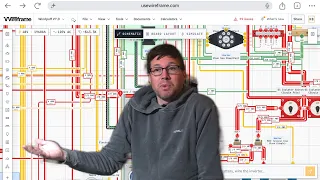
[HOW TO] Can you DESIGN your Electrical YOURSELF? | Windpuff’s Rebuild [S1 Ep 40]
Stripped to bare fiberglass, SV Windpuff undergoes a complete electrical redesign. Herb Benavent maps out five distinct voltages, 48V storage, and ABYC standards to build a safe offshore system without guesswork.
What’s the BEST Sander? | Windpuff’s Rebuild [S1 Ep 39]
Herby details the tools and sequence for shaping and glassing Windpuff's wooden hard dodger, comparing the corded DeWalt DWE 6401 DS sander, Velcro and adhesive Dura-Block longboards, neat epoxy sealing, and 1700 vs. 1708 biaxial fiberglass.

Where to find us at the Sailboat Show
Ryan and Sophie of Rigging Doctor announce their appearance at the Annapolis Sailboat Show and Cruisers University, presenting standing rigging masterclasses.
Hard Dodger Takes its FINAL Shape | Windpuff’s Rebuild [S1 Ep 38]
↓HERBY'S BOOK↓ ▸ JOIN OUR PATREON: ▸ HERBY'S BOOK: ▸ MATERIALS NEEDED FOR THIS PROJECT: ▸ MERCHANDISE: ▸ SUBSCRIBE DIRECTLY with us so you never miss an episode: ▸ PAINTING COMMISIONS: [email protected] ▸ ART FROM OUR VOYAGE: ▸ CHARLIE & GERRY CHANNEL: Herby puts th...