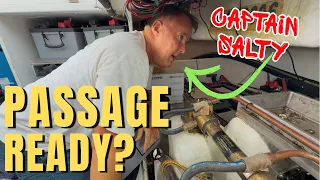
PREPPING TO CROSS THE SEA OF CORTEZ: Part 1 🇲🇽 (Heavy Batteries, Doctors & Salty Pat)
In Banderas Bay on the Pacific coast of mainland Mexico, Pat and Alexa are working through their pre-departure checklist aboard their 57-foot Nordhavn, Noeta, alongside their boat cat, Gilligan. Documented on M/V Noeta, the couple is preparing to cast off in a couple of weeks to cross the Sea of Cortez to Marina Puerto Escondido on the Baja peninsula, where they plan to spend at least 6 months.
Before leaving the mainland infrastructure around Puerto Vallarta, the crew has three primary priorities: completing annual dental and hospital checkups, replacing a failing start battery for the aft generator and wing engine buried deep in the aft lazarette, and evaluating early weather routing models for the passage north.
Mainland Dental and Hospital Checkups in Banderas Bay
Pat and Alexa begin their mainland logistics by walking down the dock to the medical plaza located directly at the end of their pier. Along the way, they pass another 57-foot Nordhavn, Arctic Tern, which is being waxed by a local crew scheduled to wax Noeta in about 2 weeks using wax the couple just purchased. Although Pat still works for Alaska Airlines and carries US health insurance, the couple prefers handling routine medical, dental, and dermatology care in Mexico, where staff are trained in Guadalajara and the US, speak English, and charge less than their insurance deductible.
Before stepping into the clinic, Pat admits that visiting the dentist is “not one of my favorite things to do in the world. I’d rather be working on the toilet.” In the clinic, dentist Lali performs both the cleanings and the examination herself rather than handing the cleaning off to a hygienist. After about a half hour each and zero cavities found, the final bill for both cleanings and consultations comes to 2,000 pesos, or just over $100. Back at the dock, Pat also retires an old fender that went flat against the hull during the last couple of hurricanes and stopped holding air after being re-inflated.
Later, after fasting in the morning, Pat and Alexa drive to the La Jolla hospital in Banderas Bay for their third round of preventative men’s and women’s wellness checkups to compare against their baseline numbers. While Pat already completes an annual EKG for his first class medical certificate at work, the hospital package includes a full blood workup, urine and stool samples, an EKG, a chest X-ray to check the lungs and surrounding bones, an abdominal ultrasound scan with gel to inspect internal organs, and a follow-up consultation with an English-speaking doctor. The complete hospital workup costs 5,700 pesos—not quite $300—per person. Within an hour and a half of leaving the doctor’s office, Alexa receives notification in her app that all lab work, ultrasound organ scans, and X-rays have been analyzed and uploaded.
Walking Marina Vallarta and Sourcing a 4D Start Battery
Between medical appointments, the couple stops for food after their morning fast and walks the docks at Marina Vallarta, the harbor closest to the airport and town. While well protected by surrounding buildings, Pat and Alexa note that they have never kept Noeta there because it caters heavily to charter and fishing boats, carries lively restaurant noise in high season, and brings constant sales pitches for condos, timeshares, and fishing charters whenever cruisers walk off the dock.
During their walk around Marina Vallarta, they look for Pancho, the resident 20-foot crocodile who frequents the freshwater runoff areas marked off with yellow caution tape. While Pancho stays out of sight, they spot black iguanas resting in the shade, hear the tourist pirate ship firing cannons out in the bay, and pass the lone Nordhavn in the basin—a Nordhavn 46 that previously operated as a local charter boat and has been on and off the brokerage market.
From the marina, Pat and Alexa drive to Zaragoza, the major marine chandlery in Puerto Vallarta, where Alexa has been texting staff for a couple of weeks to special-order a replacement 4D battery. Explaining why the replacement is needed before heading to Loreto, Pat notes, “Our after gen and the wing engine start battery is failing. So it doesn’t have enough juice to basically start the wing engine.” While the battery could still crank the aft generator—allowing the generator to then help start the wing engine—sitting between monthly test runs without a dedicated trickle charger had slowly drained its capacity. Whereas 8D batteries for house banks are stocked regularly, the smaller 4D size had to be ordered in for about 23,000 pesos. Zaragoza staff load the heavy 4D battery into the car, and back aboard Noeta, Pat places it on a battery charger where it reads 80% (after initially appearing near 90%) to top it off overnight before installation.
Hauling 8D House Batteries to Replace the Aft Lazarette Start Battery
The next morning, Pat and Alexa empty the aft lazarette to reach the failed 4D start battery tucked into the far back corner. Looking into the cramped compartment, Pat remarks, “It’s the least convenient battery to fail.” Because there is no overhead pulley angle in the corner to lift the dead battery straight out of its tray, Pat first has to disconnect and slide two heavy 8D house bank batteries out of the way, hoping to avoid moving the main generator start battery as well.
While Alexa lowers the boat’s hoist to help lift batteries in and out of the lazarette and sands corrosion off the battery terminals for clean connections, Pat wrestles with greasy, welded hold-down bolts in the heat. After finally freeing the hardware, he says, “That was about 10 times harder than it should have been.” Before sliding the batteries back into place, Pat pre-runs and ties off wiring leads for a Victron DC-DC battery-to-battery charger that he has on order, similar to a trickle charger setup he previously wired to a breaker on their former Nordhavn 50, so he will not have to crawl back into the corner once the unit arrives.
Using an old dinghy bench seat as a ramp to slide the new 4D battery up and over the interior ledge, Pat secures the starter battery in place and turns on the breaker to test it before reassembling the house bank. The wing engine fires up on the first try just as a rare morning rain shower begins. Asked why they have not yet switched to lithium batteries, Pat explains that their lead-acid house bank still has plenty of service life left, adding, “We’ve rebuilt the electrical system, the inverters, uh the solar chargers, everything with lithium in mind. They’re Victron, so it’s pretty easy.” When the current house batteries eventually wear out in a couple of years, converting will only require reprogramming the Victron components and adjusting a few bus bars and battery switches.
Weather Routing for the 350-Mile Sea of Cortez Crossing and Galley Grill Prep
On the morning of October 17th, Pat sits down with PredictWind to review the earliest long-range European weather model data for their roughly 350-mile passage from Banderas Bay to Baja, targeting a tentative departure date of November 4th. Although the early forecast lacks ocean wave data and initially plots a dive south of the Tres Marias islands that they likely will not take, the wind fields show favorable blue and purple low-wind zones suited for a powerboat. Near Cabo, the model shows a 10-knot puff that Pat expects cape effects to magnify to 15 to 20 knots.
The preliminary routing schedule has Noeta departing Vallarta between 3:00 and 3:30 in the morning and dropping anchor around 3:00 to 3:30 in the afternoon at Martos, just around the corner from La Paz. Calculating fuel consumption for the crossing, Pat notes, “I figured out conservatively, we’re going to burn about 200 gallons to do that passage.” From La Paz, the couple plans to island-hop and anchorage-hop north to Marina Puerto Escondido, just south of Loreto.
That evening, with cat 1 Hurricane Trudy located 160 km outside the bay and tracking west away from the coast, Pat lights their built-in propane deck grill—an older discontinued model he rebuilt the previous winter—by resting a sacrificial zinc on its dirty thermistor heat sensor to keep propane flowing. While prepping cheeseburgers, the couple’s bowed bamboo cutting board (a promotional gift from buying their deck lounge chairs) suddenly snaps in half on the counter. After cooking the burgers as the propane runs low, Pat switches on Noeta‘s underwater lights, illuminating tree bark and murky estuary runoff from recent rains—and a single passing fish—as they look ahead to clearer water in the Sea of Cortez and Pat’s upcoming work trip the next day.
| Item / Leg | Specification / Cost | Notes from Aboard Noeta |
|---|---|---|
| Dental Cleanings & Consult | 2,000 pesos (just over $100) | Total for 2 people with dentist Lali at the dockside medical plaza (about a half hour each) |
| Hospital Wellness Checkup | 5,700 pesos (not quite $300) per person | La Jolla hospital blood work, EKG, chest X-ray, abdominal ultrasound, and doctor follow-up |
| Wing & Aft Gen Start Battery | 23,000 pesos (4D battery) | Ordered through Zaragoza chandlery in Puerto Vallarta; charged from 80% before install |
| Banderas Bay to Baja Passage | 350 miles (est. 200 gallons fuel) | Tentative November 4th crossing to Martos near La Paz, then hopping to Marina Puerto Escondido |
| Cabo Wind & Hurricane Trudy | 10 knots (15 to 20 at cape) / 160 km | Predicted cape wind magnification near Cabo; cat 1 Hurricane Trudy distance outside bay |
Frequently Asked Questions
Their routine dental cleanings and consultations with dentist Lali at the dockside medical plaza cost 2,000 pesos total for two people (just over $100). Their comprehensive wellness checkups at La Jolla hospital—covering blood panels, urine and stool samples, an EKG, a chest X-ray, an abdominal ultrasound, and an English-speaking doctor follow-up—cost 5,700 pesos (not quite $300) per person, with results delivered to their phone app within an hour and a half.
The 4D battery serving the aft generator and wing engine lacked a dedicated trickle charger and slowly lost capacity while sitting between monthly engine starts, leaving it able to crank the generator but not the wing engine directly. Pat and Alexa special-ordered a replacement 4D battery from the Zaragoza chandlery in Puerto Vallarta for about 23,000 pesos and pre-wired leads for a Victron DC-DC battery-to-battery charger.
Because the failed 4D battery sat in the far back corner of the aft lazarette where the overhead hoist could not lift it vertically, Pat had to disconnect and slide two heavy 8D house bank batteries out of the way, unbolt corroded hold-downs while Alexa sanded the terminals, and slide the new battery over an interior ledge using an old dinghy bench seat alongside the boat’s hoist.
Pat explained that the existing lead-acid 8D house bank still has good life remaining, making an immediate replacement uneconomical. However, they already rebuilt the electrical system, inverters, and solar chargers with Victron equipment that can be reprogrammed for lithium in a couple of years with minor bus bar and switch updates.
The passage from Banderas Bay to Martos near La Paz covers roughly 350 miles and is conservatively estimated to burn about 200 gallons of fuel. Preliminary routing targets a November 4th departure around 3:00 to 3:30 AM, anticipating 10 knots of model wind magnified to 15 to 20 knots around Cabo, followed by anchorage hopping north to Marina Puerto Escondido near Loreto for a 6-month stay.
Book a trip where this was filmed — near Puerto Vallarta

Support M/V Noeta
At WeBoating.com, we profoundly acknowledge the unwavering dedication that M/V Noeta invests in crafting each and every video or voyage. Their passion for delivering exceptional ocean content shines through every frame, and it's a labor of love that deserves your attention.
We invite you to watch their captivating videos here and actively engage with their content, including their social media links above. Liking, commenting, and sharing their work goes a long way in fueling their creative fire.
We're also inviting you to explore the gear, sponsorships, and boat partnerships highlighted in the "PREPPING TO CROSS THE SEA OF CORTEZ: Part 1 🇲🇽 (Heavy Batteries, Doctors & Salty Pat)" video description, or directly on YouTube. By engaging with these offerings or purchasing services and items, you directly support M/V Noeta, their collaborators, and the brands they're associated with.
To ensure you never miss an offshore update, consider visiting their official YouTube Channel to subscribe, like, and join their community directly.
If you have any feedback, corrections, or additional information about M/V Noeta or their videos, please use the comment form below to share your thoughts with us.
Thank you for being a part of our community and supporting the creators we cherish. Your time and support truly matter!
The countdown is officially ON! In Part 1 of our multi-part Sea of Cortez crossing series, we are tackling all the critical prep work best handled right here on the mainland before we throw off the dock lines for Marina Puerto Escondido on the Baja in a couple of weeks.
From heavy mechanical chores to personal wellness, getting ready for an extended passage means taking care of the boat and the crew.
In this episode:
Start Battery Replacement: Sourcing, hauling, and installing a massive new engine start battery—a heavy, sweaty job that gets Pat a little extra "salty" in the engine room!
Health & Wellness Check: Taking advantage of excellent, affordable healthcare on the mainland with routine dental and medical doctor visits.
Passage Planning: Sitting down with weather models and routing software to scout out our ideal weather window for crossing the Sea of Cortez.
In This Episode:
0:00 - Intro: The Sea of Cortez Crossing Series Begins!
1:34 - Mainland Logistics: Dentists, Doctors & Crew Prep
8:00 - Marina Vallarta: Marina Tour & Pancho the Crocodile
14:22 - Aft Laz Battles: Replacing the Main Start Battery (Salty Pat Alert!)
23:13 - Weather Routing: Analyzing Models for the Crossing
30:30 - Final Mainland Checklist & What’s Next
#Nordhavn #SeaOfCortez #MarinaPuertoEscondido #BoatMaintenance #Nordhavn57 #TrawlerLife #LiveaboardLife #MexicoCruising #PassagePrep #MVNoeta #ParadiseVillage
Leave us a comment, hype, like and subscribe!
🌴 Follow our journey! 🌴
📱TikTok: nordhavn.mv.noeta
📸 Instagram: instagram.com/mvnoeta
😉 Facebook: facebook.com/mvnoeta
🖥️ Website: www.mvnoeta.com
🎽 Merch Store: https://mvnoeta-shop.fourthwall.com/
Products used aboard Noeta (these are affiliate links and we will receive compensation if the links are used):
💨 Predict Wind: https://www.predictwind.com/?ref=owfhn2e
🎥 Insta360 x5 Camera: https://amzn.to/45YKZq7
📸 Insta360 Ace Camera: https://amzn.to/4r97lgZ
📹 DJI Neo Mini Quadcopter: https://amzn.to/462Fyqc
🎬 DJI Mini 5 Pro Drone: https://amzn.to/4acrtZF
📗The 'Shawn and Heather' Guide Book we use in the Sea of Cortez: https://amzn.to/4cpn3zy
📙The 'Shawn and Heather' guide book we use for Pacific Mexico: https://amzn.to/4dmDM7L
⚓️ Mantus Chain Hook: https://www.mantusmarine.com/m3-chain-hook/?v=28886f13f578
🌊🌊🌊🌊🌊🌊🌊🌊🌊🌊🌊🌊🌊🌊🌊🌊🌊🌊🌊🌊🌊
#MVNoeta #nordhavn #liveaboard #Cruising #Boating #Powerboats #Yachts #BoatLife #Adventure #OutdoorLife #NordhavnOwners #DIY #LongDistanceCruising #LiveaboardLifestyle #BoatLife #GilliganTheFatBoatCat

M/V Noeta
Are you dreaming of leaving the 9-to-5 behind for a life of ocean crossings, remote anchorages, and the ultimate liveaboard adventure? Welcome to our home! We are Pat and Alexa, and together with our famous "fat boat cat" Gilligan, we live, work, and travel full-time aboard Noeta, our 57-foot Nordhavn expedition trawler. We've lived aboard for 9 years, most of that in Mexico, both Pacific coast and the Sea of Cortez. Our channel is a deep dive into the "unfiltered" reality of long-range cruising and trawler life. We don't just show the beautiful sunsets; we show you the grit, things like: 🛠️Trawler Maintenance & DIY Boat Repair 🌊Offshore Passage Making 🛥️Liveaboard Lifestyle 🇲🇽Baja Exploration Whether you are an experienced captain, an aspiring liveaboard cruiser, or someone who just loves marine wildlife and adventure travel, our goal is to inspire you to find your own "Noeta"—your own path to freedom. We upload new episodes every week documenting our journey.⚓ Subscribe Today!
Channel Information:
Social Media Links:
PREPPING TO CROSS THE SEA OF CORTEZ: Part 1 🇲🇽 (Heavy Batteries, Doctors & Salty Pat) Location
- Marina Vallarta, Puerto Vallarta, Banderas Bay, Mexico (20.6656,-105.253)
- La Paz, Baja California Sur, Mexico (24.1426,-110.3128)
- Marina Puerto Escondido, Loreto, Baja California Sur, Mexico (25.8142,-111.3108)
Latest Episodes from M/V Noeta
Explore the most recent voyages. Subscribe to the channel to never miss an update!
Noeta LIVE at Anchor on the Baja! Sun, Nov 15th @ 2 pm Pacific Time
Anchored at Isla Carmen in the Sea of Cortez, the crew of M/V Noeta breaks down their rough passage across from mainland Mexico, fuel pricing realities, and equipment maintenance aboard their Nordhavn 57 trawler.
LAST-MINUTE BOAT DRAMA! 🧊 Broken Ice Maker, Mexican Paperwork, Cockpit Views & Ready to Cast Off!
Aboard M/V Noeta in Nuevo Vallarta, Alexa troubleshoots a leaking freezer ice maker, secures Mexican cruising permits, and preps for passage across the Sea of Cortez.
Dozens of Rays Surround Noeta #mvnoeta #nordhavn #majesticseaflapflap
The new underwater lights have already given us so much joy! Over 30 eagle and devil rays swam around Noeta for hours in Ensenada Grande on Mexico’s Baja.
SEA OF CORTEZ Crossing PREP: Part 3🇲🇽 EPIRB Update, Wooden Bungs, Provisioning & Overseas Voting! 🗳️
Pat and Alexa tackle essential passage preparations aboard Noeta in Banderas Bay, outfitting thru-hulls with emergency wooden bungs, updating their EPIRB beacons, restocking galley provisions, and submitting midterm election ballots from Mexico.
SEA OF CORTEZ PREP Part 2: PredictWind Routing, Float Plans & TimeZero Setup! ⚓ (& FREE Template)
Pat and Alexa prepare their Nordhavn 57 Noeta for crossing the Sea of Cortez, dialing in PredictWind weather routing, TimeZero navigation, propane provisioning, and offshore float plans.