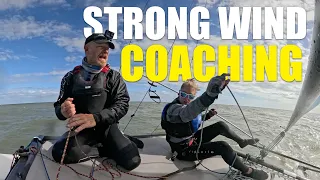
How to Stop Losing Places to Wind Shifts | Sailing Live Q&A
Catamaran racing operates on a knife-edge of aerodynamic trim and hull dynamics, where upwind positioning determines whether a crew maintains podium pace or bleeds places to the fleet. In high-performance multihull circles, few competitors examine these tactical variables with the forensic focus of Joseph Bennett (Joyrider TV). Drawing from championship competition—including the Hobie 16 International Championships in Ocean Springs, Mississippi, alongside crew Laura—Bennett tackles a vital tactical problem: how to master wind shifts when turning a beach catamaran incurs an immense kinetic tacking penalty.
Unlike ballasted monohulls that carry momentum smoothly through a turn, lightweight catamarans scrub speed rapidly when tacking. Across challenging training waters from Vassiliki Bay on Lefkada, Greece, to Lake Garda in Italy, sailors must calculate shift geometry against vessel deceleration. Bennett breaks down the mathematics of fleet separation, oscillating versus persistent breeze, and the discipline needed to protect Velocity Made Good.
Upwind Course Geometry and the Mathematics of Wind Shifts
In high-performance catamaran racing, mastering subtle wind shifts marks the definitive boundary between fleet leaders and those who steadily bleed places, a tactical reality analyzed by Joseph Bennett of Joyrider TV across premier testing grounds ranging from Vassiliki Bay in Lefkada, Greece, to the gusty alpine waters of Lake Garda in Italy.
During an upwind beat, breezes oscillate around a mean heading or bend along shorelines. When a boat catches a lifted tack, its bows point closer to the windward mark, enhancing Velocity Made Good (VMG). When headed, the bows point away from the mark, requiring the crew to bear away. The critical factor magnifying these shifts is lateral separation across the course.
Bennett highlights this geometry with precise ratios. If two catamarans maintain 100 meters of lateral separation and experience a 10-degree shift, the boat on the favored side gains roughly 17 meters toward the mark—a 17 percent leverage ratio. At 300 meters separation, that 10-degree shift produces a 52-meter advantage. In Ocean Springs, Bennett leveraged this by splitting left off the line, hooking into a left shift, and tacking onto port to take a commanding lead.
Yet separation remains high risk. In an oscillating breeze that cycles every few minutes, banging the course boundary is a gamble. If a boat fails to tack before the oscillation reverses, that 52-meter gain becomes a 52-meter deficit. Bennett advises sailors defending positions to stay centered and synchronized with fleet shifts.
The Catamaran Tacking Penalty and Velocity Made Good
Understanding the severe kinetic penalty of turning a multihull through the eye of the wind is fundamental to catamaran racing, where Joseph Bennett and Joyrider TV emphasize that reacting blindly to sudden wind shifts can devastate overall Velocity Made Good whether dueling through Vassiliki Bay in Lefkada, Greece, or navigating choppy mountain corridors on Lake Garda in Italy.
Lacking heavy ballast keels, beach catamarans possess minimal rotational inertia. Pushing two slender hulls through oncoming chop creates immediate drag. The crew must unhook from the trapeze wire, cross the trampoline, backwind the jib to turn the bows, hook onto the new wire, and re-sheet the main to rebuild forward momentum.
This maneuver costs three to five boat lengths. Consequently, Bennett warns against tacking on every minor header. On a 3- to 4-degree shift, the distance gained on the new heading is completely lost to deceleration. Only when an oscillating header exceeds 8 to 10 degrees does tacking generate a net VMG improvement.
In persistent shifts where breeze steadily clocks in one direction, sailors should sail deeper into the header. Extending into the new breeze before tacking ensures the subsequent tack points directly at the mark at full velocity.
Header Versus Lift Identification and Tactical Compass Tactics
Accurate identification of headers and lifts forms the foundation of smart catamaran racing, with Joseph Bennett from Joyrider TV demonstrating how digital compasses and telltale telemetry decode volatile wind shifts during rigorous training runs in Vassiliki Bay in Lefkada, Greece, as well as competitive regattas across Lake Garda in Italy.
Skippers often mistake apparent wind shifts for true wind changes. When a catamaran accelerates in a gust, apparent wind moves aft, creating the sensation of a lift even if true wind direction is unchanged. Hitting chop slows the boat, swinging apparent wind forward like a header. Bennett stresses using a digital tactical compass to verify true direction.
Bennett recommends sailing close-hauled on both tacks for 15 minutes before the start to log baseline compass numbers. During racing, headings reveal true lifts or headers instantly. In chop, helmsmen should feather up wave faces to save distance, then bear off slightly over the crest to keep foils attached and driving.
Strategic Course Positioning and Defending the Favored Side
Tactical course positioning dictates whether leverage translates into podium finishes in catamaran racing, as Joseph Bennett and the Joyrider TV team examine fleet separation and localized wind shifts on tricky waters such as Vassiliki Bay in Lefkada, Greece, and the shear-line conditions typical of Lake Garda in Italy.
When wind trends are uncertain, Bennett highlights the rule of sailing the longer tack first. Spending more time on the tack pointing closer to the mark ensures early miles make direct progress. If an unexpected shift occurs, the boat has already eaten up leg distance, simplifying the final approach.
Bennett warns against early layline approaches. Reaching laylines too early surrenders flexibility: headers force extra tacks, while lifts cause overstanding and wasted distance. Leaders should stay between the fleet and the mark, while trailing boats should seek calculated separation in clean breeze.
Rig Tuning and Aerodynamic Control for Shifting Conditions
Optimizing sail controls and rig geometry is essential for maintaining boat speed through variable breezes in catamaran racing, a subject explored in forensic detail by Joseph Bennett on Joyrider TV as sailors adapt to sudden wind shifts across the thermal amphitheater of Vassiliki Bay in Lefkada, Greece, and the brisk freshwater race tracks of Lake Garda in Italy.
In gusty breeze, raw boat speed provides maneuverability. Bennett identifies the downhaul (Cunningham) as essential: cranking on downhaul flattens mainsail draft and twists open the upper leech, venting excess power. Snug jib tension complements this, preserving attached airflow across high apparent wind angles.
Rig pre-bend via diamond wires—adjusted with a 17mm wrench on Formula 18 and Tornado platforms—pre-flattens masts for heavy air. On Hobie 16s, 45-degree mast rotation stops align the wing mast with apparent wind. While lifting the windward rudder cuts wetted drag, Bennett cautions that jammed rudder cams during quick maneuvers can derail a race, proving mechanical reliability is paramount.
Wind Shift Tactical Matrix and Multihull Decision Framework
To synthesize tactical execution during competitive catamaran racing, Joseph Bennett of Joyrider TV outlines a strategic decision matrix balancing wind shifts against kinetic penalties for skippers competing across diverse international fairways, from Vassiliki Bay in Lefkada, Greece, to Lake Garda in Italy.
The following structured table encapsulates the decision logic required when navigating variable breezes on a high-performance catamaran, highlighting VMG tradeoffs, compass telemetry, and positioning guardrails:
| Tactical Scenario | Wind Shift Characteristic | Multihull VMG & Tacking Penalty | Compass & Course Decision Logic |
|---|---|---|---|
| Major Oscillating Header | Breeze shifts 8° to 15° against heading; cycle repeats periodically. | Lifted tack gain exceeds 4-boat-length tacking penalty; strong net VMG increase. | Tack immediately onto lifted tack; cash in spatial leverage before shift reverses. |
| Minor Oscillating Header | Micro-shift of 2° to 5° caused by localized turbulence or temporary lull. | Tacking penalty completely wipes out heading advantage; net VMG loss. | Hold course; feather mainsheet slightly and maintain speed until breeze settles. |
| Persistent Geographic Shift | Breeze shifts steadily in one direction along shoreline, headland, or front. | Substantial compounding VMG dividend on favored side over entire leg. | Sail into header to reach new breeze direction, then tack once for maximum lift. |
| Irregular / Chaotic Breeze | Unpredictable gust vectors with no consistent period or pattern. | Frequent tacks compound kinetic drag and exhaust crew without positional gains. | Select favored course side based on pressure, sail longer tack, work averages. |
| Approaching Course Layline | Catamaran nears outer boundary line leading directly to windward mark. | Headers force extra tacks; lifts cause overstanding and wasted distance. | Never hit laylines early; keep inside tactical corridor until final approach. |
| Fleet Separation Deficit | Trailing by significant margin behind lead pack on a one-sided course. | Mirroring leaders locks in defeat; separation magnifies gain potential. | Split from fleet toward unexploited pressure; accept risk to leverage next shift. |
Frequently Asked Questions
Addressing common tactical queries encountered in catamaran racing, Joseph Bennett and Joyrider TV clarify the technical mechanics of wind shifts, upwind positioning, and boat handling across demanding venues like Vassiliki Bay in Lefkada, Greece, and Lake Garda in Italy.
A sailor determines heading status by cross-referencing masthead telltales with a calibrated digital tactical compass against a pre-established baseline. Because catamaran speed alters apparent wind direction, true shifts must be verified via compass heading rather than sail feel alone.
A catamaran should tack on an oscillating shift only when the header is substantial enough (typically 8 to 12 degrees or greater) that the VMG gain on the new lifted tack exceeds the 3- to 5-boat-length kinetic tacking penalty incurred during the maneuver.
Beach catamarans lack heavy ballast keels to carry inertia through turns. As two narrow hulls pass through wave chop, they experience severe deceleration, requiring crew wire-to-wire repositioning, backwinded jibs, and careful sail trimming before rebuilding top speed.
Prior to the preparatory signal, the crew should sail hard close-hauled on both port and starboard tacks for 10 to 15 minutes across the fairway. Recording median heading numbers establishes the true wind baseline to identify headers and lifts immediately during racing.
Reaching laylines early robs a multihull of tactical flexibility. If the wind heads, the boat is knocked below the mark and must execute two additional high-drag tacks; if the wind lifts, the boat overstands, having sailed wasted distance without advancing relative to the fleet.
Separating across the racecourse is advisable when trailing significantly behind the fleet with little to lose, as mirroring leaders locks in a deficit. Conversely, when leading, boats should remain between the pack and the mark to neutralize separation leverage.
Lifting the windward rudder reduces wetted surface friction and steering drag on long, steady tacks. However, it can cause rudder cams to invert and jam during quick maneuvers, removes tactical stealth before tacks or gybes, and is prohibited in several strict one-design classes.
Book a trip where this was filmed — near Lefkada

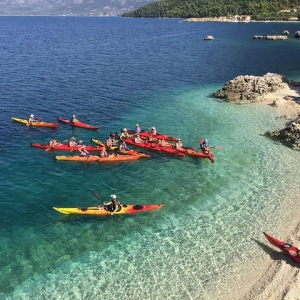
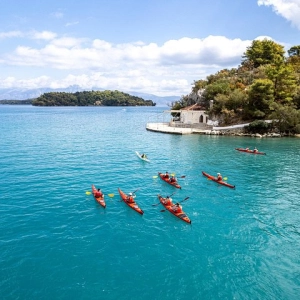
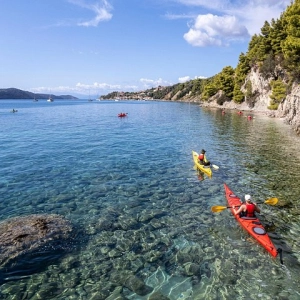
Lefkada Skorpios and Madouri Island-Hopping Kayak Tour with Lunch
Sold by TREKKING HELLAS
Marine Adventure Cruise Snorkeling and Swimming in Lefkada
Sold by Marine Adventure Lefkada
Support Joyrider TV
At WeBoating.com, we profoundly acknowledge the unwavering dedication that Joyrider TV invests in crafting each and every video or voyage. Their passion for delivering exceptional ocean content shines through every frame, and it's a labor of love that deserves your attention.
We invite you to watch their captivating videos here and actively engage with their content, including their social media links above. Liking, commenting, and sharing their work goes a long way in fueling their creative fire.
We're also inviting you to explore the gear, sponsorships, and boat partnerships highlighted in the "How to Stop Losing Places to Wind Shifts | Sailing Live Q&A" video description, or directly on YouTube. By engaging with these offerings or purchasing services and items, you directly support Joyrider TV, their collaborators, and the brands they're associated with.
To ensure you never miss an offshore update, consider visiting their official YouTube Channel to subscribe, like, and join their community directly.
If you have any feedback, corrections, or additional information about Joyrider TV or their videos, please use the comment form below to share your thoughts with us.
Thank you for being a part of our community and supporting the creators we cherish. Your time and support truly matter!
How do you stop losing places to wind shifts—especially on a catamaran that loses speed every time you tack?
In this Joyrider TV sailing Q&A, we explore upwind race strategy using my final race with Laura at the Hobie 16 International Championships in Ocean Springs, Mississippi. Discover how separation from the fleet affects your position, why a favourable wind shift can quickly turn against you, and how oscillating and persistent shifts call for different decisions.
We also discuss catamaran sailing in gusty conditions and waves, strong-wind upwind speed, downhaul settings, crew position, boat measurement and class rules. Plus: the advantages and drawbacks of lifting the windward rudder, adjusting diamond-wire tension, solo sailing considerations, and how mast rotation and mast bend affect sail shape on a fast reach.
Featuring discussion of the Hobie 16, Hobie 14, Hobie 18, Tornado, Formula 18 and Topcat K2X.
Build your catamaran sailing skills with the Joyrider Classroom Course, and find coaching, the Speed Stick leaderboard and Joyrider merchandise:
https://totaljoyrider.com
TIMESTAMPS
00:00 Welcome and today’s catamaran sailing questions
03:40 Hilton Head race clinic: what to bring
11:03 Sailing in gusty winds and choppy lake conditions
13:08 Trapeze height and handling waves
15:58 Spotting gusts before they reach your boat
17:56 Improving upwind speed in strong winds
20:32 Jib trim, crew position and balanced rudders
23:35 Steering and tacking through waves
27:22 Upwind race strategy in shifting winds
27:46 Hobie 16 race example: gaining from a left shift
30:13 How separation magnifies wind-shift gains and losses
32:49 When is separating from the fleet worth the risk?
35:09 Persistent wind shifts: sailing into a header
36:29 Irregular shifts and the cost of extra tacks
38:56 Unsure which way to go? Sail the longer tack
40:58 Bent masts and the Topcat K2X
45:31 Boat measurement, modifications and class legality
51:56 One-design, Formula 18 and development classes
56:26 Adjusting diamond-wire tension on the water
58:30 Solo catamaran sailing considerations
1:03:45 Joyrider stickers
1:05:25 Lifting the windward rudder: benefits and drawbacks
1:09:58 Hobie 16 mast rotation on a strong-wind reach
1:14:34 Mast bend, mainsheet tension and sail shape
1:17:16 Wrap-up and the next Speed Stick update
Thanks to everyone who submitted questions, joined the live chat and supported the session through Super Chats and Super Stickers.
#CatamaranSailing #Hobie16 #SailingTips
➡️ Master Catamaran Sailing – Faster
Stop guessing. Start improving.
• 18 structured modules
• 120+ lessons
• From beginner to confident sailor
Boat handling. Power control. Racing. All explained clearly.
Get instant access:
YouTube Membership:
https://www.youtube.com/channel/UC1lH
Full Course (one-time):
https://totaljoyrider.com/products/joyrider-academy-the-classroom-series
Official Joyrider Hub
Merch, Speed Stick leaderboard, coaching and more
https://totaljoyrider.com](https://totaljoyrider.com
Gear I Use and Recommend
SunGod Sunglasses
https://www.sungod.co/s/eR4VYYu3/](https://www.sungod.co/s/eR4VYYu3/
Telemetry Overlay – add GPS data to your sailing videos
Use code JOYRIDERTV for discount
https://bit.ly/telemetryoverlay
Instamic Waterproof Audio
https://instamic.io/?aff=119
Xero Shoes
https://xeroshoes.com/go/joyridertv
Forward WIP – impact protection for sailing
@forwardwip
Want to be part of the action?
Upload your sailing videos to Joyrider Worldwide and get featured.
Get uploader access at https://totaljoyrider.com
About Joyrider TV
Joyrider TV is one of YouTube’s leading channels for catamaran sailing.
Videos include tutorials, maintenance guides, Q+As, race strategy and real-world sailing.
Whether you sail a Hobie, Nacra, A-Class, Prindle, Dart, Tornado, F18, F16 or more, you’ll find practical, no-nonsense advice to help you sail faster, safer and with more confidence.
---
#catsailing #sailboat #joyridertv

Joyrider TV
Joseph Bennett: The high-performance 'Joyrider' mastering 26-knot catamaran runs in Vassiliki, Greece, while redefining budget DIY racing for the global community.
Channel Information:
Social Media Links:
How to Stop Losing Places to Wind Shifts | Sailing Live Q&A Location
- Vassiliki Bay Catamaran Training Fairway, Lefkada, Ionian Islands, Greece (38.629,20.604)
- Circolo Vela Torbole, Lake Garda, Trentino, Italy (45.87,10.875)
Latest Episodes from Joyrider TV
Explore the most recent voyages. Subscribe to the channel to never miss an update!
Mid-Fleet? Where to Find the Biggest Gains | Q+A LIVE
Are you stuck in the middle of the fleet? What's really holding you back from getting better results in your catamaran racing? In today's LIVE Joyrider TV Q+A, we're looking at where sailors can make the biggest performance gains — and why improving your sailing skills is often far m...
Worried About Gybing? Try the Long Tack | Catamaran Sailing
Not confident gybing your catamaran in strong wind? The long tack takes you through the wind instead, turning from one broad reach onto the other without a downwind gybe. Onboard the Hobie 16, we look at the sequence: bring the traveller in, sheet in while keeping control of the steering, then tack...
Improving Race Starts | A Real Hobie 16 Training Session
Joseph Bennett of Joyrider TV joins Gerardo off Mexico's Yucatan Peninsula for a two-boat Hobie 16 race start training session in 12-knot winds.
Catamaran Tiller Arm Too Low? A Simple Fix
When a catamaran rudder is raised and the tiller arm drags on the deck, Joe Bennett from Joyrider TV shares a practical repair: rotate the tube upward and re-rivet it.
Lightweight Sailing Gear for Hot Weather What I Wear
Joseph Bennett from Joyrider TV details his lightweight catamaran sailing gear for hot weather on Mexico's Yucatan Peninsula, balancing impact protection and agility.