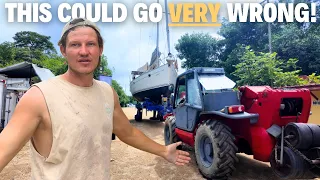
A 50 Knot Squall Hit Before We Even Left | Day 0
We’re finally doing it!
After months of preparation, upgrades, and hard decisions, we’re leaving the United States and sailing south to Colombia. North America to South America — just us, Escapade, and the open ocean.
This marks Day 0 of a new daily vlog series where we’ll be sharing the entire passage as it unfolds — the good decisions, the hard lessons, the unexpected moments, and everything in between.
This isn’t just another sail down the coast. It’s a real offshore passage, a real test of the boat, and a real step toward the bigger adventure ahead.
And as always… things don’t go exactly to plan.
New episodes every day as we make our way to Colombia. 🇨🇴⛵
If you’d like to support the channel and follow along even closer, we’ve got early access and ad-free videos over on Patreon—including daily vlogs from our sail from the USA to South America that aren’t on YouTube yet.
We honestly need your support now more than ever as we prepare for our Pacific crossing ❤️
👉 Join us here: https://www.patreon.com/Leadingtheescapade
or make a one off Donation 🫶🏽 to our PayPal to support our creations and help us cross the Pacific Ocean:
☞ https://www.paypal.com/donate/?hosted_button_id=R48D67JJBMDB4
If you enjoyed the video, don’t forget to subscribe and follow along as we prepare Escapade for our biggest adventure yet.
CHAPTERS:
INTRO: 0:00
DAILY VLOG: 1:10

Leading the Escapade
Janaye and Jason, two ocean-loving Aussies, have embarked on a once-in-a-lifetime adventure to circumnavigate the world aboard a 2002 Jeanneau Sun Odyssey 40.
Channel Information:
Social Media Links:
Support Leading the Escapade
At WeBoating.com, we profoundly acknowledge the unwavering dedication that Leading the Escapade invests in crafting each and every video or voyage. Their passion for delivering exceptional ocean content shines through every frame, and it's a labor of love that deserves your attention.
We invite you to watch their captivating videos here and actively engage with their content, including their social media links above. Liking, commenting, and sharing their work goes a long way in fueling their creative fire.
We're also inviting you to explore the gear, sponsorships, and boat partnerships highlighted in the "A 50 Knot Squall Hit Before We Even Left | Day 0" video description, or directly on YouTube. By engaging with these offerings or purchasing services and items, you directly support Leading the Escapade, their collaborators, and the brands they're associated with.
To ensure you never miss an offshore update, consider visiting their official YouTube Channel to subscribe, like, and join their community directly.
If you have any feedback, corrections, or additional information about Leading the Escapade or their videos, please use the comment form below to share your thoughts with us.
Thank you for being a part of our community and supporting the creators we cherish. Your time and support truly matter!
Leaving the United States for a blue-water passage to South America is a milestone that demands respect, meticulous preparation, and, as the crew of SV Escapade recently discovered, a healthy dose of humility before the elements. Setting out from Miami’s Key Biscayne, Janaye McDonald and Jason Marshall, along with their new crew member Tom, found themselves staring down a 52-knot squall before they even cleared the harbor. This ‘Day 0’ was less a graceful exit and more a trial by fire—or rather, by wind and rain. Aboard their 2002 Jeanneau Sun Odyssey 40, the team had to manage last-minute hull maintenance, instrument calibration failures, and the logistical puzzle of a three-person watch rotation. As the engine hummed against the initial push of the Gulf Stream, the reality of the 1,000-mile journey to Colombia set in, reminding every sailor that the ocean dictates the schedule, regardless of birthdays or departure dates.
- Severe Weather Readiness: A localized squall delivered 52-knot gusts in Miami, highlighting the importance of securing the vessel even when ‘ready’ to depart.
- Instrument Calibration: A new anemometer required manual recalibration to correct a 30-40 degree discrepancy between apparent and true wind readings.
- Optimized Watch Systems: The addition of a third crew member allowed for a 4-hour on, 8-hour off rotation, significantly reducing fatigue during the Gulf Stream crossing.
| Metric | Details |
|---|---|
| Vessel | SV Escapade (Jeanneau Sun Odyssey 40, 2002) |
| Starting Point | Key Biscayne, Miami, FL |
| Destination (Leg 1) | Ragged Islands, Bahamas |
| Max Wind Recorded | 52 Knots (Squall) |
| Crew Count | 3 Humans, 2 Cats |
| Primary Goal | Crossing the Gulf Stream to Colombia |
The Calm Before the 52-Knot Storm
Preparation for a passage of this magnitude involves more than just checking the rigging. For the Escapade crew, the final hours in Miami were spent ‘scraping the bottom’—a cold, arduous task that new crew member Tom found himself spearheading while Jason supervised from the relative warmth of the deck. This crew initiation is a standard rite of passage in the cruising world; a clean hull is the difference between a sluggish crossing and an efficient one. However, the maritime gods had other plans for Janaye’s birthday. As they finalized the stowage of fresh vegetables and prepared to slip their lines, a massive thunderstorms rolled over the bay. The wind screamed through the rigging, peaking at 52 knots. To put that in perspective, Jason recalled hitting 56 knots in Turkey and 62 in Greece, but 50-plus knots in a crowded anchorage like Key Biscayne is enough to make any skipper’s blood run cold. They watched from the cockpit as TowBoatUS and the Coast Guard scrambled to assist less fortunate vessels in the vicinity.
Tactical Navigation: Beating the Gulf Stream
Once the squall passed, leaving a trail of whitecaps and adrenaline, Escapade finally made her move. The tactical challenge was immediate: the Gulf Stream. This ‘river in the ocean’ flows north at speeds of up to 4 knots, and crossing it requires a careful calculation of Speed Over Ground (SOG) versus heading. Jason’s strategy was to motor through the initial shallow waters near Stiltsville—the iconic 1920s-era structures built on pilings in Biscayne Bay—before turning south. By hugging the coastline, they avoided the full brunt of the current until they could find a favorable angle to cross towards the Bahamas. The transition from the flat water of the bay to the short, punchy swell of the Atlantic was a wake-up call for the crew and the cats alike. The Sun Odyssey 40 handled the head-seas with her characteristic bobbing, but the motion was enough to send Janaye and Tom into their first rest shift while Jason held the initial watch.
Waypoint Log: Miami to the Edge of the Bahamas
| Waypoint | Coordinates (Est.) | Conditions / Notes |
|---|---|---|
| Departure: Key Biscayne | 25.71° N, 80.16° W | 52-knot squall, heavy rain, birthday departure. |
| Stiltsville Transit | 25.65° N, 80.14° W | Navigating historic hazards; shallow water prior to Gulf Stream. |
| Gulf Stream Entry | 25.60° N, 79.95° W | Bashing into short swell; 4.8 knots SOG while motoring. |
| Night 1: Mid-Crossing | 25.40° N, 79.50° W | Transition to sail; first reef in main, engine off. |
The Gear Locker: Anemometers and Anomilies
One of the more frustrating logistical hurdles involved their recently installed anemometer. In the maritime world, having accurate wind data isn’t just a luxury; it’s a safety requirement for sail trim and reefing decisions. However, the crew noticed a massive 30 to 40-degree discrepancy between their apparent wind and what they were feeling on their faces. Using a combination of the manufacturer’s manual and ChatGPT for troubleshooting, they determined that the mounting bracket—though original—wasn’t aligned perfectly with the bow. Calibration required motoring directly into the wind and resetting the instrument to zero. While they admitted the fix was ‘close enough’ rather than laboratory-perfect, it allowed them to finally trust their readings as they set the first reef in the mainsail and turned off the engine. There is no sound quite like the silence that follows a long motor, replaced by the rush of water against a hull under sail.
Sailing from Miami to Colombia: Frequently Asked Questions
When 50-knot squalls hit, as seen with SV Escapade, the priority is to ensure the anchor is well-set with sufficient scope. In crowded areas like Key Biscayne, crew should be on deck to monitor for dragging vessels and be ready to start the engine to take the load off the windlass if necessary.
A standard 4-hour on, 8-hour off rotation is highly effective. It allows each crew member to have consistent rest periods and ensures there is always a fresh pair of eyes on deck. For the Escapade crew, this meant shifts of 6-10, 10-2, and 2-6, which Janaye noted made a ‘huge difference’ in morale and energy levels.
Crossing the Gulf Stream requires heading south-east to counteract the northerly current. Ideally, you want a weather window with no northerly wind components, as ‘wind-against-current’ creates dangerous, steep square waves. Motoring in light air is often safer than sailing in a ‘north-on-top-of-stream’ scenario.
Growth like barnacles and algae increases drag significantly, reducing speed and increasing fuel consumption. For a boat like a Jeanneau 40, a clean hull can add 0.5 to 1.0 knots of speed, which adds up to hours or even days saved over a 1,000-mile voyage.
Most systems require you to enter a calibration mode through the multi-function display. You must then motor the boat directly into the wind (0 degrees apparent) at a steady speed and ‘lock in’ the offset. Some older systems may also require you to perform slow circles to calibrate the magnetic heading and true wind calculations.
Yes, a 40-foot production boat like the Jeanneau Sun Odyssey 40 is well-suited for this crossing, provided the weather window is chosen carefully. The key is structural integrity, a reliable engine for the lulls, and a crew capable of managing sail changes in squally conditions.
A 50 Knot Squall Hit Before We Even Left | Day 0 Location
- Miami Key Biscayne (25.7138,-80.1626)
- Stiltsville (25.6483,-80.1444)
Latest Episodes from Leading the Escapade
Explore the most recent voyages. Subscribe to the channel to never miss an update!
Boat Repairs, Tropical Islands & One Last Bocas Adventure! Ep-239
📍Bocas del Toro, Panama sailing adventure! Before setting off for San Blas, we head 7NM into Bocas Town for a civilisation fix and to pickup our replacement navigation gear destroyed by a lightning strike. From tropical Starfish Beach to boat jobs and mast climbs, beach party vibes, skurfing, an...
Sailing Panama…We Found a Secret Jungle River 🇵🇦 Ep-237
Sailing in Bocas del Toro, Panama is starting to feel a little too comfortable… so naturally, we find ourselves leaving the boat to explore what’s hiding beyond the islands. 🌴⛵️ This week aboard Escapade takes us from Starfish Beach into the canals and jungle of Bocas del Toro, with light-wind sail...
Living the Dream in Bocas del Toro 🌴 Sailing, Tropical Paradise & Starfish
After days of nonstop rain, we finally get some sunshine and make the most of it! 🌴☀️ In this episode, we start with a few cosmetic boat jobs we’ve been putting off while waiting for the weather to improve. Then we set sail through Bocas del Toro, Panama, heading to Dolphin Bay Yacht Club to check ...
WE’RE BACK AT SEA! 🌴 San Blas, Boat Repairs & Insurance Update! Ep-235
Sailing the San Blas Islands, Panama after months of sailboat repairs, boatyard damage and an ongoing insurance claim! ⛵️🌴 After months stuck in the boatyard, Escapade is finally back on the water and we’re sailing again! In this episode, we take you along for our first week back aboard Escapade as...
Back on the Water in Bocas del Toro… 🌴 Ep-234
We’ve been itching to get back out exploring, and this time we’ve got a new toy to see the adventure from a whole different perspective! 🚁 In this episode, we take the Antigravity A1 out for its first real adventure. After learning the basics back in the boatyard, we head to Bocas del Toro, Panama,...