Ropes always in the water? TRY THIS!!!

Joyrider TV
Joseph Bennett: The high-performance 'Joyrider' mastering 26-knot catamaran runs in Vassiliki, Greece, while redefining budget DIY racing for the global community.
Channel Information:
Social Media Links:
Support Joyrider TV
At WeBoating.com, we profoundly acknowledge the unwavering dedication that Joyrider TV invests in crafting each and every video or voyage. Their passion for delivering exceptional ocean content shines through every frame, and it's a labor of love that deserves your attention.
We invite you to watch their captivating videos here and actively engage with their content, including their social media links above. Liking, commenting, and sharing their work goes a long way in fueling their creative fire.
We're also inviting you to explore the gear, sponsorships, and boat partnerships highlighted in the "Ropes always in the water? TRY THIS!!!" video description, or directly on YouTube. By engaging with these offerings or purchasing services and items, you directly support Joyrider TV, their collaborators, and the brands they're associated with.
To ensure you never miss an offshore update, consider visiting their official YouTube Channel to subscribe, like, and join their community directly.
If you have any feedback, corrections, or additional information about Joyrider TV or their videos, please use the comment form below to share your thoughts with us.
Thank you for being a part of our community and supporting the creators we cherish. Your time and support truly matter!
Here we’re looking at how to handle and adjust the mainsheet, traveller, jib sheet and jib travellers whilst sailing solo on a Hobie 16. These methods are of course applicable to any type of small catamaran where you helm on the trapeze.
Beach catamarans, commonly called “beachcats,” trace their origins all the way back to Polynesian double-canoe sailboats which were simply shoved up onto the beach when not in use, and pushed back into the ocean when it was time to hit the water again. Their defining factor is just that—they can be beached on the sand, and re-launched through the surf.
Beach cats have a number of common characteristics. For starters, naturally, they’re twin-hulled catamarans as opposed to having a single hull, like a monohull. They’re relatively light for their size, to make launching easier. Often this is accomplished by designing the boat without a solid deck to speak of, and instead of a rigid material a fabric called the “trampoline” bridges the open areas between the two hulls and their supports. They also have rudders which can be flipped up and removed from the water moments before the boat is beached, so they don’t get caught in the sand and break off. For the same reason they don’t have keels protruding beneath the hulls but may instead be rigged with “daggerboards,” which are essentially removable keels that slide down through the hulls. Most beach cats also have sailing rigs that can be disassembled quickly, for easy transportation.
Modern beach catamarans are known for their fast speeds—some can break 20 knots—and athletic sailing abilities. They can be sailed with one hull out of the water as the boat heels, and it’s not uncommon for both sailors and their boats to be pushed to the limits. Getting wet, sometimes very wet, is all part of the game, when sailing a beachcat. While there are a number of beach catamarans on the water, the Hobie Cat unquestionably has had the most success making this class of boat popular and is a rather iconic brand among beachcat fans.
Good luck.
for the full list of sailing instructional videos:
https://totaljoyrider.com/pages/joyrider-tv
Joe’s Patreon Pge
https://www.patreon.com/joseph_bennett
Sailing gear hand picked
https://www.amazon.com/shop/josephbennett
Or follow what’s going on
https://www.facebook.com/totaljoyrider/
https://www.instagram.com/totaljoyrider/
#catsailing
#joyridertv
Latest Episodes from Joyrider TV
Explore the most recent voyages. Subscribe to the channel to never miss an update!
Hobie 16 Jib Battens Keep Getting Stuck? Here’s the Fix
If you sail a Hobie 16, you’ve probably experienced this — the jib battens catching on the mast, halyards or rigging right when you’re trying to tack. During the Hobie 16 Championships, Laura took the helm so I could demonstrate a few simple techniques that can make a big difference. We look at li...
What’s Next for Hobie Cat Racing? | 2027 World Championships Revealed
What’s next for international Hobie Cat racing? At the International Hobie 16 Championships in Ocean Springs, I caught up with Rich McVeigh, President of the International Hobie Cat Class Association, to find out what sailors can look forward to in 2027. We talk about the upcoming World Championsh...
What I Learnt Racing at 3 Major Regattas | Q+A Live
I’ve recently competed in three very different regattas: the Tornado European Championships on Lake Garda, the Hobie Wave Grand Prix in Pensacola and the Hobie 16 International Championships in Ocean Springs. In this Q+A Live, I’ll be sharing what I learnt from each event—including boat preparation...
We Led the Final Race… Until the Wind Shifted | Hobie 16 International
The final race of the Hobie 16 International Championships—and we couldn’t have asked for a better start. We came off the line strongly and sailed into FIRST PLACE. Then a major wind shift completely changed the race and dropped us into the back half of the fleet. From there, it became a fight for...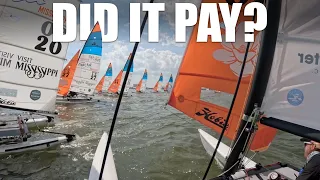
Going All In on the Start! | Hobie 16 International Finals Day 2
After repeated delays at the Hobie 16 International Championships, Race Officer Mark Santorelli finally sent us onto the water when the breeze shifted into the southeast. With just 3–6 knots of light, variable wind, we made a high-risk decision: start on port tack and try to reach the right-hand si...