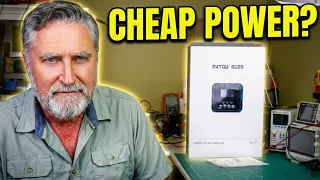
Wavlink AX3000 Review. How to Get Internet on Your Boat Free
Clark evaluates the Wavlink AX3000 outdoor Wi-Fi access point as a practical long-range solution for vessels seeking reliable shore internet connectivity. Documenting his setup for Emily & Clark’s Adventure, he unpacks the hardware on the workbench to inspect its dual-band architecture, external antennas, and power delivery options. Priced at $189 on Amazon, the rugged unit offers cruising sailors a dedicated method to capture weak public signals from marinas, yacht clubs, or anchorages without incurring recurring cellular subscription costs.
Beyond standard marine installations, Clark highlights the versatile deployment potential for large outdoor properties: “This device would also be handy if you wanted to transmit your existing Wi-Fi signal out over a longer range, like if you had a farm or something”.
External Antenna Assembly and Weatherproofing
The Wavlink AX3000 features a weather-resistant cylindrical body engineered for outdoor mounting. Physical setup begins by mounting four omnidirectional external antennas to the top ports. The housing markings specify the operating frequencies for each connection, requiring two 2.4 GHz antennas and two 5 GHz antennas matched directly to their corresponding threaded studs. Clark cautions that installers must inspect the molded port labels closely before tightening, having initially swapped the antenna positions during his first physical assembly.
At the base of the device, network connectivity is routed through a single downward-facing Ethernet port. The port incorporates a screw-in compression gland designed to prevent water intrusion along the jacket of the Ethernet cable. Because the cable carries both data and operating current over distance, Clark ran an exterior-grade line during a multi-week residential installation before evaluating the hardware for boat deployment.
Marine DC Power Conversion and Inverter Elimination
Powering outdoor marine electronics presents unique efficiency challenges on cruising sailboats. The Wavlink AX3000 relies on Power over Ethernet (PoE), using a supplied injector block that splits local network data from high-voltage DC power. In a standard household setting, the injector connects to an AC wall outlet through a 54V barrel-jack power adapter.
Operating standard AC wall transformers aboard a vessel requires running an onboard inverter continuously. Idle power consumption and dual-conversion losses quickly drain house battery banks. While standard commercial PoE systems operate at 48V, the Wavlink injector specifies 54V input. Clark eliminates inverter waste by incorporating an efficient 12V direct-current step-up converter.
By soldering a matching barrel plug with correct polarity onto the 12V DC-to-54V boost module, the entire access point operates directly from the vessel battery bank without cycling AC machinery or wasting energy through inverter standby draw.
Overcoming Anchorage Connectivity Gaps
Securing usable internet at anchor or on the outer docks of a marina remains a persistent cruising hurdle. Vessel crews frequently spot active Wi-Fi networks broadcast by dockmasters or shoreline restaurants, yet standard laptop and smartphone antennas lack sufficient gain to establish stable handshakes. In mooring fields or slips far from the marina office, signals become too weak for practical web browsing.
Cruisers historically tackled this challenge using USB boosters hoisted aloft. Clark previously deployed an Alfa network adapter sealed in a protective plastic bag and hauled up the mast with an amplified cable. That legacy configuration suffered from severe operational constraints: it could only deliver internet connectivity to a single computer over a hardwired cable. In contrast, the AX3000 operates as an autonomous outdoor station, receiving the remote Wi-Fi source and rebroadcasting an independent local network to every phone, tablet, and workstation aboard.
Software Setup in FAT Access Point Mode
Configuring the Wavlink AX3000 requires selecting the proper operating mode within the device firmware. The manufacturer supplies several printed booklets, with the quick start guide offering step-by-step instructions for physical mounting and software setup.
To repeat an external Wi-Fi signal, the access point must be configured in FAT AP mode rather than as a managed client: “The biggest thing you need to figure out, the way I’m using it, is you want to configure it as an FAT access point.”
Clark connects a laptop directly to the PoE injector LAN port via Ethernet to access the internal management console, though configuration can also be completed wirelessly over the default broadcast network. The setup process requires selecting repeater operation and scanning for available source networks. Clark emphasizes the simplicity of the interface: “I sat down and like in 10 minutes it was up and working.”
Once initial configuration is complete, the access point remembers credentials and automatically rebroadcasts the shared connection under a custom local SSID and password.
Real-World Range Testing and Neighbor Network Repeating
To verify wireless transmission performance through physical obstructions, Clark conducted broadcast tests across a residential neighborhood containing houses, parked automobiles, and mature trees. Carrying a mobile device connected to the AX3000 broadcast, he walked halfway around his suburban block while maintaining continuous wireless connection.
Clark subsequently validated repeater performance by simulating an offshore anchorage connection. Borrowing the Wi-Fi credentials of a friend living across the street, Clark pointed the AX3000 toward the neighboring residence. The high-gain antennas locked onto the distant broadcast and established a stable link, which was then repeated locally to Clark laptop and mobile devices.
Throughout extended operational testing, the repeated wireless link delivered robust throughput: “I can’t tell the difference in speed between this and the wired one I have in the house.” Routine data tasks, including uploading weekly 4 GB video files, proceeded without connection drops or throttling.
Technical Specifications and Marine Power Data
| System Metric | Engineering Specification |
|---|---|
| Hardware Retail Price | $189 on Amazon |
| Dual-Band Frequencies | 2.4 GHz and 5 GHz external antennas |
| Vessel Input Voltage | 12V direct-current battery power |
| Standard PoE Voltage | 48V network standard |
| Boost Converter Output | 54V DC injector supply |
| Setup and Configuration | 10 minutes bench completion |
| Heavy Workload Testing | 4 GB weekly video upload |
Frequently Asked Questions
The Wavlink AX3000 uses four high-gain external antennas and high-power transceivers to lock onto distant shore or marina Wi-Fi signals that are too faint for mobile phones, repeating the connection as a strong local network throughout the vessel.
By wiring a 12V-to-54V DC step-up boost converter with a soldered barrel connector, the Power over Ethernet injector can run directly from the 12V shipboard battery bank, avoiding the standby power draw of an AC inverter.
The unit should be configured in FAT Access Point (FAT AP) mode and set to repeater function, allowing it to connect to the remote source network and rebroadcast a private SSID for onboard devices.
Older masthead adapters like Alfa receivers required plastic bag waterproofing and only fed a single computer via cable. The AX3000 is fully weather-resistant and rebroadcasts Wi-Fi to multiple phones, tablets, and computers simultaneously.
Book a trip where this was filmed — near Hilton Head Island
Support Emily & Clark’s Adventure (Clark’s Adventure)
At WeBoating.com, we profoundly acknowledge the unwavering dedication that Emily & Clark’s Adventure (Clark’s Adventure) invests in crafting each and every video or voyage. Their passion for delivering exceptional ocean content shines through every frame, and it's a labor of love that deserves your attention.
We invite you to watch their captivating videos here and actively engage with their content, including their social media links above. Liking, commenting, and sharing their work goes a long way in fueling their creative fire.
We're also inviting you to explore the gear, sponsorships, and boat partnerships highlighted in the "Wavlink AX3000 Review. How to Get Internet on Your Boat Free" video description, or directly on YouTube. By engaging with these offerings or purchasing services and items, you directly support Emily & Clark’s Adventure (Clark’s Adventure), their collaborators, and the brands they're associated with.
To ensure you never miss an offshore update, consider visiting their official YouTube Channel to subscribe, like, and join their community directly.
If you have any feedback, corrections, or additional information about Emily & Clark’s Adventure (Clark’s Adventure) or their videos, please use the comment form below to share your thoughts with us.
Thank you for being a part of our community and supporting the creators we cherish. Your time and support truly matter!
Affiliate Links on Amazon
https://amzn.to/4vW0ERt for the Power Over Ethernet 12v Boost Converter
https://amzn.to/4ePP6sc for the Wavlink AX3000
Have questions or comments? Leave them below! We do our best to read and answer all comments on our channel.
-----------
LINKS TO PRODUCTS WE LOVE (Affiliate links to things we actually own, use, and recommend. We are almost never paid by companies to endorse products. If we are, we will tell you in the video): https://www.amazon.com/shop/emilyclarksadventure
PLEASE SUBSCRIBE and click the BELL to see new videos every week, and more content like this.
CONNECT & SUPPORT OUR CHANNEL
Patreon: https://www.patreon.com/emilyandclark
PayPal: https://www.paypal.me/emilyandclark
Buy S/V Temptress shirts and swag: https://teespring.com/stores/emily-clarks-sailboat-swag
Check out our favorite products on Amazon: https://www.amazon.com/shop/emilyclarksadventure
#emilyandclark #emilyandclarksadventure #svtemptress

Emily & Clark’s Adventure (Clark’s Adventure)
Join Clark of Clark’s Adventure as he documents his 2026 return to solo offshore racing following a successful recovery from cancer aboard his Creekmore 45.
Channel Information:
Social Media Links:
Wavlink AX3000 Review. How to Get Internet on Your Boat Free Location
- St. Simons Island, Georgia (31.1444,-81.3853)
Latest Episodes from Emily & Clark’s Adventure (Clark’s Adventure)
Explore the most recent voyages. Subscribe to the channel to never miss an update!
Datou Boss 48v 100ah Rack Mount Battery Review
Clark tests and disassembles the budget Datou Boss 48V 100Ah server rack LiFePO4 battery, evaluating cell compression, BMS safety, and marine wiring.
LiThink 334ah Review
Clark conducts a bench test and full internal teardown of the LiThink 334 Ah LiFePO4 battery, measuring 347 Ah of usable capacity, verifying genuine EVE cells, and evaluating thermal performance under a 113-amp continuous discharge.
BLUETTI Apex 200 Review: The Best Power Station for RVs & Home Backup?
Clark from Emily & Clark’s Adventure reviews the Bluetti Apex 200 power station, evaluating its 3,600 W inverter, camper air conditioning loads, AC charging speeds, and 48 V bench solar input.
WirenTech 100ah 48v Rack Mount Review (second look)
Clark tests the WirenTech 48-volt 100Ah server rack battery in Florida, teardown inspecting REPT cells, verifying UL 1973 certification, diagnosing BMS balancing rates, and confirming 105.6Ah capacity under load.
WirenTech 100ah 48v Rack Mount Review
Clark puts two WirenTech 48V 100Ah rack mount lithium batteries through forensic bench testing, uncovering Grade B cells and slow balancing despite solid build quality.